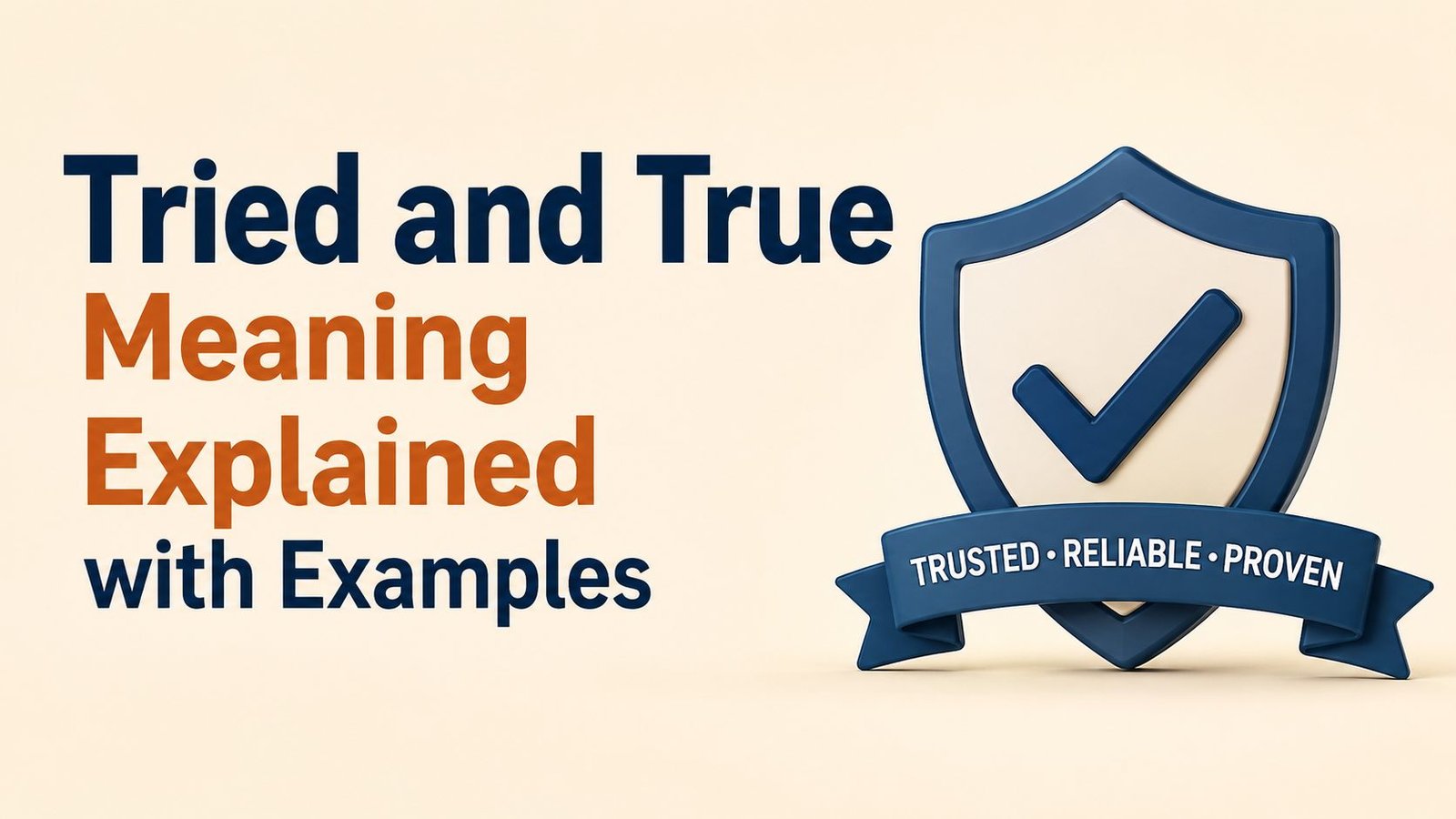
Tried and true describes something tested repeatedly through real experience and proven reliable every time, not just assumed to work. It’s the phrase we reach for when trust has been earned, not given.
Some things survive because they actually deliver, generation after generation, while flashy trends fade within a season. That’s the quiet power behind this phrase.
This guide breaks down where tried and true comes from, when to hyphenate it, whether it reads as a compliment or a quiet dig, and how it shows up everywhere from grandma’s recipes to modern ad campaigns.
What Does “Tried and True” Mean?
Here’s the short version: tried and true describes something that’s been tested enough times that you can trust it. Not because someone assumes it works. Because it’s already proven itself, over and over, under real conditions.
Picture your grandmother’s chili recipe. Nobody in the family debates whether it’s good anymore. It’s been made a hundred times, at a hundred family dinners, and it’s never once failed to disappear off the table. That’s tried and true in a nutshell — not flashy, not new, just quietly reliable.
The phrase works as an adjective phrase, describing a noun or following a linking verb, and it almost always signals positive connotation. When someone calls a method “tried and true,” they’re vouching for it. They’re saying: I’ve seen this work, more than once, and you can count on it too.
The Short Answer
If you need one sentence for a dictionary entry, here it is: tried and true means “tested by experience and proven to be effective, reliable, or trustworthy.”
That’s it. No hidden meaning, no sarcasm baked in by default (though, as you’ll see later, tone can change that). It’s one of English’s more straightforward idioms — the words mostly mean what they say.
Breaking Down the Two Words Separately
It helps to split the phrase apart for a second.
- Tried — past tense of “try,” meaning tested, attempted, put through trial.
- True — accurate, genuine, faithful to what it claims to be.
On their own, neither word carries much weight. “Tried” just means someone attempted something once — it doesn’t promise success. “True” alone can mean anything from “accurate” to “loyal.” Put them together, though, and you get a fixed expression that means something more specific and more powerful than either word does solo: tested repeatedly, and proven genuine every time.
That’s actually a great mini-lesson in how idiomatic expressions work. The whole phrase means more than the sum of its parts, which is exactly why linguists file it under idiom definition rather than treating it as two ordinary words stuck together.
Pronunciation and Part of Speech at a Glance
Here’s a quick reference table for anyone who wants the grammatical nuts and bolts.
| Feature | Detail |
|---|---|
| Pronunciation | /traɪd ənd truː/ (rhymes with “eyed and blue”) |
| Part of speech | Adjective phrase (sometimes hyphenated compound adjective) |
| Function | Predicate adjective or attributive adjective, depending on placement |
| Register | Neutral to informal; common in everyday conversation and marketing copy alike |
| Word origin | Middle English, from “trie” and “trewe” |
You’ll notice it can act as a predicate adjective (“This method is tried and true”) or as an attributive adjective (“a tried-and-true method”). The hyphen changes depending on which job it’s doing — more on that shortly, because it trips up more writers than you’d think.
Where Does “Tried and True” Come From?
Every phrase has a backstory, and this one’s more interesting than most people assume.
Origin: The Original Sense of “Tested and Proven”
The roots go back to Middle English, where “trie” meant to test or examine something closely, and “trewe” meant faithful or honest. Put those together across a few centuries of language drift, and you land on a phrase that quite literally meant: examined closely, and found to be honest.
That’s a much more literal image than we usually picture today. Medieval English speakers weren’t being poetic — they meant it almost like a quality-control stamp. Something had been checked, and it passed.
First Recorded Use
Language historians trace written use of the phrase back to at least the 14th century, with Merriam-Webster listing evidence of “tried and true” (in various spellings) circulating well before Shakespeare’s era. It shows up again and again in English literature from the 1500s onward, usually describing loyalty, friendship, or craftsmanship that had stood up to scrutiny.
By the time you reach the 19th century, the phrase had settled into almost exactly the form we use now, and it started showing up in everyday speech far outside literary circles — in newspapers, in advertisements, in casual writing.
It’s worth noting that “trie,” the root behind “tried,” shares a family tree with the modern verb “try,” which still means to test or attempt something today. That connection isn’t a coincidence. English speakers have been linking testing with trustworthiness for hundreds of years, long before anyone coined phrases like tested and proven or battle-tested for the same purpose. If you trace the thread far enough, you’ll find this same logic sitting underneath dozens of English idioms: the idea that trust has to be earned through repetition, not granted on the first attempt.
How the Meaning Evolved Over Time
Originally, “tried and true” leaned toward describing people — a tried and true friend, a tried and true soldier. Loyalty tested by hardship, and found genuine.
Over the following centuries, English speakers stretched the phrase to cover objects, methods, and ideas too. A tried and true recipe. A tried and true strategy. A tried and true remedy. The core meaning never really changed — tested, proven, dependable — but the range of things it could describe grew much wider.
That’s a common pattern in language evolution, by the way. Phrases that start out describing character traits often migrate toward describing methods and products, especially once industry and commerce start borrowing them for marketing purposes. You’ll see that exact shift again later in this article, once we get to advertising.
Is It an Idiom, a Cliché, or Just a Phrase?
This question comes up a lot, and it’s worth untangling because the answer actually affects how you should use the phrase.
Why Linguists Call It an Idiom
Technically speaking, tried and true qualifies as an idiom because its meaning isn’t fully predictable from its individual words. Sure, “tried” and “true” both point in a reasonable direction on their own. But native speakers understand the combined phrase as a single semantic unit — a package deal — rather than parsing it word by word each time they hear it.
That’s the textbook test for an idiom definition: can a non-native speaker guess the meaning just by translating each word? With “tried and true,” they’d get close, but they’d miss the specific weight the phrase carries — the implication of repeated testing across time, not a single attempt.
“Tried” Alone vs. “Tried and True” — Why the Second Word Changes Everything
Say “tried” by itself, and you’re really only claiming an attempt was made. “I tried the new coffee shop” says nothing about whether it was any good.
Add “and true,” though, and the whole meaning shifts from attempted to validated. That’s the difference between “I tried the recipe” (neutral, could’ve gone either way) and “It’s a tried-and-true recipe” (it’s been tested, and it works, full stop).
That two-word addition is doing a lot of heavy lifting. It’s the difference between a rookie explanation and expert endorsement.
Idiom, Cliché, or Both?
Here’s an honest answer: it can be both, depending on how it’s used.
As an idiom, it’s simply a fixed expression with an established meaning — no shame in that. English is full of them. But because “tried and true” gets reached for constantly in advertising and casual writing, it’s also earned a reputation as something of a cliché, especially in copywriting circles where editors flag it as an easy, low-effort shortcut.
The distinction matters for writers. Using it in conversation? Totally natural, no issue. Using it as the headline of your fifth product description this month? That’s when it starts to sound tired — ironic, given the phrase is about reliability, not repetition.
Think of it this way: a popular saying earns its popularity because it captures something useful in a compact form. That’s genuinely valuable, and there’s no need to avoid a good common expression just because it’s common. The trouble starts only when a writer reaches for it as a crutch, using “tried and true” to avoid explaining why something actually works. A reader can usually tell the difference between a phrase used with intention and one used to fill space. If you can swap in a specific detail — a number, a date, a named result — and the sentence still needs “tried and true” to make its point, you’re using it correctly. If the phrase is doing all the work by itself, that’s your sign to either cut it or back it up with something real.
Hyphenation: “Tried and True” or “Tried-and-True”?
This is probably the most practical section of this whole guide, so let’s get the grammar rule locked down.
The Rule in One Sentence
Hyphenate it as tried-and-true when it functions as a compound modifier sitting directly in front of a noun. Leave the hyphens out everywhere else, especially after a linking verb like “is,” “was,” or “seems.”
That’s genuinely the whole rule. English hyphenation rules generally work this way for compound adjectives: when multiple words team up to modify a single noun that follows them, you hyphenate to show they’re acting as one unit. When those same words show up after the noun (or after a verb), the grouping is already clear from word order, so the hyphen becomes unnecessary.
Before a Noun — Compound Modifier Examples
Here’s the pattern in action:
- She reached for her tried-and-true umbrella before the storm.
- He swears by his tried-and-true training routine.
- It’s a tried-and-true strategy for closing more sales.
- Grandma’s tried-and-true method never fails.
In each case, the hyphenated phrase sits directly before a noun (umbrella, routine, strategy, method), functioning as a single compound adjective.
After a Verb — No Hyphen Examples
Compare those to sentences where the phrase follows a verb instead:
- This method is tried and true.
- Her advice has always been tried and true.
- The recipe proved tried and true after decades of use.
- His instincts are tried and true.
Here, the phrase acts as a predicate adjective, describing the subject from the other side of the verb. No noun immediately follows it, so no hyphen is needed.
The 5-Second Test: “Does It Come Right Before the Thing It’s Describing?”
If you’re ever stuck mid-sentence wondering whether to hyphenate, ask yourself one quick question: Is there a noun sitting right after this phrase, waiting to be described?
- Yes, a noun follows immediately → hyphenate (tried-and-true method).
- No, it’s standing alone after a verb → skip the hyphen (the method is tried and true).
That’s the entire test. No grammar textbook required, just a quick glance at word order.
Example Sentences for Each
| Sentence | Hyphenated? | Why |
|---|---|---|
| “It’s a tried-and-true approach to budgeting.” | Yes | Modifies “approach,” which follows directly |
| “Her approach to budgeting is tried and true.” | No | Comes after the verb “is” |
| “We stuck with the tried-and-true supplier.” | Yes | Modifies “supplier” |
| “That supplier has always been tried and true.” | No | Predicate position, after “been” |
Is “Tried and True” a Compliment or an Insult?
Most of the time, calling something tried and true is high praise. But not always — and knowing the difference matters if you don’t want to accidentally damn something with faint praise.
The Positive Read: Dependable, Proven, Worth Trusting
In its default use, the phrase signals trustworthy, reliable, and verified — qualities people actively want in a friend, a product, or a strategy. Calling a technique “tried and true” tells your audience: this isn’t a guess, it’s been road-tested.
That’s why the phrase shows up so often around things people genuinely rely on — medicine, financial advice, cooking, parenting tips, home repair. Anywhere the stakes of failure are real, proven reliable methods earn trust fast.
The Negative Read: Stale, Predictable, Playing It Safe
Here’s the flip side. In certain contexts, especially ones where innovation is the whole point, calling something “tried and true” can come across as a polite way of saying “unoriginal” or “boring.”
Picture a tech startup pitch where an investor says, “Your approach is very tried and true.” That’s rarely a compliment in that room. It usually means: safe, expected, nothing here that surprises me.
How Tone and Context Flip the Meaning
Compare these two sentences:
“I love that this bakery still uses a tried-and-true recipe from 1952.”
“Their marketing strategy is a little tried and true for my taste.”
Same phrase, completely different emotional temperature. The first praises heritage and consistency. The second gently criticizes a lack of imagination. Context — specifically, whether the situation values consistency or novelty — decides which read applies.
How to Use “Tried and True” in a Sentence
Time for the fun part: seeing the phrase actually at work in daily speech, spoken English, and casual writing.
Common Sentence Patterns
The phrase tends to slot into a few recurring structures:
- [Noun] is tried and true. — simple predicate use.
- A tried-and-true [noun]. — compound modifier before a noun.
- Stick with the tried-and-true [noun]. — advice or recommendation framing.
- Tried and true, [statement continues]. — sentence-opener, more conversational and rare.
12 Example Sentences Across Contexts
- Cooking: “My mom’s lasagna is a tried-and-true dish that never leaves leftovers.”
- Relationships: “After twenty years of marriage, they’ve found a tried-and-true way to handle disagreements.”
- Business: “We’re sticking with the tried-and-true onboarding process this quarter.”
- DIY: “Duct tape is the tried-and-true fix for almost anything around the house.”
- Sports: “The coach went with his tried-and-true defensive lineup in the final minutes.”
- Health: “Her doctor recommended a tried-and-true treatment rather than an experimental one.”
- Travel: “We took the tried-and-true route instead of the shortcut the GPS suggested.”
- Parenting: “Reading before bed is a tried-and-true trick for getting toddlers to sleep.”
- Finance: “Index funds remain a tried-and-true strategy for long-term investors.”
- Gardening: “Composting is a tried-and-true method for improving soil quality.”
- Technology: “Some engineers still prefer tried-and-true legacy systems over untested new ones.”
- Everyday conversation: “Honestly, I just go with what’s tried and true at this point.”
Notice how naturally it fits nearly any topic where reliability matters more than novelty. That flexibility is a big part of why it’s stuck around in English for centuries.
“Tried and True” in Marketing and Business Writing
If you’ve ever read a product description, you’ve almost certainly seen this phrase used as a trust signal.
Why Copywriters Reach for This Phrase
Marketing and business writing leans heavily on phrases that suggest reliability without requiring hard data. “Tried and true” does exactly that — it implies a track record without forcing the brand to cite statistics or case numbers. It’s shorthand for “you can trust us,” aimed straight at a reader’s instinct to avoid risk.
That’s a powerful psychological lever. Buyers, generally speaking, don’t want to be the guinea pig. A phrase that promises “others have tested this and it worked” lowers the perceived risk of a purchase.
Real Ad Copy Examples
You’ll spot the phrase across a huge range of industries:
- Kitchenware brands describing cast-iron skillets as “the tried-and-true cookware chefs trust.”
- Financial services firms marketing retirement plans with “a tried-and-true approach to building wealth.”
- Skincare companies calling a decades-old formula “our tried-and-true classic.”
- Outdoor gear companies describing boots as “a tried-and-true design since 1978.”
Notice the pattern: heritage brands, in particular, lean on this phrase constantly, because it reinforces the idea that longevity itself is proof of quality.
When It Becomes a Red Flag Cliché in Copywriting
Here’s the catch. Overuse it, and the phrase stops sounding trustworthy and starts sounding like filler. Copywriters and editors alike flag “tried and true” as one of those go-to phrases that shows up when a writer hasn’t taken the time to describe why something works — just that it does, allegedly, according to no one in particular.
If you’re writing marketing copy, the phrase works best paired with something concrete: a year, a number, a specific detail. “Tried and true since 1952” lands harder than “tried and true” floating alone with nothing to back it up.
A Quick Case Study: Legacy Brands and the “Tried and True” Angle
Think about how long-running food brands, hardware companies, and family-owned businesses talk about themselves. They rarely lead with “innovative” or “revolutionary” — those words belong to startups chasing disruption. Instead, legacy brands lean hard into heritage marketing, and “tried and true” sits right at the center of that strategy.
“Some things don’t need reinventing. They just need to keep working.”
That’s roughly the pitch behind a huge share of heritage advertising, whether or not the phrase appears word-for-word. A cast-iron cookware company doesn’t need to prove its skillets are cutting-edge. It needs to prove they’ll outlast three generations of cooking, which is exactly the promise tried and true makes without a single statistic attached. The lesson for writers: this phrase works best as emotional shorthand for brand trust, not as a substitute for actual evidence. Pair it with a real number, a real year, or a real testimonial, and it stops sounding like filler and starts sounding like a fact.
“Tried and True” vs. Similar Phrases
English offers several near-synonyms, and each one carries a slightly different flavor.
vs. “Tried and Tested”
Tried and tested means almost exactly the same thing and is, frankly, more common in British English, while tried and true dominates in American usage. If you’re writing for a UK audience, “tried and tested” will feel more natural to native ears.
vs. “Time-Tested”
Time-tested shifts the emphasis toward duration specifically — the passage of years or decades, rather than the number of attempts. Something can be tried and true after just a handful of successful uses, but calling something “time-tested” implies it’s survived a genuinely long stretch of time.
vs. “Proven”
Proven is the blunt, no-frills version. It communicates the same core idea — tested and verified — but without any of the warmth or nostalgia that “tried and true” carries. “Proven” fits clinical or technical writing better; “tried and true” fits conversational or heritage-driven writing better.
Comparison Table
| Phrase | Best Used For | Regional Preference | Tone |
|---|---|---|---|
| Tried and true | General reliability, heritage, personal recommendations | American English | Warm, conversational |
| Tried and tested | Products, processes, methods | British English | Neutral, practical |
| Time-tested | Emphasizing long duration | Both | Slightly formal |
| Proven | Technical, scientific, clinical claims | Both | Direct, unemotional |
| Battle-tested | Software, leadership, resilience under pressure | American English (tech industry) | Assertive, modern |
Synonyms and Antonyms
Building out your vocabulary around this phrase helps you avoid repeating it too often in the same piece of writing.
Synonyms
- Reliable
- Dependable
- Established
- Time-honored
- Stalwart
- Trusted
- Verified
- Consistent
- Old faithful
- Time-proven
- Long proven
- Enduring
Antonyms
- Untested
- Unproven
- Experimental
- Novel
- Untried
- Unverified
- Speculative
- Unreliable
- Cutting-edge (in the sense of “not yet established”)
Keep both lists handy if you’re editing a longer piece — swapping in a synonym now and then keeps your writing from sounding repetitive, which matters just as much for writing accuracy as grammar does.
Common Mistakes People Make with This Phrase
A few usage errors show up again and again, so let’s clear them up.
Misspelling It (“Tried and Truth” or “Try and True”)
This is the single most common mistake. “Tried and truth” isn’t a real phrase — it’s a mishearing that gets typed out as written. Similarly, “try and true” drops the past tense, which breaks the grammar of the phrase entirely. The correct form is always tried and true, past tense on both sides.
Getting the Hyphenation Wrong
As covered earlier, the hyphen only belongs there when the phrase functions as a compound modifier before a noun. Slapping a hyphen onto “This method is tried-and-true” (after a verb) is a small but noticeable grammar mistake that trained editors will catch immediately.
Using It When “Innovative” or “Cutting-Edge” Would Fit Better
Context matters. If you’re writing about a brand-new product, describing it as “tried and true” undercuts your own pitch — it tells the reader the opposite of what “new” and “innovative” are supposed to communicate. Save this phrase for situations where reliability, not novelty, is the selling point.
Quick Reference: Right vs. Wrong Usage
| Wrong | Right |
|---|---|
| “Try and true method” | “Tried-and-true method” |
| “Tried and truth” | “Tried and true” |
| “This recipe is tried-and-true.” (after a verb) | “This recipe is tried and true.” |
| “A tried and true recipe” (missing hyphen before noun) | “A tried-and-true recipe” |
Where You’ll See It — Books, Songs, Headlines
The phrase has a long history of showing up outside everyday conversation too.
Notable Titles and Uses in Media
You’ll find “tried and true” (or close variations) used as a title or tagline across music, publishing, and journalism, usually invoking nostalgia, loyalty, or old-fashioned reliability. It’s a favorite in headline writing specifically because it communicates so much meaning in just three short words — efficient, familiar, and immediately understood by readers.
Why It Shows Up So Often in Headlines and Taglines
Headline writers love fixed expressions like this one because readers process them instantly, without needing to decode anything. A phrase this old and this familiar practically guarantees comprehension at a glance, which is exactly what a headline needs to do in the half-second before someone scrolls past it.
When Should You Use “Tried and True”?
Let’s wrap up with a practical gut check for your own writing.
Good Fit: Reliability Is the Point
Reach for tried and true when you’re describing something valued precisely because it’s dependable — recipes, routines, relationships, classic methods, legacy products, long-standing traditions. Anywhere consistency is the selling point, this phrase does its job well.
Bad Fit: You’re Trying to Sound Fresh or Innovative
Avoid it when your whole message is about newness — launching a product, pitching an idea, marketing something experimental. In those cases, “tried and true” works against you, subtly telling your audience the opposite of what you’re trying to say.
FAQ
Is “tried and true” one word, two words, or hyphenated?
It’s a three-word phrase. Hyphenate it only when it sits right before a noun, like “a tried-and-true method.”
Where does “tried and true” come from?
It traces back to Middle English, combining “trie” (to test) and “trewe” (faithful), with written use dating to at least the 1300s.
Is “tried and true” the same as “tried and tested”?
They mean nearly the same thing. “Tried and tested” is more common in British English, while “tried and true” dominates in American usage.
Is “tried and true” always a compliment?
Usually, yes — it signals reliability. But in fast-moving fields like tech or fashion, it can subtly suggest something feels outdated.
What’s a more formal alternative to “tried and true”?
Try “time-honored,” “established,” or simply “proven” for writing that calls for a more professional tone.
Conclusion
Tried and true meaning really comes down to trust earned through repetition, not luck. It’s proven, dependable, and worth relying on. Get the hyphen right, watch your tone, and this phrase will always land the way you intend.
Words carry weight when people understand them fully, and now you do. The next time you hear someone use it, you’ll catch every layer behind it. Keep this tried and true meaning guide handy, and you’ll never second-guess the phrase again.