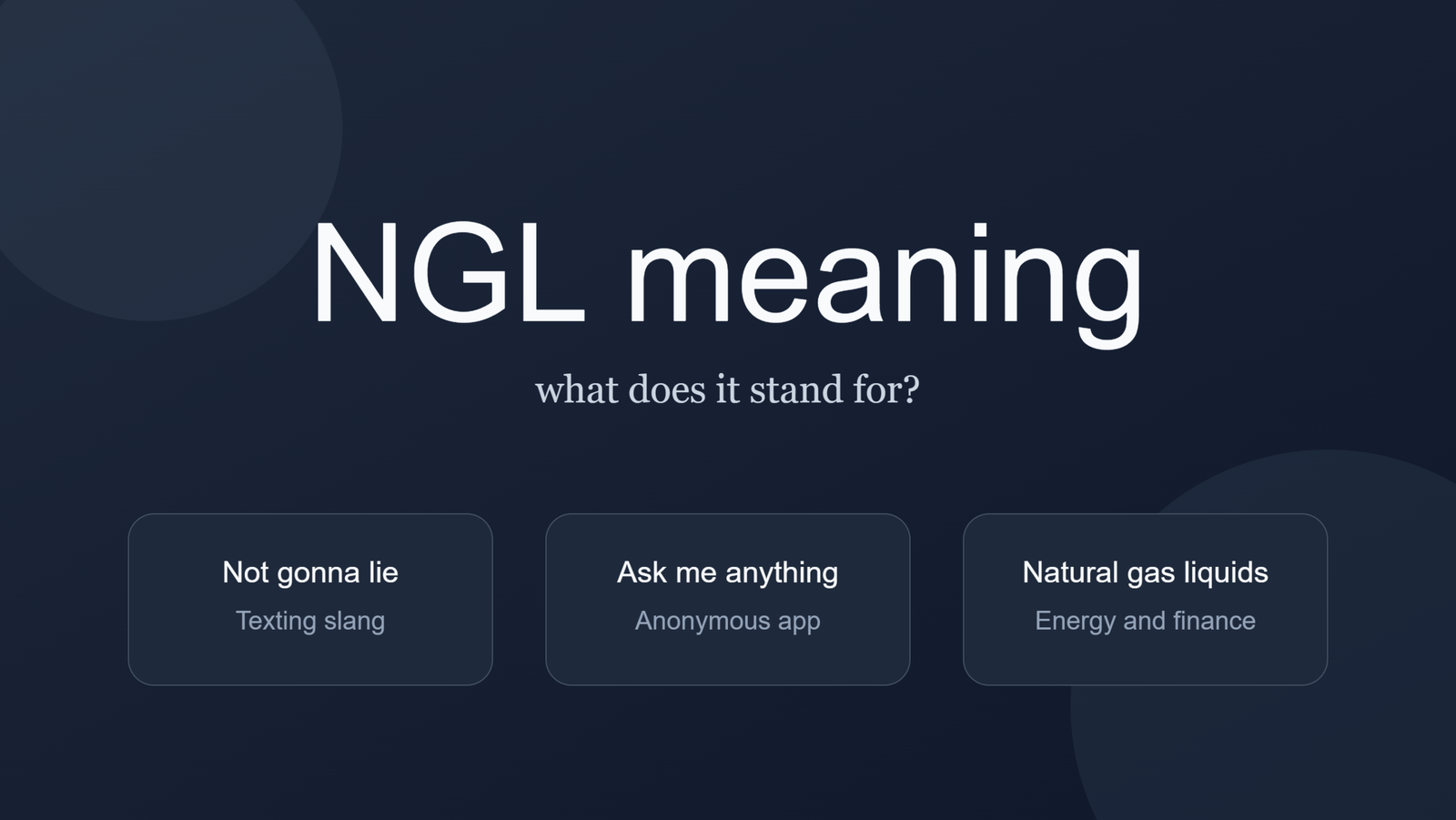
The NGL meaning is simple: it stands for “Not Gonna Lie,” a casual phrase used to introduce an honest, blunt statement in texts and social posts.
But that’s only half the story. The same three letters also power a viral anonymous messaging app and a major term in the energy industry — three completely different worlds, one shared abbreviation.
This guide breaks down every NGL meaning you’ll actually run into, with real examples, a comparison to similar slang, and the latest facts on the app’s legal troubles. By the end, you’ll never confuse one NGL meaning for another again.
NGL Meaning at a Glance
Here’s the short version before we go deep.
| Context | NGL Meaning | Example |
|---|---|---|
| Texting & social media | Not Gonna Lie | “ngl, that test was harder than I expected” |
| Mobile app | NGL: ask me anything (anonymous Q&A app) | “Send me anonymous messages on my NGL link” |
| Finance & energy | Natural Gas Liquids | “NGL prices rose 4% this quarter” |
In nearly all casual conversation, the NGL meaning you’ll run into is “Not Gonna Lie.” It’s a confession marker — a way of flagging that what comes next is an honest, sometimes slightly awkward, admission. The app meaning and the finance meaning are both real, but they live in completely different corners of the internet, and you’ll rarely see them confused with each other because the contexts don’t overlap.
The Three Meanings of NGL Explained
Before you use this abbreviation anywhere, it helps to know that “NGL” isn’t a single, tidy acronym. It’s three unrelated things that happen to share three letters. Here’s how to tell them apart.
NGL as Slang (“Not Gonna Lie”)
This is the meaning most people are actually searching for. NGL as slang stands for “Not Gonna Lie,” and it works as a verbal disclaimer. When someone types “ngl,” they’re signaling that they’re about to say something honest — often something a little blunt, embarrassing, or unpopular.
Think of it as a softer, more casual cousin of “honestly” or “to be real with you.” It shows up constantly in:
- Text messages between friends
- Twitter/X posts and replies
- TikTok and Instagram captions
- Reddit comments and forum threads
- Group chats and DMs
The tone is casual and conversational, never formal. You won’t see “ngl” in a news article or a legal document — it belongs to digital slang, the kind of shorthand that develops naturally in fast-moving online discussions.
“ngl I’ve rewatched that show four times this month”
That’s the core use case: a quick, honest aside dropped into an otherwise ordinary sentence.
Why the phrase works the way it does. Linguists have a name for this kind of expression: a hedge. Hedges soften a statement, manage the listener’s expectations, or protect the speaker’s social standing before they say something that might land awkwardly. “ngl” does exactly that — it flags the statement as unfiltered before the listener hears it, which makes the honesty feel intentional rather than careless. That’s also why it pairs so naturally with mildly negative or self-deprecating admissions (“ngl I forgot,” “ngl I’m bad at this”) more than with neutral facts. You rarely see “ngl, the sky is blue,” because there’s no social risk to soften in the first place.
How usage differs slightly by platform. The underlying meaning stays constant, but the tone shifts a little depending on where you see it:
| Platform | Typical Tone | Common Use |
|---|---|---|
| Text messages | Personal, direct | Confessions between friends |
| Twitter/X | Punchy, public | Hot takes and self-aware humor |
| TikTok captions | Reflective or comedic | Framing a video’s honest premise |
| Reddit comments | Explanatory | Prefacing a controversial opinion in a thread |
| Discord/group chats | Casual, rapid-fire | Quick asides mid-conversation |
None of these are hard rules — it’s genuinely flexible slang — but noticing the pattern helps explain why the same three letters can read as funny in one spot and sincere in another.
NGL the App (Anonymous Q&A on Instagram)
The second common meaning is a specific product: NGL: ask me anything, an app that lets people receive anonymous messages through a link they share on Instagram Stories. Launched in 2021, it rose quickly to the top of app store charts on a simple premise — friends and followers can send you anonymous questions or comments, and you can post the replies back to your Story.
This is a case where the brand name is a direct play on the slang. The idea was that people would feel free to be honest — to “not gonna lie” — because the sender’s identity stays hidden. It’s a clever bit of branding, but it’s also where a lot of confusion happens, because someone unfamiliar with the app might think “NGL” always refers to the slang phrase when someone’s actually talking about the product.
We’ll cover the app’s mechanics, and its serious legal troubles, in a dedicated section further down.
NGL in Finance and Energy (What NGL Stands For There)
Step outside of texting and social media, and NGL means something else entirely: Natural Gas Liquids.
This is a technical term from the oil and gas industry, and it has zero connection to the slang or the app. Natural Gas Liquids are hydrocarbons that are extracted from raw natural gas during processing, before the remaining “dry gas” is sent into pipelines for heating and power generation. Each NGL component has its own commercial use:
| Component | Common Use |
|---|---|
| Ethane | Feedstock for producing ethylene, a building block of plastics |
| Propane | Home heating, cooking fuel, and fuel for grills and forklifts |
| Normal Butane | Gasoline blending and lighter fuel |
| Isobutane | Refining process fuel and aerosol propellant |
| Natural Gasoline (pentanes+) | Blended into gasoline and used as a diluent for heavy crude |
Pricing for these products is typically benchmarked against hub locations, with Mont Belvieu, Texas serving as the primary U.S. pricing point for NGLs, much the way West Texas Intermediate (WTI) serves as a benchmark for crude oil. Major midstream companies that gather, process, transport, and sell NGLs include names like Enterprise Products Partners, Energy Transfer, ONEOK, and Targa Resources — all companies whose earnings reports and investor materials use “NGL” constantly, with no relationship whatsoever to the slang term.
- Energy sector professionals tracking production and processing data
- Investors following NGL-focused stocks, pipelines, and midstream companies
- Commodity traders watching NGL pricing benchmarks at hubs like Mont Belvieu
- Students and analysts researching the oil and gas value chain
A quick way to keep these worlds separate: if the sentence mentions barrels, pipelines, ethane, or commodity prices, you’re reading about Natural Gas Liquids. If it mentions texting, captions, or “honestly,” you’re reading about the slang. The NGL meaning almost never gets confused between these two groups in practice, simply because their content never overlaps.
How to Use NGL in a Sentence (Slang Meaning)
Once you’re clear on which NGL meaning you’re using, the grammar is simple. As slang, “ngl” is almost always lowercase, and it functions as an interjection — it sits outside the main grammar of the sentence, tacked onto the front or the back.
At the Start of a Sentence
Placed first, “ngl” works like a warning label for the honest statement that follows.
- “ngl, I forgot your birthday was this week.”
- “ngl, this recipe turned out way better than I thought it would.”
- “Ngl, that presentation was rough.”
At the End of a Sentence
Placed last, it works more like a stamp of sincerity on what you just said — similar to how people tack “honestly” onto the end of a sentence in spoken English.
- “That movie was way too long, ngl.”
- “I’ve been ignoring my emails all week, ngl.”
- “This coffee is kind of burnt, ngl.”
Real Example Sentences
Here’s a broader set of usage examples across different everyday situations, so you can see the range of tone it covers — from lighthearted to genuinely candid.
- “ngl, I’ve had this song on repeat for three days straight.”
- “That was actually a really good point, ngl.”
- “ngl, I don’t remember agreeing to that plan.”
- “This is the best burger I’ve had all year, ngl.”
- “ngl, I’m a little nervous about tomorrow’s interview.”
- “ngl, your handwriting is impossible to read.”
- “I skipped the gym again today, ngl.”
- “ngl, that plot twist caught me completely off guard.”
Notice the pattern: every one of these is a small, personal admission. That’s the functional core of the phrase — it’s not just an abbreviation, it’s a tone marker.
Where the NGL Meaning Came From
“Not Gonna Lie” Before It Became an Acronym
“Not gonna lie” existed as a full spoken phrase long before it got compressed into three letters. It’s a natural, informal contraction of “I’m not going to lie to you,” used in everyday American English conversation as a way to preface an honest opinion. People were saying it out loud in casual speech well before texting culture turned it into shorthand.
When NGL First Appeared Online
Like most texting abbreviations, NGL emerged as part of the broader wave of internet shorthand that grew alongside SMS character limits and, later, Twitter’s original 140-character cap. Abbreviating common phrases wasn’t just convenient — it was often necessary to fit a thought into a limited space. “NGL” fits into that same family as “TBH,” “IMO,” and “FR,” all of which trace back to the texting and early social media era of the 2000s and 2010s.
It’s worth being upfront here: there isn’t a single, verifiable “first use” moment for “ngl” the way there sometimes is for a specific meme or hashtag. It developed gradually through internet conversations, forums, and texting, the way most organic slang does — which makes any specific origin date more of a guess than a fact. Be skeptical of any source that claims an exact founding date without a citation.
What is well documented is the environment that produced abbreviations like this one in the first place. Early SMS text messages were capped at 160 characters, and predictive text systems like T9 made typing full sentences on a numeric keypad slow and tedious. That combination pushed an entire generation of texters toward shorthand — “u” for “you,” “ur” for “your,” and phrase-length compressions like “ngl,” “tbh,” and “brb.” Once smartphones and full keyboards made typing faster, the character-limit pressure disappeared, but the shorthand had already become part of how people communicated casually — a style choice as much as a practical shortcut.
Crowdsourced slang dictionaries played a role in cementing definitions, too. Sites where users submit and vote on definitions for slang terms have long served as an informal record of how abbreviations like NGL get used and understood, even without an official governing body deciding what’s “correct.” That’s part of why slang definitions can vary slightly by community — there’s no single authority, just widespread, overlapping usage.
Google Trends Data on NGL’s Rise
Search interest in the phrase and its abbreviation has grown alongside the broader rise of short-form social video and Gen Z-driven internet culture, but exact search volume figures shift constantly and are best checked directly on Google Trends rather than quoted from a static snapshot. If you’re building this out for your own research, pull a live Trends comparison of “ngl meaning” against related terms like “tbh meaning” and “fr meaning” — that’ll give you an accurate, current picture rather than a number that goes stale the moment it’s published.
NGL vs. Similar Abbreviations: TBH, FR, FRFR, IMO
NGL belongs to a cluster of similar abbreviations that all serve a similar social function — adding tone or emphasis to a casual statement — but each does a slightly different job. Confusing them is one of the more common small mistakes people make in texting.
| Abbreviation | Full Phrase | Function | Example |
|---|---|---|---|
| NGL | Not Gonna Lie | Marks an honest confession | “ngl, I was late on purpose” |
| TBH | To Be Honest | Marks a personal opinion | “tbh, I didn’t like the ending” |
| FR | For Real | Emphasizes sincerity or agreement | “that was so awkward fr” |
| FRFR | For Real For Real | Intensified version of FR | “I’m not joking frfr” |
| IMO | In My Opinion | Frames a statement as subjective | “imo, the sequel was better” |
The real distinction isn’t just what each one stands for — it’s what job it does in a sentence:
- NGL signals a confession or admission, often something slightly uncomfortable to say.
- TBH frames a personal, sometimes contrarian opinion.
- FR and FRFR add emphasis or agreement — they underline sincerity rather than introduce new honesty.
- IMO explicitly frames a statement as a subjective viewpoint, softening it in case others disagree.
You’ll often see them combined, too — “ngl fr that movie was terrible” stacks a confession marker with an emphasis marker, which is common in casual texting and social captions.
Two more terms worth knowing from the same family, since they tend to travel together in the same sentences:
| Abbreviation | Full Phrase | Function | Example |
|---|---|---|---|
| No cap | (No exaggeration) | Confirms a statement is not exaggerated | “that concert was amazing, no cap” |
| Deadass | (Dead serious) | Emphasizes total seriousness | “I’m deadass about to fall asleep” |
Neither of these is technically an acronym — they’re full phrases rather than letter-based abbreviations — but they occupy the same functional space as NGL: signaling that the speaker means exactly what they’re saying, without embellishment.
Is It OK to Use NGL at Work or in Formal Writing?
When It’s Fine
Workplace culture varies a lot, and casual internal channels are usually more forgiving than you’d expect.
- Internal Slack, Teams, or Discord messages among a casual team
- Text messages to coworkers you’re friendly with
- Informal social media posts representing your personal brand, not a company
- Casual internal feedback, like “ngl, I think we should scrap this draft and start over”
A few realistic examples of where it lands naturally at work:
- “ngl, this ticket description is confusing — can we clarify the requirements?”
- “The new dashboard is a big improvement, ngl.”
- “ngl I’m swamped this week, can this wait until Monday?”
Each of these works because the setting is informal and the relationship supports directness. Swap any of them into a message to a client you’ve never met, and the tone shifts from “relaxed colleague” to “unprofessional.”
When to Avoid It
Some contexts call for a more polished tone, where slang risks looking careless or unprofessional.
- Client-facing emails or proposals
- Formal reports, contracts, or documentation
- Resumes and cover letters
- Any writing representing your company publicly, like a press release or official blog post
A good rule of thumb: if you’d hesitate to say “honestly” out loud in the same setting, “ngl” probably doesn’t belong there either. The phrase is built for a conversational style, not formal prose.
How to Respond When Someone Texts You “NGL”
When someone leads with “ngl,” they’re usually signaling that what follows is sincere — sometimes even a little vulnerable. The right response depends on what they said, but a few patterns work well:
- If it’s a confession or admission: Acknowledge the honesty before reacting. “Appreciate you being upfront about that” lands better than just replying “ok.”
- If it’s a compliment or opinion: Respond in kind, matching the casual, direct tone. “ngl that means a lot” works fine.
- If it’s a criticism aimed at you: Take a beat before responding defensively — the “ngl” is often there specifically because the person knows the comment might sting, and they wanted to be direct rather than passive-aggressive about it.
The worst response is usually the flattest one. “ngl” is an invitation for a real reaction, not a one-word “k.”
Here’s a quick reference for how to match your reply to the situation:
| What They Said | What It Signals | A Good Response |
|---|---|---|
| “ngl, I really admire how you handled that.” | Sincere compliment | “That means a lot, genuinely — thank you.” |
| “ngl, I think we should’ve planned this better.” | Constructive criticism | “Fair, ngl. What would you change next time?” |
| “ngl, I’m kind of dreading tomorrow.” | Vulnerable admission | “Want to talk through it, or just vent?” |
| “ngl, that outfit is questionable.” | Blunt teasing | A light, good-humored comeback, if the relationship supports that tone |
The common thread: “ngl” tends to raise the emotional stakes of a message slightly, even in something as small as a joke about an outfit. Responding with the same level of directness usually keeps the conversation feeling natural.
Common Mistakes People Make With the NGL Meaning
Even though it’s a simple abbreviation, there are a few recurring slip-ups worth knowing:
- Confusing NGL with NVM (“never mind”) or IMO (“in my opinion”). They look similar in a fast-scrolling feed but serve completely different functions.
- Assuming the finance meaning in the wrong context. If you’re skimming an article about “NGL prices” and expect slang, you’ll be lost — and vice versa.
- Overusing it until it loses meaning. Because “ngl” signals honesty, tacking it onto every single sentence dilutes that signal. If everything is “ngl,” nothing stands out as a genuine admission.
- Using it in contexts that call for professional tone, where it can read as careless rather than casual-cool.
- Assuming it always refers to the app. Plenty of people use the slang with zero awareness that an app by the same name exists, and vice versa.
- Capitalizing it unnecessarily. In casual texting, “ngl” is almost always lowercase; all-caps (“NGL”) tends to read as shouting or as referring to the app/brand name rather than the slang.
- Treating it as a hard confession every time. Sometimes it’s used loosely for comedic emphasis rather than a genuinely private admission — context still matters more than the letters themselves.
The NGL App: What It Is and How It Works
NGL: ask me anything is a mobile app that launched in late 2021 and quickly climbed app store charts on a simple, viral mechanic: users post a link to their Instagram Story, friends and followers click it to send anonymous messages or answer prompts, and the recipient can share those anonymous responses back to their own Story.
Case Study: How NGL Went From Launch to No. 1 on the App Store
NGL’s growth curve is a useful case study in how fast an anonymous social app can spread — and how fast the problems can follow. Here’s the actual timeline, based on contemporaneous reporting:
| Date | Milestone |
|---|---|
| Late 2021 | App launches, built by a developer initially reported as DeepMoji, later operating as NGL Labs |
| June 16, 2022 | App appears on the U.S. App Store charts for the first time |
| June 2022 | NGL becomes the No. 1 free app (non-game) on the U.S. App Store |
| Early July 2022 | Reporting places the app past 15 million installs and roughly $2.4 million in revenue |
| August 2022 | Following press scrutiny, NGL updates the app to disclose when a message isn’t actually from a real friend |
| July 2024 | FTC and Los Angeles DA file a complaint; $5 million settlement follows |
| January 2026 | Refund claims process opens for eligible NGL Pro subscribers |
The core issue behind the 2022 update: NGL was found to be sending some users automated, fake anonymous messages designed to make the app feel more active than it actually was — then charging a $9.99-per-week subscription for “hints” about who supposedly sent them. That pattern of manufactured engagement paired with a paid reveal feature became central to the FTC’s later case.
The lesson for anyone evaluating a similar app today: rapid App Store rankings and viral growth aren’t the same thing as a trustworthy product. NGL’s climb to No. 1 happened in the same month that scrutiny over its practices began — the popularity and the problems were happening simultaneously, not one after the other.
How the Anonymous Messages Feature Works
The flow is straightforward:
- A user creates an NGL link inside the app.
- They share that link as a sticker on their Instagram Story.
- Anyone who taps the link can send an anonymous message or answer a built-in prompt — no account or login required on their end.
- The recipient sees the anonymous message inside the app and can choose to reply or repost it to their own Story.
The appeal is obvious: anonymity lowers the social risk of sending an honest compliment, a confession, or a blunt opinion — the same emotional space the slang phrase “ngl” occupies.
Safety, Privacy, and Legal Issues Parents Should Know
This is the part of the NGL story that goes well beyond wordplay, and it’s worth taking seriously if a teenager in your life uses the app.
In July 2024, the Federal Trade Commission and the Los Angeles County District Attorney’s Office filed a joint complaint against NGL Labs, LLC and its two co-founders. The allegations were substantial:
- NGL was marketed to minors despite the company knowing it was exposing them to cyberbullying and harassment, according to then-FTC Chair Lina Khan.
- The company had claimed to use “world class AI content moderation,” including deep learning and pattern-matching systems, to filter out harmful language and bullying — but when the FTC tested the app, it failed to do so.
- The complaint also alleged NGL sent some users fake anonymous messages designed to push them toward paying for a premium subscription to reveal a sender’s identity.
- Separately, the case alleged violations of the Children’s Online Privacy Protection Act (COPPA), including retaining information from users under 13 without required parental notices or consent.
The settlement, finalized in July 2024, was notable for reasons that go beyond the dollar figure:
| Settlement Detail | What It Means |
|---|---|
| $5 million total | $4.5 million earmarked for consumer redress, $500,000 as a civil penalty to the LA DA’s office |
| Ban on marketing to minors | NGL Labs and its founders are permanently banned from offering the “NGL: ask me anything” app to anyone under 18 |
| Mandatory age gate | The order required NGL to implement a neutral age gate barring any user the company has actual knowledge is under 18 — the first time the FTC has ever barred an online service from hosting minors entirely |
| Data deletion requirement | NGL must delete personal information collected from existing users unless the user confirms they’re over 13 or a parent provides consent to retain it |
As of early 2026, there’s a further update worth flagging for anyone who paid for the app’s premium tier: a refund program tied to the settlement began accepting claims, with the FTC confirming that anyone 18 or older who paid for NGL Pro between January 2022 and July 2024 and was hit with unauthorized charges can apply for a cash refund through the official FTC settlement site. Payments were expected to begin going out sometime in 2026, after the claims filing deadline passed.
What this means practically for parents:
- Don’t take an app’s “AI safety” marketing claims at face value — verify them, or assume they’re overstated until proven otherwise.
- Anonymous messaging apps built around teen and young-adult social networks carry real cyberbullying risk, regulatory findings aside.
- If your teen was already using NGL and paid for the Pro subscription, it’s worth checking the official FTC settlement page for eligibility rather than a third-party site, since scam sites tend to spring up around any high-profile refund program.
FAQs
Good — the claims window has actually closed since we wrote the article (April 6, 2026 deadline). Here are 5 updated FAQs reflecting the current status:
Is the NGL refund claim window still open?
No. The FTC stopped accepting new claims after the April 6, 2026 deadline.
Have NGL refund payments been sent out yet?
As of the FTC’s latest update, payments haven’t gone out — the agency is still reviewing claims and hasn’t set a mailing date.
How much will approved NGL refund claims pay out?
The FTC hasn’t set a fixed amount; payouts depend on factors like the total number of valid claims filed.
What if I missed the NGL refund deadline?
You’re out of luck for this claims round — the FTC isn’t accepting late submissions, and no new filing period has been announced.
Is the NGL app still banned for users under 18?
Yes. The 2024 FTC order permanently bars NGL Labs from marketing or offering the app to anyone under 18, and that restriction remains in effect.
Want me to update the article itself with this current status, since the version I wrote said claims were “open” and payments were “expected in 2026”?
conclusion
The NGL meaning always depends on where you see it. It’s slang for “not gonna lie.” It’s also an app. And in energy markets, it stands for Natural Gas Liquids. Knowing which one applies saves confusion fast.
Once you know the right NGL meaning, using it gets easy. Say it to soften an honest comment. Skip it in formal writing. And if you used the app, check your refund status directly on FTC.gov — not a random third-party site.