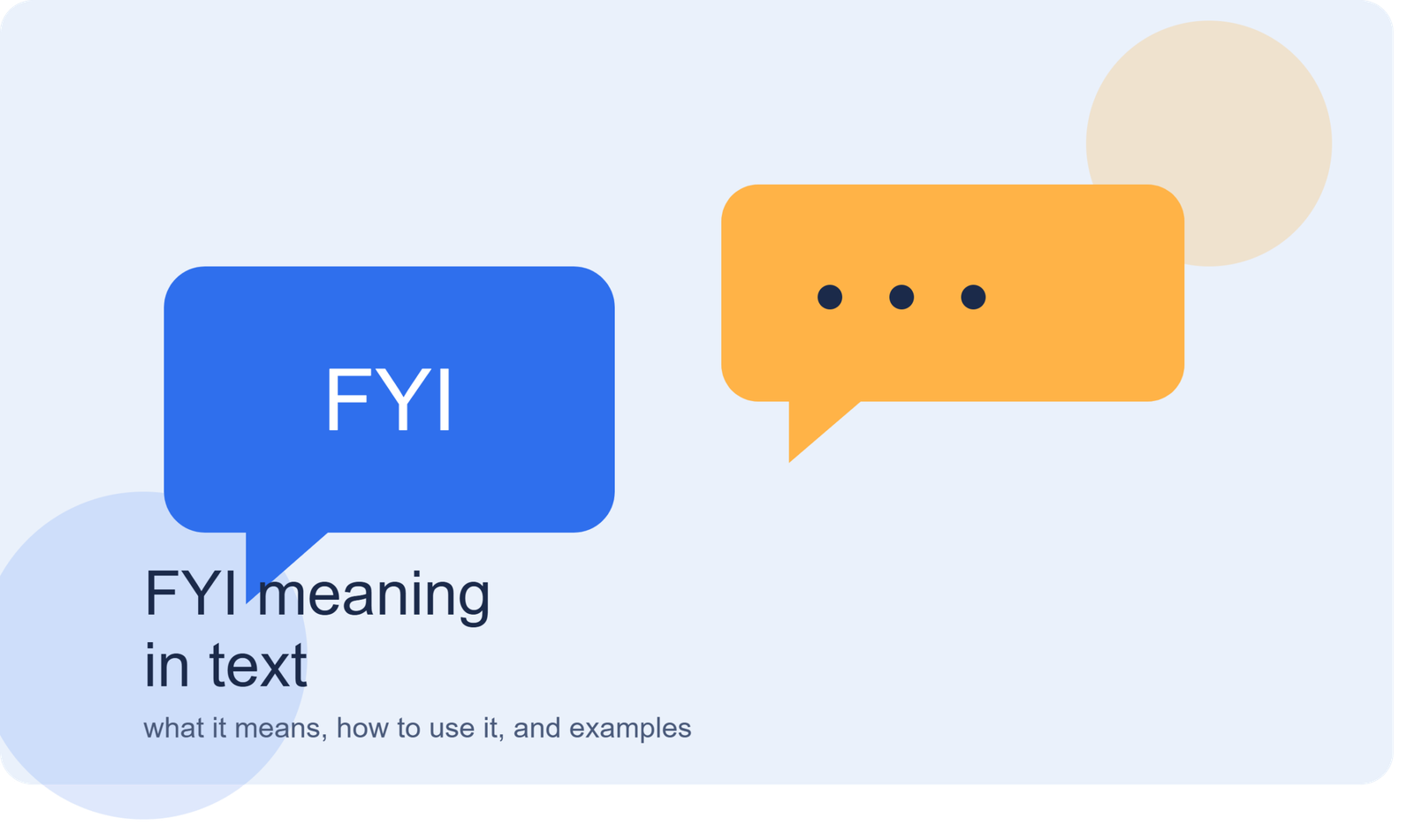
FYI meaning in text refers to a short way of sharing information without asking for a reply. FYI stands for “for your information,” and it shows up in texts, emails, and work chats every single day.
Picture this: a single text pops up, three letters long, and suddenly a whole message becomes clear. That’s the quiet power of FYI. It’s small, but it shapes how people talk, work, and stay connected online.
Understanding the true FYI meaning in text helps you use it the right way, every time. This guide breaks down its origin, its tone, and its everyday use across platforms. By the end, the FYI meaning in text will feel simple, natural, and easy to apply.
What Does FYI Mean?
FYI stands for for your information. It’s a quick way to share something the reader didn’t ask for but might find useful — a schedule change, a heads-up, a small detail worth knowing.
So, what does FYI mean in practical terms? It signals: “Here’s some info. No response needed, no action required.” That’s the whole job of the phrase.
A few quick facts about the FYI abbreviation:
- It’s technically an initialism, not an acronym — you say the letters (“eff-why-eye”), not a new word.
- It works as a sentence starter, a sentence ender, or a standalone reply.
- It’s one of the most recognized pieces of workplace shorthand in English, alongside ASAP and RSVP.
FYI definition, in one line: a low-effort way to pass along information without implying urgency or requiring a reply.
Where Did FYI Come From?
The meaning of FYI goes back further than texting. It started in mid-20th-century office memos, where managers used it to route documents to employees “for their information” — no action needed, just awareness. Typed at the top of a memo, it told the reader exactly how to treat what followed.
When email took over office communication in the 1990s, FYI moved with it. People used it in subject lines (“FYI: Q3 Numbers”) to instantly tell the recipient this wasn’t a task — just context. From there, it slid naturally into instant messaging, texting, and eventually social media, keeping the same core job it always had: flagging information as optional reading.
How to Format and Punctuate FYI Correctly
This part trips people up more than you’d think. Here’s the actual FYI usage breakdown.
Capitalization doesn’t change the definition, but it does shift the tone:
| Style | Common Context | Feels Like |
|---|---|---|
| FYI | Email, formal text | Neutral, standard |
| fyi | Casual texting | Relaxed, low-effort |
| F.Y.I. | Rare, older writing | Overly formal or dated |
Comma rules for proper FYI usage:
- “FYI, the meeting moved to 3pm.” — comma reads slightly more polished, common in email.
- “FYI the meeting moved to 3pm.” — no comma, common in texting, feels quicker and more casual.
Both are grammatically accepted in informal writing. Pick based on the context you’re writing in, not a hard rule.
Standalone use is also valid: replying to a message with just “FYI.” as an acknowledgment that you’re passing something along with no further comment attached.
Is FYI Formal or Informal?
This is where most confusion happens, because FYI genuinely works in both worlds — the effect depends entirely on tone and setting.
In Casual Conversation
Between friends or family, FYI is quick, blunt, and low-stakes. It often appears lowercase, with minimal punctuation, folded into a text like any other word.
Example:
“fyi I’m running late, be there in 10”
No formality needed. The informal communication style here mirrors how people actually talk — short, direct, unbothered.
In Professional and Work Settings
In professional work settings, FYI is still common, but etiquette experts often suggest softer alternatives in very formal emails, especially with clients or senior leadership. Inside a team, it’s completely normal. Outside your organization, “for your awareness” or “just to keep you posted” sometimes reads more polished.
Example (internal, fine as-is):
“FYI, the deck is finalized and shared in the drive.”
Example (external, softer alternative worth considering):
“Wanted to flag this for your awareness — the deck is finalized.”
FYI in Different Contexts
The FYI meaning in text doesn’t change across platforms, but how it lands definitely does.
In Texting and Chat Apps
This is the most casual use case. Everyday texting and casual messages use FYI to drop quick, low-stakes updates without ceremony.
Text example:
“fyi the wifi password changed, it’s on the fridge”
In Email
Professional email relies on FYI heavily — often right in the subject line. It tells the recipient before they even open the message: this is informational, not a task.
Email example:
Subject: FYI — Office Closed Monday Body: “Just a heads-up that the office will be closed Monday for the holiday. No action needed.”
In Workplace Chat Tools (Slack, Teams)
Slack, Microsoft Teams, and similar team messaging platforms are arguably where FYI gets the most daily use in 2026. These workplace chat tools are built for exactly this kind of low-friction, no-reply-needed update.
Slack example:
“FYI — deployed the fix to staging, testing now.”
This kind of internal communication keeps teammates looped in without cluttering their to-do list. It’s one of the most practical uses of the phrase in modern businehttps://en.wikipedia.org/wiki/Business_communicationss communication.
In Social Media Captions and Comments
On social media, FYI adds a punchy, attention-grabbing edge to caption examples and comments. It’s less about formality and more about tone — often playful or urgent-sounding.
Caption example:
“FYI this drops at midnight and it WILL sell out 👀”
This is a good example of casual online communication — the phrase works as a hook as much as an information flag.
Does FYI Sound Rude?
Short answer: not inherently. The word itself is neutral. Tone, punctuation, and context do all the heavy lifting.
Friendly Tone
Paired with warmth, FYI reads as helpful and considerate.
“Just FYI, no rush at all — whenever works for you!”
Neutral Tone
Plain and factual, no emotional signal either way.
“FYI, the invoice is attached.”
Passive-Aggressive Tone
Short, capitalized, or dropped right after a correction, FYI can read as curt or pointed.
“FYI I already told you this yesterday.”
The words are identical to the neutral example structurally, but the context — a correction, clipped phrasing — shifts the read entirely. This is the core of good intehttps://textmeaninghub.com/wp-admin/post.php?post=578&action=editrpersonal communication: knowing that identical words can land completely differently depending on what surrounds them.
When to Use FYI (and When Not To)
Situations Where It Works
- Sharing logistics (time changes, location updates)
- Passing along a deadline reminder
- Flagging a completed task teammates should know about
- Giving a friendly heads-up with zero urgency attached
Situations Where It Backfires
- Delivering bad news — feels abrupt and cold
- Correcting someone — can read as a jab
- Anything requiring empathy or nuance
In sensitive emotional conversations, FYI almost always undersells the moment. If the news carries weight, skip the shorthand and just say it plainly.
FYI vs. BTW vs. ASAP
FYI = For Your Information
Signals a no-action-needed heads-up.
BTW = By The Way
Signals a related side note or tangent, often less important than the main topic.
The Real Difference Between FYI and BTW
| Phrase | Purpose | Implies Urgency? | Typical Use |
|---|---|---|---|
| FYI | Share standalone info | No | “FYI, the store closes early today.” |
| BTW | Add a related side thought | No | “BTW, did you see that email?” |
FYI tends to open or close a message as its own point. BTW usually tacks onto an existing conversation as an aside.
FYI vs. ASAP
These aren’t really interchangeable, but people mix them up. ASAP (“as soon as possible”) signals urgency and action. FYI signals the opposite — no action, no urgency.
| Phrase | Meaning | Action Required? |
|---|---|---|
| FYI | For your information | No |
| ASAP | As soon as possible | Yes, immediately |
Other Abbreviations Worth Knowing
A quick reference for phrases that often show up alongside FYI:
- TBH — to be honest
- IMO — in my opinion
- NVM — never mind
- TL;DR — too long; didn’t read
- PSA — public service announcement
These share FYI’s shorthand DNA — built for speed, not formality.
Do You Need to Reply to an FYI Message?
Generally, no. That’s the built-in function of the phrase — it explicitly tells the recipient a response isn’t expected.
Exceptions exist. If the sender buries a question inside the FYI (“FYI, are you still coming?”), a reply is obviously warranted — but that’s really a formatting mistake on the sender’s part, covered further down.
How Businesses and Teams Use FYI
In business communication, FYI plays a specific role: keeping people “in the loop” without adding to their workload. It shows up constantly in:
- CC’d emails — read-only context for people not directly involved
- Team channel updates — status changes, completed tasks, minor announcements
- Internal memos — the format’s original home, still in use today
Quick case example: A product manager finishes a bug fix and posts in the team’s Slack channel: “FYI, the checkout bug is patched and live.” No one needs to act. Everyone just needs to know. That’s office communication doing exactly what it’s designed to do — informing without demanding.
Common Mistakes People Make With FYI
Using It to Ask a Question
“FYI, are you coming?” mismatches the phrase’s purpose. FYI announces information; it doesn’t request it. If a question follows, drop the FYI and just ask.
Overusing It
Attaching FYI to every single message weakens its impact. When everything is “FYI,” nothing stands out as genuinely worth flagging. This is one of the most frequent FYI mistakes in workplace chat — using it as filler rather than a real signal.
Using It in Sensitive or Emotional Conversations
FYI strips emotional weight from whatever follows. Layoffs, health updates, conflict resolution — none of these belong after “FYI.” The phrase reads as detached exactly when detachment isn’t welcome.
Real FYI Examples by Context
A quick side-by-side of the same core message, adjusted per platform:
- Texting: “fyi running 10 min late 🙏”
- Email: “FYI — attached is the finalized budget for review.”
- Slack/Teams: “FYI, pushed the release notes to the shared doc.”
- Social media: “FYI these sell out fast, link in bio before they’re gone!”
Same core function across all four — flag information, skip the small talk — but each one adjusts tone to fit its platform.
FAQs
FAQs: FYI Meaning in Text
What does FYI stand for?
FYI stands for “for your information.” It’s a quick way to share something without expecting a reply.
Is FYI still commonly used in 2026?
Yes, it’s still everywhere — especially in Slack, Teams, and email. If anything, workplace chat tools have made it more common than ever.
Is it rude to text someone “FYI”?
Not on its own. The word’s neutral — tone and context (caps, timing, punctuation) are what make it read friendly or curt.
Can you use FYI in a formal email?
Yes, it’s fine internally. For client-facing or executive emails, “for your awareness” often reads a bit more polished.
What’s a good alternative to FYI?
Try “just so you know,” “heads-up,” or “for your awareness” — all carry the same meaning with a softer tone.
conclusion
Conclusion
At its core, FYI meaning in text stays simple: it’s a quick way to share info, not ask for one. It works in texts, emails, and work chats alike. Tone shapes how it lands, not the word itself.
Once you get the FYI meaning in text right, you’ll use it with more confidence. Save it for easy updates and heads-ups. Skip it for hard news or emotional talks. Get that balance right, and FYI stays a small, handy piece of everyday shorthand.