Orgo slang meaning refers to the casual, shortened way college students refer to organic chemistry — one of the toughest courses on any science track. Students clip the full name down for speed, the same way “psych” replaces psychology.
But orgo isn’t just a nickname. It’s a badge of survival, a shared inside joke passed between exhausted classmates at 2am, and proof that even chemistry can go viral.
This guide breaks down where the term came from, how pre-med students and STEM majors actually use it, and why it keeps popping up across TikTok, Reddit, and group chats every single exam season.
What Does “Orgo” Actually Mean?
At its core, the orgo slang meaning is simple. It’s a clipped, casual version of “organic chemistry,” used the same way “psych” stands in for psychology or “calc” stands in for calculus. Students shorten long course names constantly. Orgo just happens to be one of the most recognizable examples, because the course behind it has such a strong reputation.
Organic chemistry itself studies carbon-based compounds and the reactions they undergo. It’s a foundational class for STEM majors, biology majors, and especially aspiring doctors, since most medical school programs require it before admission. That’s the “chemistry course” part of the definition, and it’s not up for debate. If someone says “I have orgo tomorrow,” they mean the class, full stop.
What makes the word slang, rather than just an abbreviation, is the emotional weight it carries. Nobody clips “gen chem” or “calc” with quite the same dread in their voice. Orgo comes loaded with a reputation: hard, competitive, and often treated as a rite of passage. That reputation is baked into how the word gets used, which is why “orgo explained” usually involves more than just a dictionary definition — it involves context.
It helps to think about the orgo definition the same way you’d think about any nickname that grows out of shared experience. Soldiers shorten “basic training” to “basic.” Law students shorten “constitutional law” to “con law.” The pattern shows up everywhere: when a group of people spends enough hours struggling through something together, they eventually find a faster way to say its name. Orgo just happens to be the version that made it out of lecture halls and into everyone’s group chat.
Quick definition table:
| Term | What It Stands For | Who Uses It |
|---|---|---|
| Orgo | Organic chemistry | College students, pre-med applicants, STEM majors |
| Gen chem | General chemistry | First-year science students |
| Biochem | Biochemistry | Upper-level science and health majors |
| Physics | Physics (rarely shortened) | Engineering and physical science students |
Notice something in that table? Orgo is really the only course nickname that’s crossed over into wider internet slang. Gen chem, biochem, and physics get shortened in casual speech too, but none of them show up in memes, TikTok captions, or Reddit threads with anywhere near the same frequency. That crossover is worth understanding on its own, and it’s a big part of why this guide exists in the first place.
Why Language Nerds Would Call This “Clipping”
If you want the linguistics term for what’s happening here, it’s called clipping — shortening a longer word while keeping its meaning fully intact. “Photo” from “photograph,” “gas” from “gasoline,” “prof” from “professor.” Orgo fits neatly into this same pattern. It’s not a new word being invented from scratch. It’s an existing word getting trimmed down for speed and casualness, which is exactly why it spread so easily once online chat and texting became the default way people talk to each other.
Orgo in a Sentence — Real Examples
Seeing the word used naturally makes the term meaning click faster than any formal definition. Here’s how it actually shows up.
Talking About the Class Itself
“I have orgo at 8am, kill me.”
This is the most literal use. No hidden meaning, no metaphor — just a student referencing their actual class schedule. You’ll hear this in dorm hallways, see it in group chats, and read it in casual text messages between roommates comparing schedules.
Exam and Study Stress Posts
“Orgo final in three hours and I’ve studied for zero of them.”
This is where the word picks up its emotional charge. Organic chemistry exams are notorious for testing reaction mechanisms in ways that punish memorization and reward actual understanding — which means cramming rarely works. Posts like this show up constantly during finals season on Reddit and X (Twitter), often tagged with self-deprecating humor rather than genuine panic.
Identity and Flex Use
“Survived orgo, ask me anything.”
Once a student finishes the course, orgo becomes a badge. Mentioning it signals shared struggle to anyone who’s been through the same thing, kind of like veterans swapping stories about basic training. It’s a quick way to bond with other undergraduate students or classmates who understand exactly what the reference means without further explanation.
Study Group Coordination
“Orgo study group at the library, 7pm, bring your own coffee.”
This is one of the most common practical uses. Study groups, tutoring sessions, and revision sessions almost always use the shorthand instead of the full course name, simply because it’s faster to type and say out loud.
Messaging Apps and DMs
“Bro did you send me the orgo notes from Tuesday? I missed lecture.”
This kind of message shows up constantly on messaging apps. Whether it’s a WhatsApp thread for a whole class section, a DM between two lab partners, or a private group chat for a specific study group, orgo gets used the exact same way “notes,” “homework,” or “lecture” would. There’s nothing fancy happening here — it’s just efficient, casual texting between people who already share context.
Direct Reference to Frustration
“Why did I sign up for orgo AND physics in the same semester? I need my head examined.”
This example shows how orgo often gets paired with venting about scheduling regret. It’s less about the class content and more about the decision to take it in the first place, which is a very common flavor of complaint among undergraduates juggling multiple demanding courses at once.
Where “Orgo” Actually Comes From
Here’s where a lot of articles online start inventing things. You’ll find pieces claiming orgo has a precise origin story from the 1970s, or a decade-by-decade evolution chart. Honestly, there’s no solid documentation supporting that level of detail. Slang like this rarely has a single inventor or a clean paper trail. What we can say with confidence is more useful anyway.
The Reputation Behind the Reputation
Organic chemistry earned its infamous status because of how many pre-med tracks use it as a weed-out class — a course deliberately structured to be difficult enough that only the most prepared or persistent students make it through. For decades, this reputation has been common knowledge on university campuses, especially among students heading toward healthcare careers.
When a class becomes that central to a whole track of study, students naturally develop a shorthand for talking about it. Orgo isn’t unique in getting nicknamed. But because so many students go through it, and because the stakes feel so high for applicants hoping for strong grades on their medical school admissions file, the nickname stuck harder than most.
From Campus to the Internet
The path from “classroom slang” to “internet slang” isn’t complicated. Students talk about their classes online the same way they talk about anything else that dominates their week. As online platforms like Reddit, TikTok, and X (Twitter) grew, so did the volume of posts referencing coursework. Orgo, being one of the most talked-about classes among college students, naturally carried over.
This is really the whole story. No secret history, no cinematic origin. Just a heavily used course name, shortened by students, and then amplified by the same platforms that amplify basically everything else in student life.
How Students and Academics Use “Orgo”
What “Taking Orgo” Signals
When someone mentions they’re “taking orgo,” they’re usually communicating more than just a class schedule. They’re signaling:
- They’re likely on a pre-med, biology, or chemistry track
- They’re probably taking the year-long sequence (Orgo I and Orgo II), not just a single semester
- They understand the course’s reputation and are bracing for a heavy workload
This layered meaning is part of why the word functions as shorthand for an entire experience, not just a class title.
Why It’s Shorthand for Struggle, Not Just the Subject
There’s a reason nobody says “psych final, kill me” with the same intensity as “orgo final, kill me.” Organic chemistry requires understanding reaction mechanisms conceptually, not just memorizing facts. Students who succeed in earlier science classes through memorization sometimes hit a wall here, which contributes to the course’s reputation as a serious filter for STEM and pre-med paths.
“Orgo doesn’t care how good you were at chemistry before. It’s a different kind of hard.” — a common sentiment echoed across countless study group conversations and student forums.
Do Professors Use the Term Too?
Somewhat, yes. Professors and teaching assistants often use “orgo” informally in office hours, casual conversation, or even in classroom usage when addressing a relaxed room. That said, it almost never appears in syllabi, official course catalogs, or formal writing. The word lives in spoken and casual written coursework conversation, not institutional documents.
A Realistic Case Study — One Student’s Semester
To make this less abstract, picture a typical pre-med sophomore we’ll call Maya. She’s a biology major aiming for medical school, and this semester she’s enrolled in Orgo I alongside a full course load.
Here’s how the slang shows up across her actual week:
- Monday morning: She texts her roommate, “orgo lecture in 20, wish me luck”
- Wednesday night: She posts a TikTok of her desk covered in flashcards, captioned “orgo has taken my will to live”
- Thursday: Her study group chat lights up with “who’s down for orgo review before the quiz tomorrow”
- Saturday: She scrolls Reddit’s r/premed and finds a thread titled “how do I not fail orgo,” with dozens of replies sharing tips on tackling reaction mechanisms
None of this is exaggerated. It’s simply what one semester of coursework looks like when a single class dominates that much mental bandwidth. Maya isn’t inventing new slang or being ironic — she’s using the word the exact way thousands of other students use it every single week during the school year.
Orgo in Medical School Conversations
Here’s a detail that surprises people outside STEM: medical school applicants keep referencing orgo long after the class technically ends. That’s because grades from Orgo I and Orgo II carry real weight during admissions review, and applicants often discuss their orgo performance openly in interview prep forums, application strategy threads, and advice content aimed at healthcare careers.
Once students actually reach med school, the term shows up less often in daily academic conversation, since the coursework moves on to entirely different subjects. But it doesn’t disappear completely. It’s common to hear current med students reference orgo nostalgically, usually along the lines of “at least it’s not as bad as orgo was,” when comparing current workload to their undergraduate struggles. This kind of callback humor keeps the term alive well past the semester it was actually taken in, and it reinforces just how much cultural weight the word carries among people on the path to becoming physicians.
Orgo Online — Social Media in 2026
Social media is where orgo slang gets the most visibility outside of actual classrooms. Each platform uses it a little differently.
TikTok
TikTok content built around orgo tends to fall into a few recurring formats:
- “Orgo survival” videos — students documenting exam week chaos, sleep deprivation, and last-minute cramming
- Study-with-me content — timed study sessions where orgo material sits open on the desk
- Meme audio paired with orgo captions — using trending sounds to express finals-week stress
TikTok’s short-form format matches the bite-sized, high-emotion nature of orgo complaints perfectly. A ten-second clip captioned “orgo has taken everything from me” gets the point across faster than a paragraph ever could.
What’s interesting about TikTok specifically is how it turns a shared academic burden into a form of entertainment. Viewers who’ve never taken organic chemistry still enjoy these videos, because the emotions on display — exhaustion, panic, dark humor — translate universally, even without understanding a single reaction mechanism. The chemistry content itself is almost beside the point. The relatable stress is the actual product being shared.
Reddit is arguably the most text-heavy home for orgo discussion. Communities like r/premed and r/chemistry see constant, casual use of the term in threads about course difficulty, exam strategies, and whether to retake the class. Reddit’s discussion format makes it a good place to see how deeply the word is embedded in course discussion — it’s rarely explained or defined in these threads, because everyone already knows what it means.
X (Twitter)
On X (Twitter), orgo shows up mostly in quick, reactive posts. Exam-day venting, brief jokes, and one-liners dominate. The platform’s fast pace suits the word’s function as an efficient way to signal “I’m going through something academically brutal” without extra explanation.
Instagram sees the term less often as native content and more as captions layered onto crossposted TikTok videos or story updates during finals week. It’s less of a discussion hub and more of a place where the aftermath of orgo stress gets documented visually — think library selfies at 2am with a caption like “orgo owns my soul this week.”
A Quick Note on Definition Sites
Sites like Urban Dictionary host user-submitted definitions of orgo, which mostly just confirm the organic chemistry meaning with varying degrees of humor. They’re not really a separate usage context — just a place where the definition gets written down by the same student community using the word everywhere else.
Does “Orgo” Mean Anything Besides Organic Chemistry?
This is where a lot of online content starts to stretch the truth, so let’s be direct about what’s actually supported and what isn’t.
The “Organic” Connection
Occasionally, people use “orgo” as an informal, playful shorthand tied to the word “organic” in lifestyle conversations — think organic food, organic produce, or the broader wellness lifestyle space. You might see it in a caption about a farmers market haul or a clean eating post. This usage exists, but it’s minor, inconsistent, and entirely dependent on context. It doesn’t carry its own dedicated culture or community the way the chemistry meaning does.
If someone posts a photo of a farmers market table with the caption “orgo szn,” they’re clearly riffing on “organic,” not referencing a chemistry class. Context makes the difference obvious every time.
What About Skincare, Beauty, or Wellness Communities?
Within clean beauty and healthy living circles, you’ll sometimes see “organic” get abbreviated casually in captions or comments, occasionally clipped to “orgo.” Again, this is a loose, informal pattern rather than an established secondary definition. It’s more like wordplay than a distinct slang meaning with its own history.
Clearing Up Misconceptions
Here’s the part worth being blunt about: several articles online claim orgo has established meanings in workplace jargon, corporate communication, org design, or internal documents — essentially treating “orgo” as organizational shorthand in business context settings. There’s no real evidence supporting this as an actual, widely recognized usage. It reads like content written to hit keyword targets rather than reflect real language patterns.
Similarly, claims about orgo having a distinct meaning in Spanish slang, aviation communication, or as standalone medical terminology don’t hold up under scrutiny. If you search for those meanings, you’ll mostly find speculative or fabricated claims recycled across low-quality SEO content, not genuine documented usage.
The honest takeaway: orgo means organic chemistry, first and overwhelmingly. Any “organic” wordplay is occasional and obviously contextual, not a parallel definition with real staying power.
Is “Orgo” Still Widely Used in 2026?
Yes, though usage isn’t spread evenly across all groups or all times of year.
Where It’s Concentrated
Orgo usage clusters heavily around:
- Pre-med students and applicants preparing for medical school
- STEM majors, particularly biology majors and chemistry-adjacent fields
- Undergraduate students currently enrolled in the course sequence
- Online communities built around healthcare careers and physician training paths
Outside these groups, the term is understood but rarely used actively. Someone outside STEM might recognize “orgo” if they’ve seen it online, but they’re unlikely to use it themselves unless prompted.
Why It Spikes Seasonally
Orgo mentions online aren’t constant. They spike hard around midterms and finals, then quiet down during breaks. This seasonal pattern makes sense — the emotional intensity behind the word ties directly to exam stress and coursework deadlines, not to a steady, year-round trend. If you check Reddit or TikTok during a random week in July, you’ll see far less orgo content than during a chaotic week in December or May.
A Grounded Look at Longevity
The word has stuck around for a long time simply because the course itself hasn’t gotten any easier, and organic chemistry remains a near-universal requirement for pre-med tracks. As long as that stays true, students will keep needing quick shorthand for talking about it, whether that conversation happens in a dorm hallway or a DM thread.
Why It Hasn’t Faded Like Other Campus Slang
A lot of campus-specific slang fades within a few graduating classes. New students bring new words, older ones drop out of use, and the cycle repeats. Orgo has avoided that fate for one straightforward reason: the underlying course hasn’t changed in any way that would make the nickname obsolete. Organic chemistry still sits in the same spot on pre-med checklists, still gets taught with the same emphasis on reaction mechanisms, and still produces the same wave of stressed-out classmates every fall and spring semester.
Slang tends to stick around when the thing it’s describing stays constant. Compare that to something like a slang term tied to a specific app feature or a meme format — those disappear the moment the platform changes or the joke gets old. Orgo isn’t tied to a trend. It’s tied to a requirement, and requirements don’t expire on a whim.
Who Keeps the Word Alive Each Year
Every incoming class of undergraduates heading into STEM or pre-health tracks essentially “relearns” the term by osmosis. Nobody sits new students down and explains what orgo means. They pick it up naturally from classmates, older students, study group chats, and the general noise of university campus life. This organic (no pun intended) transmission is part of why the word has such staying power — it doesn’t rely on marketing, hashtags, or any deliberate effort to keep it going. It just keeps replicating itself through everyday coursework conversation.
How to Use “Orgo” Correctly
When It Fits Naturally
Orgo works well in:
- Casual texting with classmates or friends in similar academic tracks
- Group chat coordination for study groups or exam prep
- Social captions during finals season
- Conversations with anyone who’s taken or is currently taking the course
When It’ll Confuse People
Avoid orgo in:
- Formal academic writing, applications, or admissions essays — spell out “organic chemistry” instead
- Professional emails or internal documents, where clarity matters more than casual tone
- Conversations with people clearly outside STEM or pre-med circles, unless you’re prepared to explain it
How to Respond When Someone Drops “Orgo” on You
If a friend texts “orgo is destroying me rn,” you don’t need a chemistry background to respond well. A simple “that class has a reputation for a reason, hang in there” works fine. If you want to sound like you actually know what’s going on, referencing the course’s difficulty with reaction mechanisms or its role as a pre-med filter shows you understand the context, not just the word.
Quick Reference — Orgo vs. Other Class Abbreviations
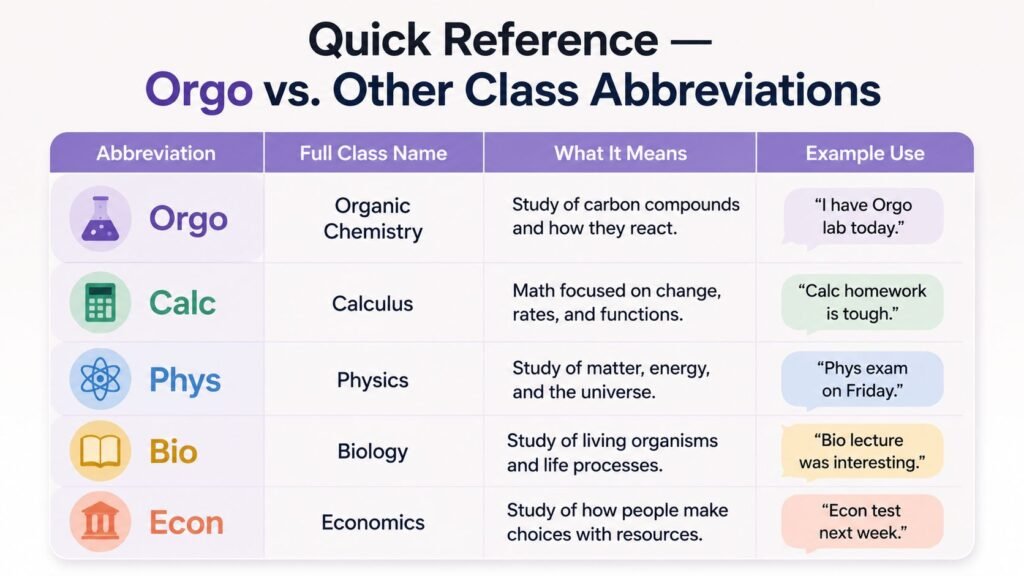
Since orgo isn’t the only shortened course name floating around university campus life, here’s how it stacks up against a few others:
| Abbreviation | Full Course Name | Typical Reputation | Common Platforms Used On |
|---|---|---|---|
| Orgo | Organic Chemistry | Extremely difficult, high-stakes for pre-med | TikTok, Reddit, X, group chats |
| Gen chem | General Chemistry | Moderate difficulty, foundational | Group chats, campus forums |
| Biochem | Biochemistry | Difficult, dense material | Reddit, study group chats |
| A&P | Anatomy & Physiology | Memorization-heavy | Nursing and pre-health forums |
| Calc | Calculus | Varies by student background | General student social media |
Orgo stands out because its reputation travels well beyond the classroom. Gen chem and calc get shortened too, but they don’t carry the same cultural weight or show up nearly as often outside of direct academic conversation.
FAQs
Is “orgo” still commonly used in 2026?
Yes. It’s still the go-to shorthand for organic chemistry among pre-med and STEM students, especially during midterms and finals season.
Does “orgo” ever mean something outside of chemistry?
Occasionally, as playful wordplay for “organic” in food or wellness captions — but this isn’t a real secondary definition, just context-dependent slang.
Is orgo one semester or two?
Most schools split it into Orgo I and Orgo II, a full year-long sequence rather than a single course.
Why does orgo have such a rough reputation?
It’s widely used as a pre-med “weed-out” class, and it rewards understanding reaction mechanisms over memorization, which trips up a lot of students.
Is it okay to use “orgo” in a professional email?
Not really — stick to “organic chemistry” in formal writing, applications, or emails to professors.
Conclusion
At its core, the orgo slang meaning is simple. It’s just organic chemistry, shortened by students who needed a faster way to talk about a tough class. No hidden history, no secret code. Just real students, real stress, and a word that stuck.
That’s really the whole point of the orgo slang meaning. It’s not fancy or complicated. It’s a small piece of student life that turned into something bigger online. So next time you see it in a text or a caption, you’ll know exactly what’s going on.