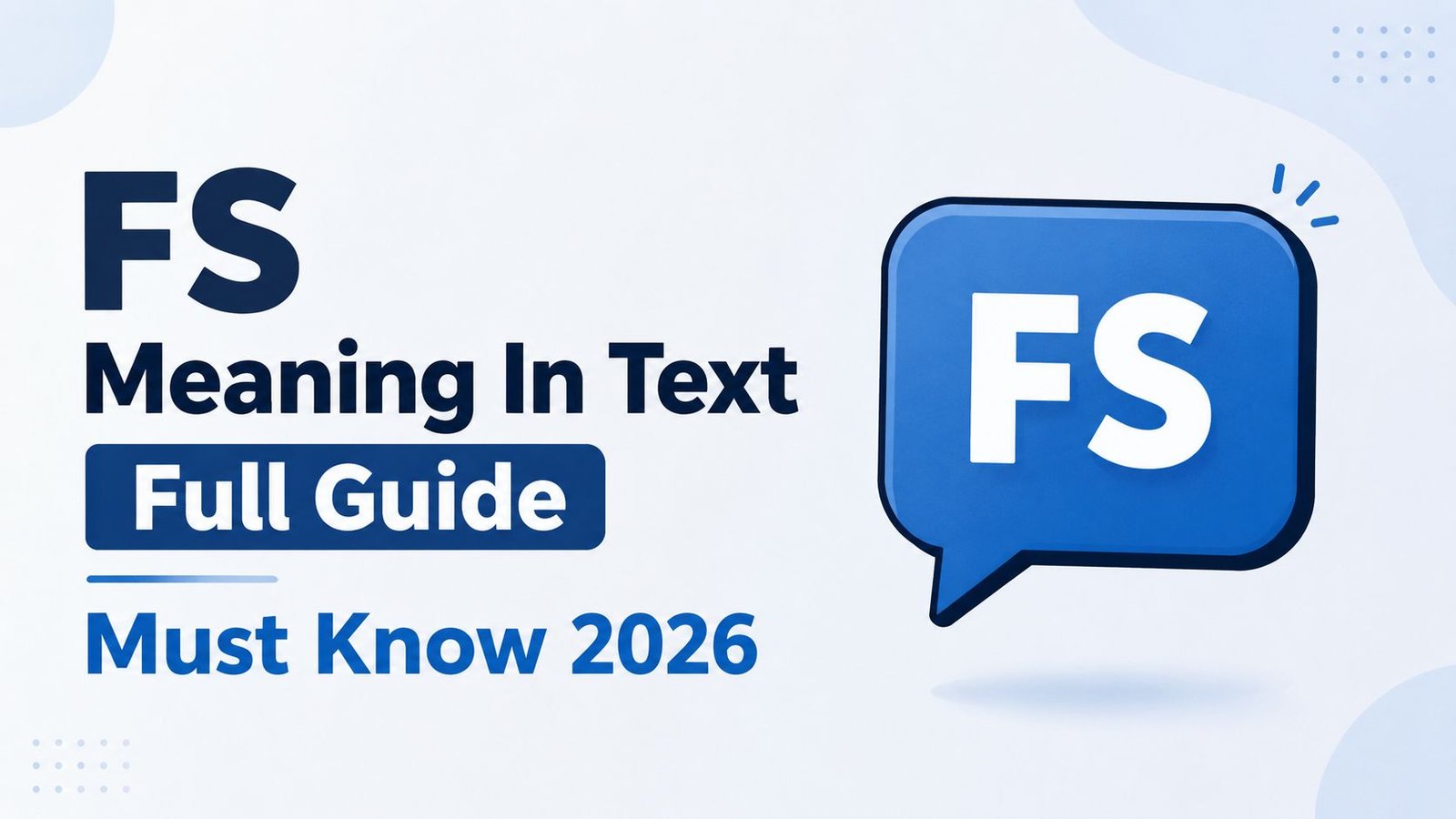
FS stands as one of the most common texting abbreviations floating around today, typically short for “for sure.” People drop it into text messages, social media comments, and gaming chat to confirm something fast without typing out a full sentence.
Picture this: your phone buzzes, you glance down, and there it is — just “fs,” sitting alone like it’s supposed to explain itself. It does, once you know the code.
This little abbreviation carries way more range than most people realize. Beyond casual agreement, FS shifts meaning across gaming, sports, and even tech circles, making context the real key to cracking it every time.
What Does FS Mean in Text?
At its core, FS is a texting abbreviation that most commonly stands for “For Sure.” It’s used to confirm something, agree with a statement, or express certainty — basically a shorter, faster way of saying “yeah, absolutely” without lifting your thumb off the keyboard for more than two taps.
But here’s the twist: FS isn’t a one-trick term. Depending on the platform, the conversation, and even the capitalization, it can mean something completely different. In gaming communication, it might mean “full send.” In grammar-heavy tech circles, it could reference File System. And if you’ve ever watched American football, you already know FS as Free Safety, a defensive position that has nothing to do with texting at all.
So while “For Sure” is the answer you’ll need 90% of the time, context is everything here. Let’s break down exactly how to read it.
Quick answer: FS most commonly means “For Sure” in online conversations and instant messaging, used to express agreement or confirmation.
The #1 Meaning — “For Sure”
If you had to bet on what “fs” means the next time you see it, put your money on “For Sure.” It’s by far the most frequent usage across texting slang, group chats, and casual online interaction.
Think about how often you type “for sure” in a day. Now imagine shaving it down to two letters. That’s the entire appeal. It’s not complicated, it’s not mysterious — it’s just efficient.
Here’s how it typically plays out:
- Friend: “You still coming to the game tonight?”
- You: “fs, wouldn’t miss it”
Or in a slightly more enthusiastic tone:
- Coworker: “This new update is way faster.”
- You: “fs, I noticed immediately”
In both cases, “fs” is doing the job of definitely, absolutely, certainly, or no doubt — just with way less typing. It carries the same weight as “yes indeed,” but sounds more natural in a casual back-and-forth.
Why People Text “FS” Instead of Typing It Out
There’s a reason abbreviations like this stick around instead of fading out. A few real factors drive it:
- Speed matters in fast-moving conversations. Group chats move quickly, and typing out full sentences can make you feel like you’re lagging behind the conversation.
- Thumb fatigue is real. Anyone texting from a phone screen knows that every saved keystroke adds up over a day of messaging.
- It matches the tone of casual chat language. Typing “For sure!” with proper capitalization and punctuation can almost feel too formal for a quick reply among friends.
- It signals familiarity. Using shorthand like “fs” tells the other person you’re comfortable enough to skip formalities — it’s practically a social cue.
None of this is really new, either. Texting slang has always evolved around convenience. “FS” just happens to be one of the more recent entries that stuck.
Other Common Meanings of FS
Here’s where things get interesting. “FS” isn’t locked into a single definition, and using it in the wrong context can genuinely confuse whoever’s reading it. Below are the meanings you’re most likely to run into.
| Meaning | Context | Example |
|---|---|---|
| For Sure | Casual chat, agreement | “fs, let’s do it” |
| For Shame | Sarcastic or teasing tone | “fs, you forgot again” |
| Full Send | Gaming, extreme sports slang | “fs into that ramp” |
| Free Safety | American football position | “He plays FS for the Ravens” |
| File System | Tech, computing | “The FS crashed after the update” |
| F***ing Stupid | Blunt frustration (informal) | “That rule is fs” |
| Full Speed | Racing, acceleration contexts | “Going FS down the straightaway” |
A few of these deserve a bit more unpacking, since they show up more often than people expect.
File System, for instance, is a legitimate technical term used across computer system architecture. It refers to how an operating system organizes, stores, and retrieves data — essentially the storage system and file management structure behind every folder you click through. NTFS, FAT32, and ext4 are all examples of an actual filesystem at work, quietly deciding how your photos, documents, and downloads get indexed on a hard drive or SSD. If you’re in a tech support thread, a coding forum, or reading system documentation, “FS” almost certainly means this, not “for sure.” You’ll see it in sentences like “the FS threw an error after the firmware update” or “check which FS your drive is formatted with before installing.” None of that has anything to do with agreeing with a friend — it’s purely technical shorthand that happens to share the same two letters.
Free Safety is a real position in American football, part of the secondary defense alongside cornerbacks and the strong safety. A safety player in this role reads the quarterback, covers deep zones, and prevents big passing plays. Unlike the strong safety, who typically lines up closer to the line of scrimmage and helps against the run, the free safety usually plays deeper and has more freedom to roam — hence the name. Sports commentary, fantasy football forums, and stat sheets use “FS” constantly in this sense, right alongside other positional abbreviations like CB (cornerback) or LB (linebacker). If you stumble across “FS” in a fantasy draft thread or a box score, this is almost certainly the meaning at play.
Full Speed and Full Send overlap conceptually — both relate to maximum speed, rapid movement, or committing fully to an action, whether that’s racing, acceleration, or just going all-in on a risky decision. You’ll spot “full speed” in contexts describing literal velocity (a car, a treadmill setting, a printer mode), while “full send” tends to describe a mindset or attitude — going for it without hesitation, regardless of the odds.
The point? Never assume. Always check the surrounding sentence before locking in a meaning. A single letter’s difference in capitalization or punctuation won’t change anything here — but the topic of the conversation will.
FS on Social Media
Social media platforms like Instagram, TikTok, and Snapchat are where “FS” gets used the most casually — and the most inconsistently.
On TikTok, you’ll usually see “fs” dropped in comment sections agreeing with a video’s point. Someone posts a hot take about pineapple on pizza, and the top comment reads “fs, people need to relax.” It’s short, it’s punchy, and it fits the fast-scrolling nature of the platform.
Instagram comments follow a similar pattern, though you’ll also catch “fs” used more sarcastically in caption replies — closer to the “for shame” meaning when someone’s poking fun at a friend.
Snapchat, being more private and conversational, tends to lean almost entirely on the “for sure” meaning. Since Snapchat conversations often mimic real-time talking, “fs” slots in exactly where you’d naturally say “yeah, for sure” out loud.
Here’s a quick real-world style example thread:
Post caption: “Coffee before 9am should be illegal.” Comment: “fs, I can’t function without it” Reply: “fs fs, second cup already”
Notice how doubling it up (“fs fs”) adds emphasis — a small but common trend across online discussions, similar to how people repeat “yes yes” for extra enthusiasm.
WhatsApp, on the other hand, sees slightly less of this particular slang term simply because its user base skews a bit older globally and leans toward more traditional digital messaging habits. Still, among younger WhatsApp users, “fs” shows up in group chats just as often as anywhere else, especially in family group chats where teens and young adults type more casually with siblings and cousins than they might with parents or grandparents.
Twitter (now X) deserves a mention too, since it’s arguably where a lot of modern texting abbreviation culture got mainstream traction in the first place. Character limits forced brevity for over a decade, and “fs” fit right into that constraint. Even now, with expanded character counts, the habit of clipping phrases down hasn’t gone anywhere — replies under viral posts still lean heavily on shorthand like “fs,” “fr,” and “ngl” stacked together.
One pattern worth noting across all of these online platforms: the more visual and fast-scrolling a platform is, the more shorthand tends to dominate. TikTok comment sections are a good example — people are scrolling past dozens of posts a minute, so comments need to land fast and read even faster. A comment reading “for sure, I completely agree with this” takes noticeably longer to parse than “fs,” and on a platform built around speed, that difference matters more than it might seem.
FS in Gaming Chat
Online gaming has its own slang ecosystem, and “FS” fits right into it — though not always with the same meaning you’d expect from a group text.
In multiplayer chat, especially in shooter and racing games, “FS” frequently means “full send.” It’s used to describe going all-in on a risky play, rushing an objective, or committing to an aggressive move without hesitation.
Examples from game messaging:
- “fs into their base, no fallback”
- “just fs it, we’ve got nothing to lose”
- “he full sent that jump and somehow made it”
This differs from the “for sure” meaning in an important way: it’s not about agreement, it’s about commitment. A teammate typing “fs” mid-match isn’t confirming a plan — they’re announcing an all-out push.
That said, “for sure” still shows up plenty in gamer slang too, particularly in post-match chat or Discord servers where players are just talking casually rather than calling plays.
Gaming communication tends to move even faster than regular texting, since players are often multitasking between typing and actively playing. That urgency is part of why abbreviations thrive so heavily in this space — there’s simply no time for full sentences mid-fight.
Case study: Battle royale callouts
Consider a squad in a battle royale match, down to the final circle with one enemy team left standing between them and the win. Typing a full sentence like “everyone push together, don’t hold back” takes precious seconds that could mean the difference between winning and getting picked off. Compare that to a single teammate typing “fs” in the squad chat — short, immediate, and understood instantly by anyone familiar with the term. In voice chat, players will often say “let’s full send this” out loud before a big push, and the text version simply mirrors that same energy in written form.
This is also where “fs” overlaps with a broader trend in gamer slang: the tendency to borrow terms from extreme sports and car culture (“full send” originally gained mainstream popularity through motorsports and stunt culture before gaming communities adopted it) and repurpose them for entirely different contexts. It’s a good reminder that slang rarely stays confined to one community for long — it migrates, mutates slightly, and picks up new shades of meaning along the way.
FS in Relationships and Dating Texts
Slang doesn’t stay locked into gaming and social platforms — it bleeds into personal, romantic, and relationship-based virtual conversation just as easily.
In dating contexts, “fs” often functions as reassurance or agreement, but the tone shifts slightly depending on what’s being confirmed.
- Text 1: “Are we still good for dinner Friday?” Reply: “fs, can’t wait”
- Text 2: “Do you actually like this or are you just saying that?” Reply: “fs, I mean it”
In these situations, “fs” often carries a bit more emotional weight than it would in a group chat about weekend plans. It’s shorthand, sure, but it’s also a quick way of adding sincerity without writing out a longer, more vulnerable-sounding message.
There’s also a flirtier variation where “fs” gets paired with emojis or exclamation points to soften or emphasize tone:
“fs!! 😄” “fs, no doubt about it”
Context and existing relationship dynamics matter a lot here. Between close friends or partners, “fs” reads as casual and warm. Between new matches who barely know each other, it can come across as a little too clipped — so pay attention to how the other person is texting before matching their shorthand.
Where FS Came From
Slang rarely has one clean origin story, and “fs” is no exception. But its rise tracks closely with two major shifts in digital communication.
The first is the character-limited era of SMS. Back when text messages were capped at 160 characters and every letter technically “cost” something (either through carrier limits or sheer typing effort on flip-phone keypads), abbreviations like “fs,” “brb,” and “lol” became necessary shortcuts rather than just stylistic choices.
The second shift came with the explosion of online messaging platforms and online platforms built around speed — Twitter’s early character limits, then later TikTok and Snapchat, where fast, casual replies became the entire point of the format.
“For sure” specifically gained traction as a phrase in American English casual speech well before texting existed, often used as a laid-back, surfer-and-skater-adjacent way of agreeing with something. Once that phrase carried over into text form, shortening it to “fs” was a natural next step — similar to how “for real” eventually became “fr.”
By the mid-2010s, “fs” was firmly embedded in Gen Z texting habits, and it’s only continued to spread across age groups since, especially as millennials picked up similar shorthand through overlapping social platforms.
It’s worth pointing out that “fs” never had a single inventor or a viral moment that launched it — unlike some slang terms that can be traced back to a specific meme, song, or influencer. Instead, it evolved gradually and organically, the same way “lol,” “brb,” and “omg” did decades earlier. Linguists sometimes refer to this kind of shift as “clipping,” where a longer phrase gets shortened over repeated casual use until the abbreviated version becomes just as recognizable as the original. “For sure” becoming “fs” follows the exact same pattern as “because” becoming “cuz,” or “you” becoming “u” — small, incremental compressions that build up over years of everyday chat language.
What makes “fs” a bit more interesting than most texting abbreviations is how it managed to pick up additional meanings along the way rather than staying locked to a single definition. Most SMS-era shorthand (“brb,” “ttyl,” “omw”) kept one consistent meaning across nearly every context. “Fs,” by contrast, ended up absorbing meanings from completely unrelated fields — sports, computing, motorsports — largely because the same two letters happened to line up with existing acronyms in those spaces. That overlap is coincidental, not connected, but it’s exactly why context-checking matters so much when you run into it.
Real Conversation Examples
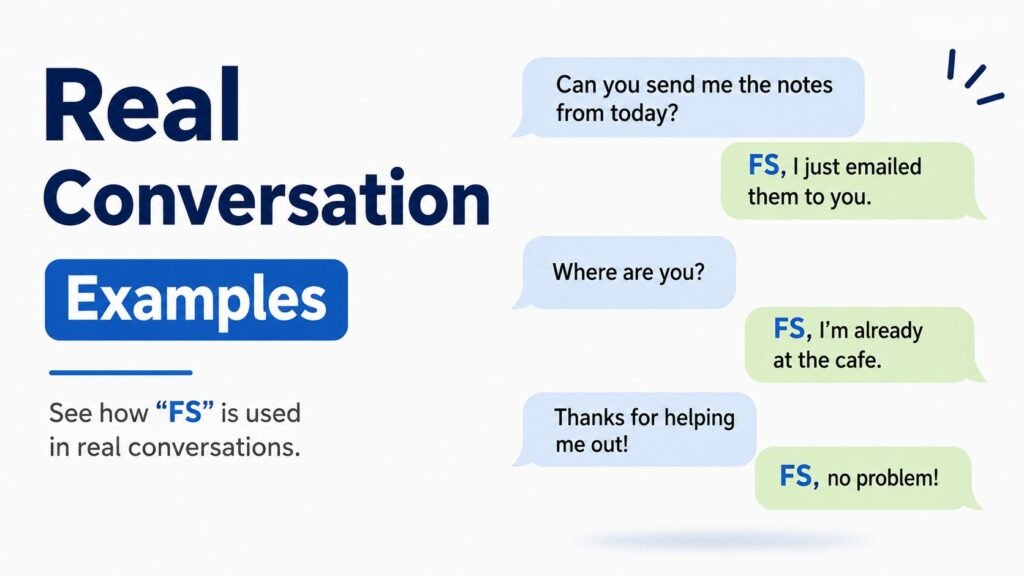
Seeing “fs” used across different real-style conversations makes the meaning click faster than any definition alone. Here are a few varied examples pulled from common digital conversations.
Example — Casual Agreement
A: “This restaurant slaps.” B: “fs, best tacos in the city”
Example — Gaming Commitment
A: “We’re pushing mid, no hesitation.” B: “fs, I’m right behind you”
Example — Sarcastic Tone
A: “I totally forgot your birthday again.” B: “fs… every year”
Example — Reassurance in a Relationship
A: “Promise you’re not mad at me?” B: “fs, we’re all good”
Each example uses the exact same two letters, yet the emotional tone shifts entirely based on what came before it. That’s the core skill in understanding chat acronym usage in general — reading the sentence around the abbreviation, not just the abbreviation itself.
FS Meaning by Context — Quick Reference Table
| Platform / Setting | Likely Meaning | Tone |
|---|---|---|
| Group text | For sure | Casual, agreeable |
| Instagram / TikTok comments | For sure | Supportive, casual |
| Gaming chat / Discord | Full send | Aggressive, committed |
| Sports commentary | Free Safety | Neutral, technical |
| Tech support forums | File System | Neutral, technical |
| Sarcastic reply among friends | For shame | Teasing, playful |
| Racing / extreme sports talk | Full speed | Energetic, intense |
Keep this table handy. Nine times out of ten, matching the platform to the likely meaning will get you the right answer before you even need to read the full sentence.
When NOT to Use FS
Here’s the part most guides skip entirely, and it’s arguably the most useful section for anyone trying to avoid an awkward mistake: knowing when “fs” simply doesn’t belong.
Avoid using “fs” in:
- Professional writing and business communication — emails, Slack messages to your manager, client-facing chats. It reads as unpolished no matter how casual your workplace culture is.
- Academic writing or anything submitted for grading. Professors and reviewers expect formal writing conventions, not shorthand.
- Official documents, contracts, reports, or anything with legal or procedural weight.
- Workplace communication with people you don’t know well yet. Even in casual industries, shorthand before establishing rapport can come across as overly familiar.
- First conversations with new contacts, whether professional or personal, where tone hasn’t been established.
A quick gut-check: if you wouldn’t say “for sure” out loud in that exact setting, don’t type “fs” either. The shorthand only works where the full phrase would already feel natural.
“Slang works because it mirrors real speech. The moment a setting calls for more formality than natural speech allows, shorthand stops working in your favor.”
Does FS Mean the Same Thing Everywhere? Regional and Generational Differences
Internet slang doesn’t spread evenly across the globe, and “fs” is a good example of that unevenness.
In the United States, “for sure” has long been part of everyday casual speech, particularly on the West Coast, which likely helped “fs” gain traction as a texting shorthand faster than in other English-speaking regions.
In the United Kingdom, “fs” shows up less consistently as “for sure,” and you’re more likely to see it interpreted as “for shame” in certain regional slang circles, particularly in more sarcastic or dry-humor contexts common in British texting culture.
Australian slang tends to favor its own set of abbreviations more heavily (“heaps,” “arvo,” “servo”), so while “fs” is understood, it doesn’t carry quite the same frequency of use as it does in American texting culture.
Generationally, there’s a noticeable gap too:
- Gen Z (born roughly 1997–2012) uses “fs” constantly and fluidly across nearly every casual platform.
- Millennials (born roughly 1981–1996) understand and use it, but often alongside the fuller phrase, switching between “for sure” and “fs” depending on the conversation’s pace.
- Older generations typically recognize it only after repeated exposure through younger family members or coworkers, and rarely initiate its use themselves.
None of this means the meaning changes drastically — “for sure” remains the dominant interpretation almost everywhere. It just means the frequency and comfort level with the abbreviation varies quite a bit depending on who’s typing.
Slang Terms Similar to FS
If you’re getting comfortable with “fs,” you’ve probably already run into its slang cousins. These terms travel in the same circles and often get mixed into the same sentences.
| Term | Meaning | Example |
|---|---|---|
| fr | For real | “fr, that movie was insane” |
| ngl | Not gonna lie | “ngl, I didn’t expect that” |
| ong | On God (I swear/for real) | “ong, best decision I made” |
| no cap | No lie, seriously | “no cap, that’s the best burger here” |
| istg | I swear to god | “istg I almost missed my flight” |
You’ll often see these stacked together in the same message for emphasis:
“fs fr no cap, that was the best concert I’ve been to”
It looks like a wall of abbreviations at first glance, but each one is reinforcing the same idea: strong agreement, strong certainty, zero exaggeration (at least according to the person typing it).
How to Figure Out What FS Means in Any Message
By now, you’ve got the full map of possible meanings. Here’s the practical framework for decoding “fs” the next time it shows up somewhere unexpected.
Step 1: Check the platform. Gaming chat leans toward “full send.” Sports content leans toward “Free Safety.” Tech forums lean toward “File System.” Everyday texting leans toward “for sure.”
Step 2: Check who’s sending it. A close friend texting casually is almost certainly using “for sure.” A coworker in a technical Slack channel is probably not.
Step 3: Check the sentence tone. Sarcastic setup? Likely “for shame.” Enthusiastic agreement? Almost always “for sure.”
Step 4: Check what came right before it. “fs” rarely stands alone as the first message in a conversation — it’s almost always a reaction to something. That preceding message is your biggest clue.
Step 5: When in doubt, ask. There’s no shame in typing back “wait, fs meaning?” Most people will happily clarify, and it beats guessing wrong in a conversation that actually matters.
FAQs
Is FS still commonly used in 2026?
Yes, “fs” remains one of the most widely used texting abbreviations across group chats, Instagram, TikTok, and Snapchat, especially among Gen Z and younger millennials.
Does FS mean something different on Discord or gaming platforms?
Often, yes. In gaming chat, “fs” frequently means “full send” (going all-in on a play), while regular texting leans toward “for sure.”
Is it okay to use FS in professional emails or Slack messages?
No. It’s best kept out of business communication and formal writing, since it reads as too casual for workplace or client-facing conversations.
Can FS mean “File System” in tech conversations?
Yes, in computing and IT contexts, FS commonly refers to File System, completely separate from its slang meaning in texting.
Is FS the same across every English-speaking country?
Not exactly. It’s most dominant in American texting culture, while British and Australian slang sometimes lean toward different interpretations or use it less frequently overall.
Conclusion
At the end of the day, understanding fs meaning in text comes down to one simple habit: read the context, not just the letters. Most of the time, it just means “for sure.” But gaming chats, sports talk, and tech forums can flip that meaning fast.
So next time “fs” pops up on your screen, don’t panic. You’ve got the full picture now. Knowing fs meaning in text means you’ll never feel lost in a group chat again. Keep this guide handy, and you’ll spot the right meaning every single time.