PU in a text message is a short, flexible abbreviation that usually means “pick up” or “pop up,” though it can also signal a reaction to a bad smell or refer to a pick-up group in gaming chat. It’s one of the most reused two-letter combos in modern texting slang.
Picture this: your phone buzzes, you glance down, and there it is, just “PU,” sitting there with zero explanation. Two letters, five possible meanings, and absolutely no clue which one your friend actually intended.
That’s exactly why this guide exists. From Snapchat pop-ups to gaming squads to old-school “P.U., what’s that smell” reactions, PU changes personality depending on where it shows up, and knowing the difference saves you from some seriously awkward replies.
The Quick Answer: What “PU” Means in Text (Before You Read Further)
If you’re in a hurry, here’s the short version: the most common meaning of PU in text is “pick up,” as in picking someone up for a ride, an errand, or a hangout. That said, the second most common meaning, “pop up,” has exploded in popularity thanks to Instagram DMs and Snapchat messages, where people use it to talk about spontaneous plans or sudden appearances.
Beyond those two, PU also shows up as an old-school disgust reaction to a bad smell (think “P.U., what’s that odor?”), a gaming meaning tied to matchmaking lobbies, and even a material abbreviation for polyurethane in shopping descriptions.
Here’s a lightning-fast cheat sheet:
| Meaning | How Common | Example Context |
|---|---|---|
| Pick up | Very common | “PU at 7?” (ride or errand) |
| Pop up | Very common | “we might PU at the park later” |
| P.U. (smell/disgust) | Common | “P.U., who cooked fish in here” |
| Gaming pick-up group | Common in gaming circles | “need one more for PU raid” |
| Put up | Rare | “can you PU the decorations” |
| Polyurethane | Niche, product-specific | “PU leather jacket” |
Context is everything here, and that’s really the whole theme of this guide. Keep reading, because the rest of this article walks through exactly how to tell these apart in real conversations.
Every Real Meaning of “PU,” Ranked by How Often People Actually Use It
Not all meanings of PU get equal airtime. Some show up constantly in your text message threads, while others are more of a “oh yeah, that’s a thing too” surprise. Below, we’ve ranked them by real-world frequency, not by how official or “correct” they sound in a dictionary.
PU = Pick Up (The Most Common One)
This is the OG meaning, and it’s stuck around because ride pickup and collect someone requests happen constantly in everyday digital communication. Parents text their kids “PU at 3,” friends confirm rides with “u still doing the PU tonight?”, and even delivery coordination sometimes shortens to PU.
Real example:
Mom: “PU after practice, same spot as always?” You: “Yep, see you at 4”
It’s efficient, it’s low-effort to type, and it fits naturally into casual SMS message culture. If someone’s talking about logistics, timing, or a specific location, “pick up” is almost always the safe bet.
Where you’ll see it most: family group chats, ride coordination with friends, casual planning texts, and even some rideshare or delivery-adjacent conversations.
PU = Pop Up (Social Media’s Favorite)
If pick up is the classic, “pop up” is the newer, flashier cousin that’s taken over online conversation on visual-first apps. Think spontaneous hangouts, unplanned appearances, or someone showing up somewhere unexpectedly.
Real example:
Friend: “we might PU at Jason’s later, no promises tho” You: “bet, lmk if it’s happening”
This version leans into the appear suddenly vibe of modern hangout culture, where nothing’s really planned until thirty minutes before it happens. It’s especially common in TikTok comments, story replies, and casual Instagram DMs where plans form and dissolve in real time.
Quick distinction to remember:
- “PU at 7” in a family context → probably pick up
- “might PU later” in a friend group → probably pop up
The tone and relationship usually tell you which one you’re dealing with.
PU = P.U. (The Disgust / Smell Reaction)
Before texting even existed, kids were shouting “P.U.!” when something smelled awful. This one predates online slang entirely, it’s just an old spoken exclamation that got typed into chats because, well, why not.
Real example:
“P.U., did someone not take the trash out??”
This meaning usually comes with unpleasant odor context clues nearby, things like gym bags, garbage, spoiled food, or a gross bathroom moment. It’s rarely subtle. If the sentence around it involves smell, disgust, or a “yuck” reaction, you’ve found your answer.
Fun fact: Linguists trace “P.U.” (sometimes written “pee-yoo”) back to mid-20th-century American slang, long before smartphones. It survived because it’s fun to say out loud, and that same expressiveness carried straight into texting.
PU = Put Up (Situational and Rare)
This one barely shows up anymore, but it still exists in specific contexts like asking someone to install, hang, or set something up.
Real example:
“Can you PU the string lights before the party?”
It’s rare enough that most people won’t guess it correctly without extra context clues in the sentence. If you see PU next to a task involving hanging, installing, or arranging something physical, this is probably it.
PU in Gaming and Streamer Culture — The Overlooked Meaning
Here’s the one most guides skip entirely, and it deserves way more attention. In gaming chat, PU almost always refers to a pick-up group, commonly shortened as PUG (Pick-Up Group). This means a temporary squad made of random players who team up for a single match, raid, or session instead of a set, coordinated gaming squad.
Real example:
“need one more for PU raid, anyone free?” “PU teams tonight are rough, nobody’s communicating”
You’ll hear this constantly in Discord servers, Xbox chat, PS Network messages, and voice comms during multiplayer lobby matchmaking. It’s especially common in games with raid mechanics (World of Warcraft), tactical shooters (Valorant, Overwatch), and any title where multiplayer team formation happens on the fly.
Case in point: Streamers frequently use “PU” live on stream when explaining why a match feels chaotic. A comment like “this is a PU group, don’t expect coordination” is basically streamer shorthand for “we didn’t queue with friends, results may vary.” If you’ve ever watched online gaming streams and wondered why chat kept typing PU, this is your answer.
PU = Polyurethane (Niche but Real)
Switching gears entirely, PU also shows up constantly in product description listings, especially for PU leather items like jackets, bags, wallets, and shoes. Here, PU stands for polyurethane, a synthetic material used as an affordable, animal-free alternative to genuine leather.
Real example:
“This bag is made from PU material, not genuine leather.”
You’ll also see it as PU foam in furniture listings, mattress descriptions, and packaging materials. It’s not slang in the internet sense at all, it’s a legitimate material abbreviation used across manufacturing and retail. If you’re shopping online and see “PU” next to a product, it almost certainly refers to synthetic leather or vegan leather, not any of the texting meanings above.
Quick comparison table for this section:
| Context | Likely Meaning |
|---|---|
| Ride, errand, timing mentioned | Pick up |
| Spontaneous plans, social app | Pop up |
| Smell, disgust, “yuck” nearby | P.U. reaction |
| Install, hang, arrange task | Put up |
| Gaming chat, matchmaking, squad talk | Pick-up group |
| Shopping listing, material description | Polyurethane |
A Table That Settles It: All Meanings Side-by-Side
Sometimes you just need the whole picture in one glance. Here’s a comprehensive breakdown covering platform, tone, and how to respond for each meaning of PU slang.
| Meaning | Platform Most Common On | Tone | Example Text | Suggested Reply |
|---|---|---|---|---|
| Pick up | iMessage, WhatsApp, SMS | Neutral, logistical | “PU at 6?” | “Yep, see you then” |
| Pop up | Instagram, Snapchat, TikTok | Casual, spontaneous | “might PU tonight” | “keep me posted!” |
| P.U. (smell) | Any platform, group chats | Playful or annoyed | “P.U. this locker room” | “lol what happened” |
| Put up | SMS, WhatsApp | Task-oriented | “can you PU the tent” | “sure, when?” |
| Gaming pick-up group | Discord, Xbox, PS Network | Casual, gaming-specific | “PU raid tonight?” | “count me in” |
| Polyurethane | Shopping sites, product listings | Informational | “PU material, water-resistant” | (no reply needed, it’s descriptive) |
This table alone answers most of what people search for, but understanding why this happens makes the whole thing click a lot faster.
Why Two Letters Ended Up Meaning So Much
Here’s a question worth asking: why does a random two-letter combo carry so much weight? The answer comes down to basic math and human laziness, both in the best possible sense.
English only has 26 letters, which means two-letter combinations are extremely limited. There are only 676 possible two-letter pairings total, and once you remove the awkward or unpronounceable ones, the useful pool shrinks even further. Texting slang naturally reuses short combos because typing fast matters more than typing precisely, and our brains are shockingly good at filling in the meaning from context.
Think about it this way: your brain doesn’t process PU alone. It processes PU plus everything around it, the platform you’re on, who’s texting you, and what the conversation’s been about. That surrounding context does almost all the heavy lifting, which is exactly why the same two letters can mean five completely different things without anyone getting confused in real life.
This isn’t unique to PU either. Chat acronym culture is full of overloaded abbreviations. “DM” can mean direct message or Dungeon Master. “TT” can mean “til tomorrow” or refer to TikTok itself in some circles. Short combos get recycled constantly because brevity wins in fast-paced messaging apps, and our brains are wired to disambiguate using context clues rather than needing every acronym to be perfectly unique.
Why Platform Changes Everything
If there’s one rule to remember from this entire guide, it’s this: the platform you’re texting on shapes which meaning of PU is most likely. Different apps attract different communication styles, and PU shifts its personality depending on where it shows up.
Snapchat and Instagram DMs
These platforms are built around visual, in-the-moment culture, so PU here leans heavily toward “pop up.” Someone might text “we’re gonna PU at the beach later” through a Snapchat message, and it almost always means a spontaneous, loosely-planned hangout rather than a scheduled ride.
iMessage and WhatsApp (Personal Texting)
This is home turf for the classic “pick up” meaning. Family coordination, ride requests, errand check-ins, all of that lands in iMessage and WhatsApp chat threads constantly. If your mom, partner, or roommate texts “PU,” it’s almost certainly about a ride or a task, not slang from social media.
Gaming Platforms — Discord, Xbox, PS Network
Here, the gaming meaning takes over completely. Discord servers, Xbox chat, and PS Network messages use PU almost exclusively to reference pick-up groups, temporary squads formed for a single match or raid. If you see PU in a gaming context and try to interpret it as “pick up” in the traditional sense, you’ll just confuse yourself.
Dating Apps — Tinder, Hinge, Bumble
On Tinder chat, Hinge messages, and Bumble chat, PU tends to lean flirty, often meaning “pick up” in a romantic sense (as in, picking someone up for a date) or occasionally referencing a pickup request for a casual meet-up. Context around the conversation, especially earlier flirty messages, usually confirms which direction it’s going.
Real example from a dating app conversation:
“PU Friday around 8? thinking that new taco spot”
Here, it’s clearly a date-related pickup, not slang for anything else.
Professional Slack or Teams Messages
This is where things get tricky, because PU almost never has a clear casual meaning in workplace messaging. If you see “PU” in Slack messages or Microsoft Teams, it’s more likely a typo, an internal shorthand specific to that company, or possibly a project code. Using casual internet slang like this in business communication is risky, since it can easily read as unclear or unprofessional. We’ll cover this more in the mistakes section below.
TikTok Comments and Twitter/X Replies
On these platforms, PU frequently shows up as the disgust reaction, especially in comment sections reacting to something gross, awkward, or cringe. “P.U., this is rough” is a common comment pattern when someone’s reacting negatively to content, rather than complimenting it.
Platform summary table:
| Platform | Most Likely PU Meaning |
|---|---|
| Snapchat / Instagram DMs | Pop up |
| iMessage / WhatsApp | Pick up |
| Discord / Xbox / PS Network | Pick-up group (gaming) |
| Tinder / Hinge / Bumble | Pick up (romantic) |
| Slack / Teams | Unclear, likely typo or internal shorthand |
| TikTok / X comments | Disgust reaction |
Is “PU” Flirty, Rude, Neutral, or Something Else?
Tone is where a lot of people trip up, especially when a text feels ambiguous, and you’re left wondering if someone’s flirting, complaining, or just being logistical.
When It’s Completely Neutral
Most of the time, honestly, PU is just neutral. Ride coordination, gaming chat, task requests, none of these carry emotional weight. If the sentence reads like a logistics question, it’s neutral.
When It’s Flirty or Suggestive
On dating slang territory, especially within romantic texting, PU can carry a flirty undertone, particularly when it’s about picking someone up for a date or when it follows a string of playful messages. Context from the rest of the conversation matters way more than the letters themselves here.
When It’s Rude or Dismissive
The disgust reaction version can occasionally feel dismissive, especially if it’s aimed at a person’s comment, idea, or behavior rather than an actual smell. “P.U., that’s a bad take” uses the smell reaction metaphorically to express disapproval, and that can land as rude depending on the relationship.
When It’s Just Confusing
Sometimes, honestly, it’s just genuinely unclear, and that’s okay. Not every ambiguous text needs decoding through pure guesswork. If you’re not sure, the next section covers exactly how to ask without looking clueless.
How to Respond to “PU” Without Looking Clueless
Nobody wants to send a reply that reveals they had no idea what the text meant. Here’s how to handle it gracefully in every situation.
When You Think It Means Pick Up
Just confirm the logistics directly:
“Yep, PU works, what time?”
This works because even if you’re slightly wrong, confirming details naturally clarifies the meaning without making it awkward.
When You Think It Means Pop Up
Match the casual energy:
“Oh nice, lmk if the PU actually happens lol”
When You’re Not Sure Which One They Mean
This is the safest, smartest move, and honestly, it works every time:
“Wait, pick you up or pop up later? 😅”
This single line solves 90% of PU confusion instantly. It’s light, funny, and gets you a direct answer without any awkwardness.
Funny Replies That Work
If you want to keep things playful, humor is your friend:
“PU as in pick up, pop up, or you just smell something? 😂”
This works especially well in group chats where the ambiguity itself becomes a bit of a joke.
Professional Replies
If PU shows up somewhere professional and it’s genuinely unclear, skip the guessing entirely:
“Just to confirm, could you clarify what PU refers to here?”
Direct, simple, and it avoids any embarrassing misunderstanding in formal messages.
Common Mistakes People Make With “PU” (And How to Avoid Them)
Assuming It Always Means the Same Thing
The biggest mistake, by far, is treating PU like a fixed-meaning word instead of a texting abbreviation that shifts by context. Fix: always check the platform and relationship before assuming.
Confusing It With “Poo” or Treating It as Offensive by Default
Some people assume PU is automatically crude or offensive because of its disgust-reaction roots. It’s not, most of the time it’s completely neutral. Fix: read the surrounding sentence before assigning a negative tone.
Using It in Professional Messages Without Context
Dropping “PU” into a work email or work chat without explanation almost guarantees confusion, since office communication rarely uses casual slang this way. Fix: spell it out fully in any professional communication.
Mixing Up Pop Up and Pick Up in Romantic Contexts
This one causes real mix-ups. Someone thinks a date is being scheduled (“pick up”) when actually it’s a loose, no-commitment plan (“pop up”), leading to mismatched expectations. Fix: clarify with a direct question if a date or plan hangs in the balance.
Overlooking the Gaming Meaning Entirely
Most guides online skip the PUG / pick-up group meaning completely, leaving gamers confused when they search for it and find nothing relevant. Fix: remember that gaming contexts almost always mean a temporary matchmaking squad, not a ride.
Similar Two-Letter Slang You Should Know
Since chat acronym culture loves recycling short combos, here are a few adjacent terms that often get confused with PU or show up in similar contexts.
| Slang | Meaning | Common Context |
|---|---|---|
| PUG | Pick-Up Group (gaming) | Basically the spelled-out gaming version of PU |
| LFG | Looking For Group | Gaming, asking others to join a squad |
| PU | Pick up / Pop up / disgust reaction | Covered throughout this guide |
| PICK | Sometimes shorthand for “pick you up” in full | Casual ride coordination |
| DM | Direct message | Slide into DMs, general messaging |
| TT | “Til tomorrow” or TikTok reference | Casual sign-offs or platform mentions |
Understanding these adjacent terms helps you avoid misreading a whole cluster of similar-looking chat message shorthand, not just PU on its own.
When You Should Skip “PU” Entirely
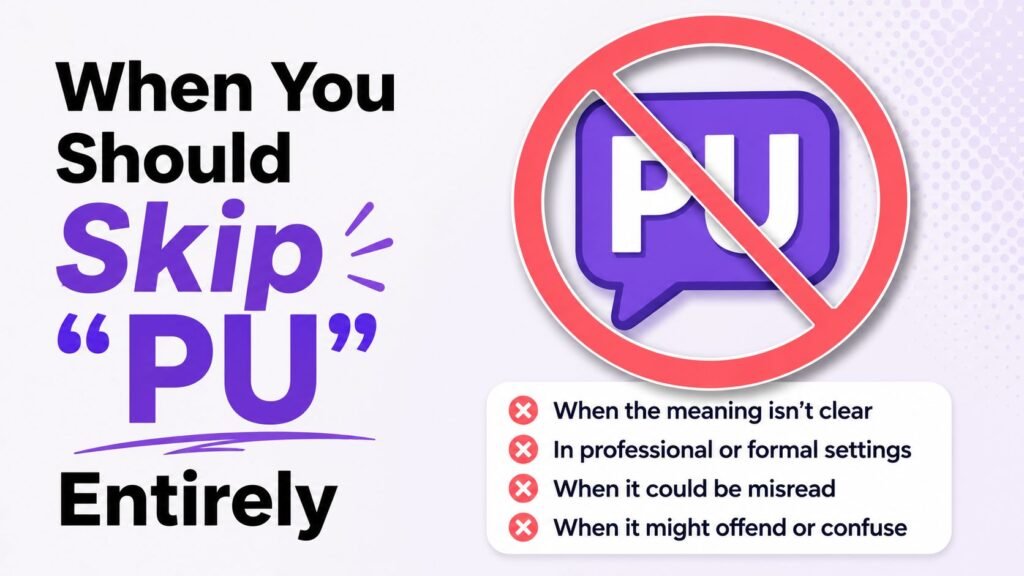
As useful as PU can be, there are moments where it’s genuinely better to spell things out fully.
Formal or Professional Communication
Business communication thrives on clarity, and casual chat acronym usage can easily come across as unprofessional or unclear. Stick to full words in work email and formal reports.
Cross-Cultural or International Conversations
Not everyone shares the same slang background, and English slang abbreviations don’t always translate cleanly across cultures or even across generations. If you’re texting someone from a different country or a different age group, spelling things out prevents unnecessary confusion.
Emotionally Charged or Sensitive Conversations
If a conversation involves conflict, apologies, or anything emotionally heavy, ambiguous slang like PU can easily get misread as dismissive or careless. Clarity matters way more than brevity in these moments.
First Impressions
Whether it’s a first date conversation on a dating app or a first message to a new coworker, first impressions benefit from clear, full sentences rather than shorthand that might get misread. There’s plenty of time for slang once the relationship’s established.
FAQs
What does PU mean in a text message?
It most commonly means “pick up” or “pop up,” depending on context. It can also react to a bad smell or refer to a gaming pick-up group.
Is PU still commonly used in 2026?
Yes, it’s still widely used, especially on Snapchat and Instagram DMs for “pop up” plans and in gaming chat for pick-up groups.
Does PU mean the same thing on every platform?
No. iMessage and family texts usually mean “pick up,” while Snapchat and TikTok lean toward “pop up” or a disgust reaction.
Is it okay to use PU in a work message?
Generally, no. It reads as unclear or unprofessional in Slack or Teams, so it’s best to spell it out fully at work.
How can I tell which meaning of PU someone means?
Look at who sent it and what platform it’s on. If it’s still unclear, just ask directly, it’s the fastest fix.
Conclusion
At the end of the day, PU meaning in text depends on context. It’s not one fixed word. It shifts with the platform, the person, and the situation. Most of the time, it’s simple: pick up, pop up, or a quick reaction to a smell. Gamers use it differently too.
So next time you see PU, don’t panic. Think about where it came from. Check who sent it. That’s the real key to PU meaning in text. And if you’re still stuck, just ask. A quick question beats a wrong guess every time.