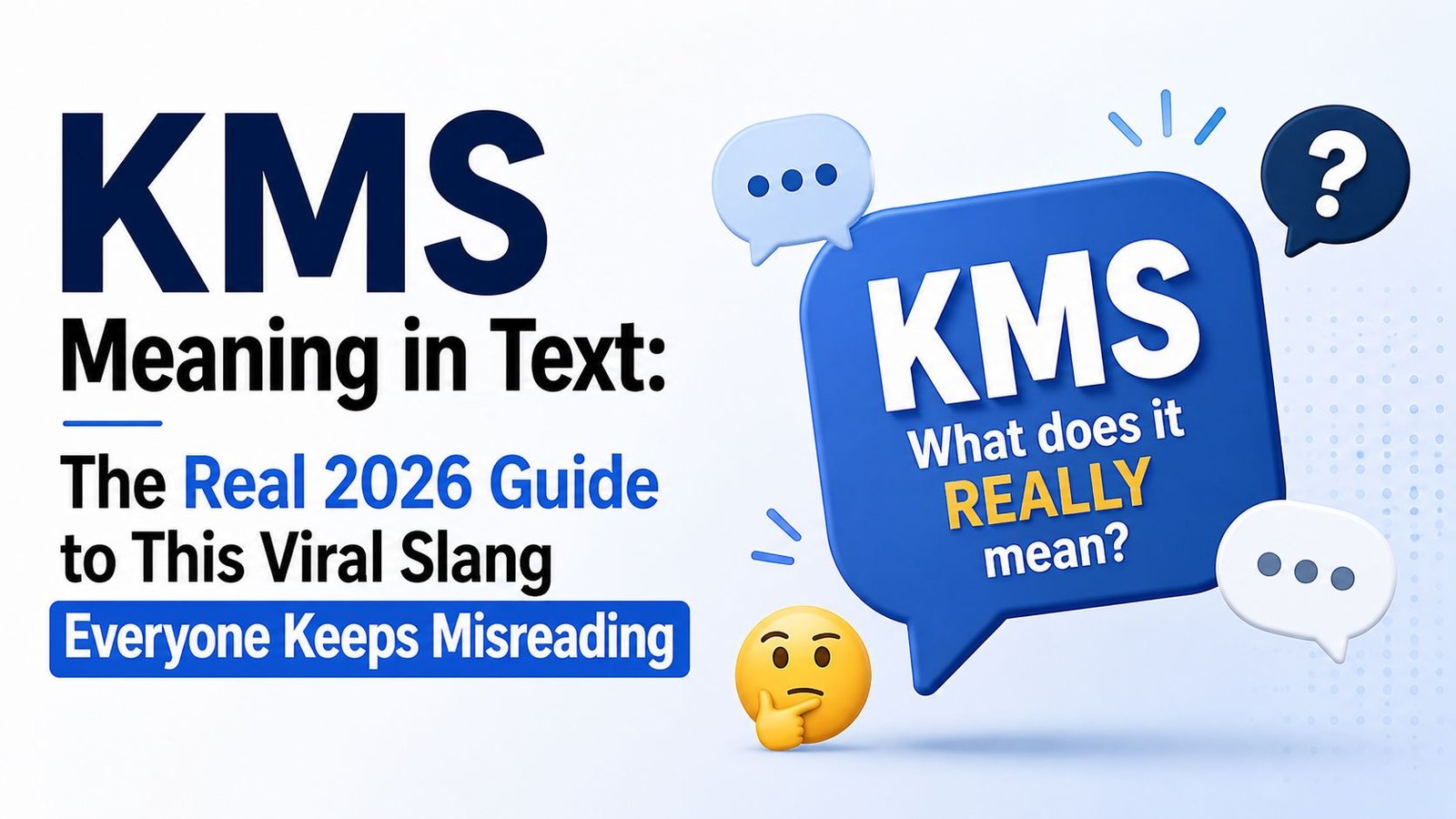
KMS stands for “kill myself,” and in text conversations, it almost never means that literally. The KMS meaning in text usually points to frustration, dark comedy, or pure exaggeration, not an actual statement of intent.
Picture this: your friend bombs a test, spills coffee on a white shirt, then gets stuck in traffic, all before noon. That’s a “kms” kind of day. The phrase has become the internet’s go-to way of screaming into the void without actually screaming.
Still, context changes everything. Between gaming chats, dating apps, and heartfelt group texts, KMS shifts tone constantly. Learning to spot the difference between a joke and a genuine cry for help turns this three-letter acronym from confusing to completely readable.
What KMS Actually Stands For (And Where It Came From)
KMS stands for “kill myself.” That’s the literal KMS full form, and no amount of internet-speak softens the raw meaning behind those three letters. But here’s the twist that trips up nearly everyone: the KMS acronym almost never means someone is planning to harm themselves. In the vast majority of cases, it’s shorthand for extreme frustration, exhaustion, or embarrassment — the texting equivalent of throwing your hands up.
Think of it like the phrase “I could just die” said out loud after spilling coffee on your shirt before a job interview. Nobody thinks you’re actually announcing a plan. It’s exaggeration, plain and simple. KMS works the same way in chat language — it’s a pressure valve, not a confession.
So where did this abbreviation come from? Like most texting slang, KMS emerged from the character-limit era of SMS and early instant messaging, back when every letter cost you space (and sometimes money). Acronyms like KYS (kill yourself), LMK (let me know), and TTYL (talk to you later) all came from the same practical need: say more with less. KMS specifically gained traction through gaming chats and forums in the mid-2010s, then exploded across TikTok, Twitter, and group texts as Gen Z slang took over the internet’s tone of voice.
By 2026, KMS has fully detached from its literal meaning for most casual users. It sits in that strange category of viral phrases that sound alarming out of context but read as completely normal once you understand the platform context they live in.
Quick Reference Table
| Term | Full Meaning | Typical Intent |
|---|---|---|
| KMS | Kill myself | Hyperbole, frustration, dark humor |
| KYS | Kill yourself | Insult directed at someone else (often hostile) |
| KMSL | Kill myself laughing | Pure comedic reaction |
| IDK | I don’t know | Neutral, informational |
| FML | F*** my life | Frustration, similar tone to KMS |
The 5 Real Meanings of KMS, Ranked by Frequency
Not every “kms” carries the same weight. Understanding KMS meaning requires reading it the way you’d read tone of voice — because that’s essentially what it replaces in a text-only medium. Here are the five most common ways people actually use it, ranked from most to least frequent.
Hyperbolic Frustration (“I Can’t Even”)
This is, by far, the most common use of KMS in texting. Someone’s printer jammed for the fifth time, their group project partner ghosted them, or they just realized they left their charger at home. “Kms” here means “I’m so done with this,” nothing more.
Example: “My professor just added a pop quiz tomorrow kms”
This isn’t a distress signal. It’s a comedic exaggeration, delivered with the same energy as slamming a laptop shut a little too hard.
Comedic/Ironic Exaggeration
Closely related to frustration but funnier and more self-aware, this version of KMS shows up as a punchline. It’s often paired with KMSL (kill myself laughing) or crying-laughing emojis. The humor comes from the absurd overreaction to something small.
Example: “He said ‘I don’t watch movies, I watch films’ kms 💀”
Here, KMS isn’t about the speaker’s feelings at all — it’s a reaction to secondhand embarrassment on someone else’s behalf. This is classic dark humor and meme culture in action: taking a serious-sounding phrase and stripping it of its weight for comedic effect.
Gaming Rage Shorthand
Anyone who spends time in multiplayer chat or Discord chat during a ranked match has seen this one. A missed shot, a lost round, or a teammate who refuses to communicate can all trigger a quick “kms” typed mid-game, then instantly forgotten once the next round starts.
Example: “got sniped through a wall again kms this game is rigged”
Gaming slang moves fast, and KMS fits neatly into the rapid-fire, low-stakes venting that defines online gaming culture. It’s less an emotional statement and more a reflex, similar to yelling at a referee on TV.
Genuine Emotional Overwhelm
This is where things get more serious, and where reading context actually matters. Sometimes KMS shows up attached to real stress — finals week, a breakup, a family conflict, burnout at work. The person isn’t joking, but they’re also not necessarily in crisis. They’re overwhelmed and using the strongest phrase they know to communicate that.
Example: “I have 3 exams tomorrow and I haven’t studied for any of them kms I’m not kidding”
Notice the qualifier “I’m not kidding” — that shift in tone is a signal worth paying attention to, which we’ll cover in detail later in this guide.
Platform-Specific Remixes
Digital slang mutates depending on where it lives. You’ll see variations like:
- KMSL — kill myself laughing (pure comedy, no ambiguity)
- KMSF — kill myself, for real (adds emphasis, still usually not literal)
- Kms 😭 — the crying emoji softens it into relatable frustration
- Kmsss — extra letters for extra emphasis, common in Snapchat slang
These remixes show how online expressions evolve to fit specific tones, and they’re one more reason why reading KMS correctly depends heavily on where you found it.
KMS vs. KYS vs. KMSL vs. “I’m Dead” — A Comparison Table
People constantly mix up KMS, KYS meaning, and KMSL meaning, but they point in completely different directions. Confusing them is one of the biggest mistakes readers make, so here’s a clear side-by-side.
| Term | Direction | Typical Tone | Red Flag Level |
|---|---|---|---|
| KMS | Self | Frustration, exaggeration, occasional genuine distress | Low, unless paired with real distress cues |
| KYS | Aimed at someone else | Hostile, insulting, sometimes “joking” among friends | Moderate to high — this is an aggressive phrase toward another person |
| KMSL | Self | Comedic, laughing at something | Essentially none |
| “I’m dead” | Self | Pure comedy, shock, disbelief | None |
| FML | Self | Frustration, bad luck | Low |
The key distinction: KMS points inward as a dramatic reaction to your own situation, while KYS is directed outward at someone else and carries a genuinely aggressive undertone, even when people claim they’re “just joking.” If you see KYS used toward someone, especially repeatedly, that’s worth taking more seriously than a casual KMS.
How KMS Shows Up on Each Platform (With Real Examples)
Platform-specific slang is real, and KMS behaves differently depending on where you encounter it. A phrase that reads as harmless on Discord might land completely differently in a private DM. Here’s a breakdown across the platforms where you’re most likely to run into it.
ALSO READ: DTM Meaning in Text: What It Really Means And How To Use It
Texting Between Friends
In one-on-one text messages, KMS usually rides on established context. Close friends know each other’s baseline humor, so “kms” after a bad day at work reads exactly the way it’s intended: pure venting.
Example exchange:
Friend: “My landlord just raised rent again kms” You: “at this point just move in with me 😭”
This is casual texting at its most low-stakes. The reply matches the energy instead of treating it as an emergency.
Snapchat and BeReal
KMS on Snapchat often pairs with a photo or Snap of something mildly disastrous — a burnt dinner, a parking ticket, a bad haircut. The visual context does a lot of the heavy lifting, making the phrase feel light and reactive rather than serious.
Instagram Comments
Instagram comments using KMS typically respond to something funny or cringe-inducing in a post — an old photo, an awkward video, a meme. It functions almost like “I can’t” or “not this” as a reaction slang shorthand.
Dating Apps
KMS on dating apps shows up in two very different flavors. Sometimes it’s self-deprecating flirting (“kms I just said something so embarrassing”), and sometimes it’s a reaction to a bad date story shared with a friend afterward. In dating conversations, tone usually stays light, but this is also a context where reading the room matters, since you’re dealing with someone you don’t know as well yet.
Discord and Gaming Chats
As covered above, KMS on Discord and in gaming community spaces functions as rapid-fire venting. It rarely lingers past the next round or match. Group texting in gaming servers tends to normalize dramatic language generally, from “I’m throwing” to “this game is unplayable,” and KMS fits right into that register.
Reddit and Twitter/X
KMS on Reddit and KMS on Twitter/X often show up in comment sections reacting to news, memes, or relatable posts. It’s almost always used as a collective, exaggerated reaction rather than a personal statement, similar to typing “not me” before admitting to something relatable.
The Workplace — Yes, It Happens
Workplace chat on Slack or Teams isn’t immune, though it shows up far more cautiously here. Someone might type “kms” after a brutal meeting or a missed deadline, almost always followed quickly by a joke or emoji to soften it. Professional communication norms mean people generally self-police here more than anywhere else, since the audience includes managers and coworkers, not just close friends.
ALSO READ: PU Meaning in Text The 2026 Guide to This Confusing Slang Everyone Misreads
Is KMS Offensive, Flirty, Rude, or a Red Flag? How to Tell
Here’s a simple framework for reading KMS accurately, because context clues matter more than the phrase itself.
Ask yourself these four questions:
- What’s the relationship? Close friends joke more freely. Strangers or new acquaintances deserve a slightly more cautious read.
- What triggered it? A minor annoyance (traffic, a bad grade, a typo) usually signals hyperbole. A major life event (breakup, job loss, family crisis) deserves more attention.
- What’s the tone around it? Emojis like 😭💀😂 soften the phrase into comedy. A lack of any lighthearted follow-up, or phrases like “I mean it” or “not even joking,” shift the tone.
- Is this a pattern or a one-off? A single “kms” during a stressful week is different from someone using it constantly across weeks or months.
Generally, KMS is not inherently offensive unless directed at someone else (which shifts it into KYS territory). It’s rarely flirty on its own, though it can appear in playful, self-deprecating banter on dating apps. It becomes a genuine red flag only when the emotional expression behind it stops looking like hyperbole and starts looking like real distress — a shift covered in detail below.
How to Respond to “KMS” — By Situation
Your reply should match the read you just made using the framework above. Here’s how to handle it across different relationships and contexts.
Close Friends (Casual/Funny Replies)
When it’s clearly hyperbole, match the energy instead of overreacting:
- “same tbh”
- “the audacity of this day”
- “we’re getting through this together”
- “okay but same energy as me right now”
Acquaintances (Low-Key Check-In)
For people you don’t know as well, a light, non-intrusive check-in works better than ignoring it or overreacting:
- “haha rough day? what happened”
- “oof, that bad?”
- “lol I feel that, what’s going on”
This keeps the door open without making things awkward if it really was just a joke.
When You’re Genuinely Concerned
If the tone shifts, or the person seems to actually mean it, drop the joking tone entirely and lead with care:
- “hey, that sounded more serious than usual — are you doing okay?”
- “I want to check in for real, what’s going on?”
- “I’m here if you want to actually talk about it”
Supportive communication in this moment isn’t about diagnosing anything. It’s about opening a door and making it clear you’re paying attention.
Professional Replies
In a workplace chat, keep it brief and redirect toward the actual issue:
- “rough one, huh? let’s regroup on this tomorrow”
- “that meeting was a lot — want to talk through next steps?”
5 Mistakes People Make Reading KMS
Digital etiquette around this phrase trips up a lot of people, usually in one of these five ways.
Taking It Literally 100% of the Time
Treating every single “kms” as a genuine crisis creates constant false alarms and can actually make friends feel like they can’t vent casually without triggering a full intervention.
Dismissing It 100% of the Time
The opposite mistake is just as risky. Assuming it’s always a joke means you might miss the rare instance when someone actually needs support.
Mixing Up KMS and KYS
These are not interchangeable. KMS points at the speaker; KYS is aimed at someone else and carries a genuinely hostile edge, even in “joking” contexts among friends.
Ignoring Age/Platform Context
A 16-year-old’s Discord server and a 45-year-old’s work Slack channel do not share the same digital communication norms. Common text abbreviations carry different weight depending on the generation and platform using them.
Missing Tone Shifts Mid-Conversation
The biggest mistake is treating the entire conversation as one static tone. People shift from joking to serious mid-conversation constantly, and the words “I’m not kidding” or “for real this time” are easy to scroll past if you’re not paying attention.
When KMS Might Signal Something Real — What to Watch For
This is the section that matters most, so let’s be direct about it.
Crisis awareness doesn’t mean treating every joke as an emergency. It means noticing when the pattern around the phrase changes. Here’s what’s actually worth paying attention to:
- Frequency increases — the phrase shows up far more often than it used to, especially outside of clearly joking contexts.
- Isolation cues — the person mentions feeling alone, unheard, or like a burden.
- Tone shifts — a normally joking friend suddenly stops using emojis or lighthearted language around the phrase.
- Direct qualifiers — phrases like “I actually mean it,” “not even joking this time,” or “I don’t know how much longer I can do this.”
- Withdrawal — the person pulls back from conversations, plans, or activities they used to enjoy.
None of these, on their own, confirm a crisis. But together, or paired with a clear shift in tone, they’re warning signs worth taking seriously.
If you’re ever unsure, ask directly. Research on suicide prevention consistently shows that asking someone directly if they’re okay, or if they’re having thoughts of harming themselves, does not increase risk — it opens the door for honest conversation.
If someone in your life seems to genuinely be struggling, here’s where to point them:
- 988 Suicide & Crisis Lifeline — call or text 988 (US), available 24/7
- Crisis Text Line — text HOME to 741741
You don’t need the perfect words to help. Simply saying “I’m here, and I care about what happens to you” can matter more than anything else you could type.
(If you’re the one feeling this way right now, please reach out to one of the resources above. You deserve real support, not just a conversation about internet slang.)
When You Should Never Use KMS
Some contexts flatten all nuance, no matter how casually you meant the phrase. Avoid using KMS in these situations:
- With strangers or new acquaintances who don’t know your sense of humor yet
- In job interviews or formal professional settings, where tone can’t be read correctly
- With someone who’s visibly upset or in crisis, where it could land as dismissive or confusing
- In official channels like customer service chats, HR communications, or school correspondence
- Around people you know are struggling, where even a joking use of the phrase could feel heavy or triggering
When in doubt, swap it for something equally expressive but less loaded — “I’m so done,” “this is a disaster,” or plain old “ugh” all get the point across without any risk of misreading.
FAQ
Is KMS a bad word to use?
Not really — among friends who share the same joking tone, it’s normal slang. It only turns into a problem when aimed at someone else or used in the wrong setting.
What does KMS mean on Snapchat or Instagram?
Same meaning as everywhere else — “kill myself” used as exaggeration. It usually pairs with a funny photo or a relatable, cringe-worthy moment.
Is KMS the same as KYS?
No. KMS points inward as hyperbole, while KYS is aimed at someone else and carries a much more hostile tone.
Why do people use KMS instead of just saying they’re annoyed?
It’s faster, funnier, and hits harder for comedic effect — internet culture favors dramatic shorthand over plain description.
Should I worry if someone texts me KMS?
Only if the tone shifts — watch for phrases like “I’m not joking” or a sudden drop in humor, since those signal it might be genuine.
Conclusion
Understanding the KMS meaning in text comes down to context, not just letters. Most of the time, it’s a joke. Sometimes, it’s real stress. The key is watching tone, not panicking at the phrase itself.
Next time you see it pop up in a chat, you’ll know exactly what to do. The KMS meaning in text changes with the moment, the platform, and the person typing it. Read the room, respond with care, and you’ll never misread it again.