Stay tuned meaning, in the simplest terms, is a phrase that asks someone to keep watching, listening, or paying attention because something important is about to follow. It works as a gentle command, not a demand.
Here’s the fun part: this two-word phrase has survived nearly a century of media revolutions without losing an ounce of its punch. Radio announcers coined it, television inherited it, and social media turned it into pure curiosity fuel.
Understanding where it comes from changes how you use it. Once you know the literal radio-dial origin behind “stay tuned,” the phrase stops feeling like filler and starts feeling like a small piece of broadcasting history, still doing its original job today.
What Does “Stay Tuned” Mean?
At its core, “stay tuned” means keep watching, listening, or paying attention because something important is coming. It’s a request — sometimes gentle, sometimes urgent — for your audience to remain engaged instead of wandering off.
Here’s a clean, quotable definition:
Stay tuned (phrase): An invitation to remain attentive to a source of information, entertainment, or updates, because relevant content is about to follow.
That’s the dictionary-style version. But the phrase carries more emotional weight than a plain definition suggests. When someone tells you to stay tuned, they’re not just asking you to wait. They’re building anticipation. They’re saying, “Trust me, this is worth sticking around for.”
That’s the psychological hook baked into the phrase, and it’s a big part of why marketers, broadcasters, and content creators still lean on it so heavily.
The Literal vs. Figurative Meaning
Here’s where it gets interesting. “Stay tuned” isn’t just a poetic turn of phrase — it used to describe something completely literal.
Old radios worked by “tuning” a dial to match a specific radio frequency. If you turned the dial even slightly, you’d lose the signal and pick up static, or worse, an entirely different broadcast station. So when a radio announcer said “stay tuned,” they meant it in the most physical sense possible: don’t touch that dial. Keep the receiver locked onto this exact frequency, or you’ll miss what’s next.
Over time, the phrase drifted away from its technical roots. Today, nobody’s fiddling with an actual tuning dial when a podcast host says “stay tuned” before a sponsor break. The figurative meaning — pay attention, keep watching, wait for updates — has completely taken over in everyday conversation. But knowing the literal origin makes the phrase feel a lot less random the next time you hear it.
Quick Definition for Fast Reference
| Term | Meaning |
|---|---|
| Stay tuned | Keep watching or listening; wait for upcoming information |
| Part of speech | Idiomatic phrase, functions as an imperative (command) |
| Tone | Casual to semi-formal, depending on context |
| Common contexts | Broadcasting, social media, marketing, everyday speech |
| First recorded use | Early-to-mid 20th century, tied to radio broadcasting |
The Origin of “Stay Tuned”
To really get the stay tuned phrase explained properly, you have to go back to the golden age of radio.
In the 1920s and 1930s, radio broadcasting was exploding in popularity across the United States. Families gathered around bulky wooden radio sets in their living rooms the way people gather around streaming services today. But early radios required manual tuning — you’d rotate a dial to find the right frequency, and even a slight nudge could knock you off the station entirely.
Announcers quickly realized they had a problem: listeners might drift to another station during a commercial or a slow segment. So they started saying things like:
- “Stay tuned to this station.”
- “Don’t touch that dial.”
- “Keep your radio tuned to this frequency.”
These phrases weren’t marketing flourishes at first. They were practical instructions, almost like a technical warning. Over the following decades, as audio broadcasting matured and radio programs became a dominant form of home entertainment, “stay tuned” solidified into standard broadcasting terminology.
From Radio to Television
When television took over as the dominant home entertainment medium in the 1950s and 60s, the phrase made a smooth jump. Television shows adopted “stay tuned” for the exact same purpose radio had used it for: keeping viewers from changing the channel during a commercial break or between segments.
You’ll still hear it in this exact form today. Local news broadcasts, in particular, love the phrase:
“Stay tuned — we’ll have the full weather forecast right after this.”
That’s a textbook use of the original broadcasting sense of the phrase, still alive and well decades later.
From Broadcast Media to Everyday Speech
Here’s the fascinating part. As broadcast media saturated American culture, the phrase escaped the studio entirely. People started using “stay tuned” in daily communication that had nothing to do with radios or TVs.
By the late 20th century, it had become a fully idiomatic expression — meaning its literal components (staying + tuned) no longer mattered. Nobody thinks about radio dials when a coworker says, “Stay tuned, I’ll have the report ready by Friday.” The phrase had transformed into a general-purpose way to say wait for updates.
This is a pretty common linguistic pattern, by the way. Plenty of familiar expressions started as industry-specific jargon before becoming common expressions in general use. Think of phrases like “on the same page” (publishing) or “across the board” (horse racing) — both drifted from their origin industries into everyday English the same way “stay tuned” did.
How to Use “Stay Tuned” in a Sentence
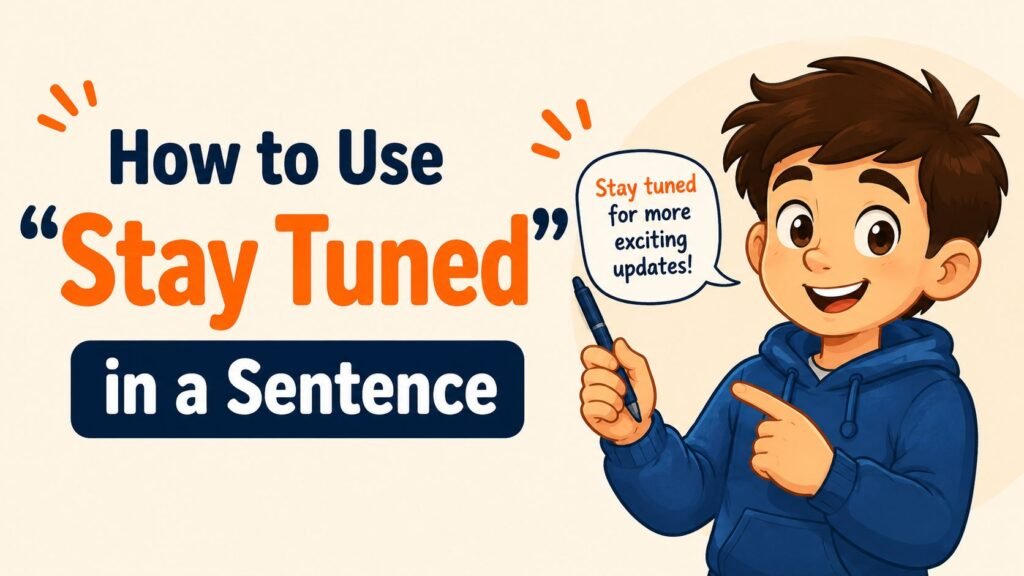
Now let’s get practical. Understanding the meaning of stay tuned is one thing — using it naturally is another.
Grammar Notes
“Stay tuned” typically functions as an imperative phrase, meaning it gives a command or instruction, even though it often sounds friendly rather than bossy. Grammatically, it’s built from:
- Stay — a verb (imperative form, addressing “you” implicitly)
- Tuned — a past participle acting as an adjective, describing the state of being tuned in
You’ll usually see it paired with a preposition depending on what follows:
- Stay tuned to + a specific channel, station, or source (“Stay tuned to Channel 4”)
- Stay tuned for + a specific piece of content or event (“Stay tuned for more updates”)
- Stay tuned on its own, as a standalone sentence (“Stay tuned!”)
Here’s a quick reference table:
| Structure | Example | When to Use |
|---|---|---|
| Stay tuned. | “Stay tuned!” | Standalone, casual, often used as a sign-off |
| Stay tuned for + noun | “Stay tuned for our big announcement.” | When something specific is coming |
| Stay tuned to + source | “Stay tuned to our newsletter.” | When directing attention to a channel or platform |
| Stay tuned as + clause | “Stay tuned as we reveal the winner.” | When describing an ongoing process or reveal |
Formal vs. Casual Usage
This is where a lot of writers stumble. “Stay tuned” sits in a strange middle zone — it’s casual enough for texting a friend, but it also shows up constantly in professional messaging and corporate communication. The trick is matching the phrase’s energy to your context.
Casual contexts (texting, social media, conversation among friends):
“Big news coming your way this weekend — stay tuned!”
Semi-formal contexts (email newsletters, product announcements, brand social accounts):
“We’re putting the finishing touches on our next release. Stay tuned for full details next week.”
Formal contexts (press releases, official business communication):
Here’s where you want to be careful. In highly formal workplace writing — think legal notices, investor updates, or official government statements — “stay tuned” can read as too breezy. In those cases, a more neutral phrase like “further details will follow” or “additional information will be provided in due course” fits the tone better.
That said, “stay tuned” has been creeping into business communication more than it used to, especially at companies that lean into a friendlier, more conversational brand voice. A tech startup announcing a product roadmap might happily use “stay tuned” in an official blog post, while a bank issuing a regulatory notice almost certainly wouldn’t. The deciding factor usually isn’t the size of the company — it’s how much personality the brand’s communication strategy allows into its official messaging. If you’re ever unsure which way to lean, a good rule of thumb is this: if the document could end up being read by a lawyer, skip it; if it’s headed for a social feed or a friendly newsletter, it’s usually a safe bet.
Real Example Sentences Across Contexts
Seeing the phrase in action across different settings makes it much easier to use naturally. Here are examples spanning the range from casual chat to formal business use.
Social media caption:
“New merch drop is almost here 👀 stay tuned, it’s going to be worth the wait.”
Email newsletter sign-off:
“That’s all for this month’s update. Stay tuned for exciting announcements coming your way in the next issue.”
Product launch teaser:
“Something big is brewing at our lab. Stay tuned — you won’t want to miss what’s next.”
Conversation between friends:
“I might have some huge news about the wedding. Stay tuned, I’ll tell you everything tomorrow.”
News broadcast:
“Stay tuned — we’ll return with breaking news on the storm system moving through the region.”
Business announcement:
“Our team has been working on a major update to the platform. Stay tuned for a formal announcement in the coming weeks.”
Podcast outro:
“That wraps up this episode. Stay tuned for next week, where we’re bringing on a guest you’re going to love.”
Customer service update:
“We’re currently investigating the issue you reported. Stay tuned — we’ll follow up with a resolution shortly.”
Notice how the tone shifts slightly in each one, but the underlying function stays constant: build anticipation, and ask the audience to remain engaged.
“Stay Tuned” in Marketing and Business
This is arguably where the phrase does its heaviest lifting today. Content marketing, audience engagement strategies, and social media campaigns rely on “stay tuned” constantly, and there’s real psychology behind why it works so well.
Why Brands Use It
Marketers aren’t just being lazy when they slap “stay tuned” onto a caption. They’re tapping into something called the Zeigarnik effect — a well-documented psychological principle showing that people remember incomplete tasks or unresolved information better than completed ones. An unfinished story creates mental tension, and that tension makes people want to come back for resolution.
That’s curiosity marketing in a nutshell, and “stay tuned” is one of the cleanest, most efficient phrases for triggering it. It signals:
- Something exciting is coming (creates anticipation)
- You don’t want to miss it (creates urgency, however soft)
- This relationship is ongoing (encourages ongoing engagement, not a one-time interaction)
Here’s a short list of what “stay tuned” typically communicates in a marketing context:
- A new product, feature, or service is launching soon
- A discount, sale, or promotion is coming
- Content (video, blog post, podcast episode) is in the works
- An announcement or reveal is scheduled but not yet public
- The brand wants to maintain a relationship with its online community, not just make a one-off sale
Case Study: Newsletter Sign-Offs
Plenty of content creators and companies use “stay tuned” as a deliberate engagement strategy to boost audience retention. A common pattern looks like this: a newsletter ends with a teaser line (“Stay tuned — next week we’re announcing our biggest partnership yet”) specifically to increase open rates on the following email. Subscribers who feel like they’re mid-story are statistically more likely to open the next message than subscribers who feel like each email is a standalone, disconnected update.
This is why you’ll see the phrase constantly in:
- Email marketing sign-offs
- Instagram and TikTok captions before a product drop
- YouTube video endings, right before the subscribe prompt
- Podcast outros, teasing next week’s guest or topic
Case Study: Social Media Teaser Campaigns
Social media platforms have arguably become the biggest home for “stay tuned” in the modern era, and the strategy behind it is worth unpacking. Many content creators and brands run what’s known internally as a “teaser sequence” — a string of posts that build toward a single announcement, each one ending with some version of “stay tuned.”
Here’s roughly how that sequence tends to play out:
- Day one: A vague, curiosity-sparking post (“Something’s changing around here…”) with no real details.
- Day three: A slightly more specific teaser (“It involves a partnership we’ve been working on for months. Stay tuned.”)
- Day five: A countdown post (“48 hours until we share everything. Keep checking back for updates.”)
- Reveal day: The full announcement, tagged back to every previous teaser post.
The reason this sequence works so well ties directly back to that Zeigarnik effect mentioned earlier. Each post in the sequence deliberately withholds resolution, which keeps the online community checking the account repeatedly rather than seeing one post and moving on. Brands running these sequences regularly report meaningfully higher engagement on the final reveal post compared to a single unteased announcement — largely because the audience has been primed across several days rather than encountering the news cold.
This same structure shows up constantly in television shows, too. Networks tease a season finale for weeks using nearly identical language — “stay tuned,” “coming soon,” “you won’t believe what happens next” — precisely because it keeps viewer interest high heading into the big moment.
“Stay Tuned” as a Call to Action
In marketing terms, “stay tuned” functions as a soft call to action. It’s not as direct as “Buy now” or “Sign up today,” but it does ask for something: continued attention. It’s a low-pressure way to say don’t disengage from us, which makes it especially useful for customer engagement strategies built around long-term relationships rather than one-time conversions.
Compare these two closing lines from a hypothetical product email:
Direct CTA: “Buy the new collection today.” Stay tuned CTA: “The new collection drops next week. Stay tuned — you’ll want to be first in line.”
The second version does something the first doesn’t: it keeps the reader emotionally invested before the product even exists yet. That’s the unique value “stay tuned” brings to marketing communication — it sells anticipation, not just a product.
Synonyms and Alternatives to “Stay Tuned”
Repeating the exact same phrase over and over gets stale fast, both in writing and in speech. Here’s a solid list of stay tuned synonyms you can rotate through depending on tone and context.
Something Exciting Is Just Around the Corner
This works well when you want to build hype without explicitly asking someone to “watch” or “check back.” It leans more into the feeling of anticipation than a direct instruction.
“We can’t say much yet, but something exciting is just around the corner.”
The Next Chapter Is Coming Soon
A softer, more narrative-driven alternative, often used by brands or creators who like storytelling language.
“This season’s been a wild ride. The next chapter is coming soon.”
Keep Checking Back for Updates
This is one of the most literal and functional alternatives, and it’s especially common in workplace writing or customer-facing updates where clarity matters more than flair.
“We’re still investigating the issue. Keep checking back for updates.”
Keep Your Eyes Peeled
A more playful, idiomatic option, popular in casual writing and social captions.
“Keep your eyes peeled — the announcement drops Friday.”
Keep Your Ears Open
Works particularly well for anything audio-related — podcasts, music releases, radio segments — since it maintains the listening imagery.
“Keep your ears open for a brand-new episode dropping this week.”
Check Back Soon
Direct, simple, and commonly used on websites or apps that are mid-update.
“This page is under construction. Check back soon for new content.”
Additional Alternatives Worth Knowing
Here’s a broader table of substitutes, organized by tone:
| Synonym/Alternative | Best Used In |
|---|---|
| Watch this space | Marketing, social media |
| More to come | Business updates, casual writing |
| Stick around | Casual conversation, streaming, podcasts |
| Don’t touch that dial | Humorous, retro-styled writing |
| Stay connected | Newsletters, community updates |
| Hang tight | Casual, reassuring tone |
| Keep following | Social media accounts, influencers |
| Stay informed | Formal updates, news outlets |
| Don’t miss out | Marketing, urgency-driven copy |
| Return for updates | Websites, blogs, apps |
Mixing these into your writing instead of repeating “stay tuned” every time keeps content feeling fresh rather than formulaic — which, as it happens, is exactly what good SEO writing and good human writing both reward.
“Stay Tuned” vs. Similar Phrases
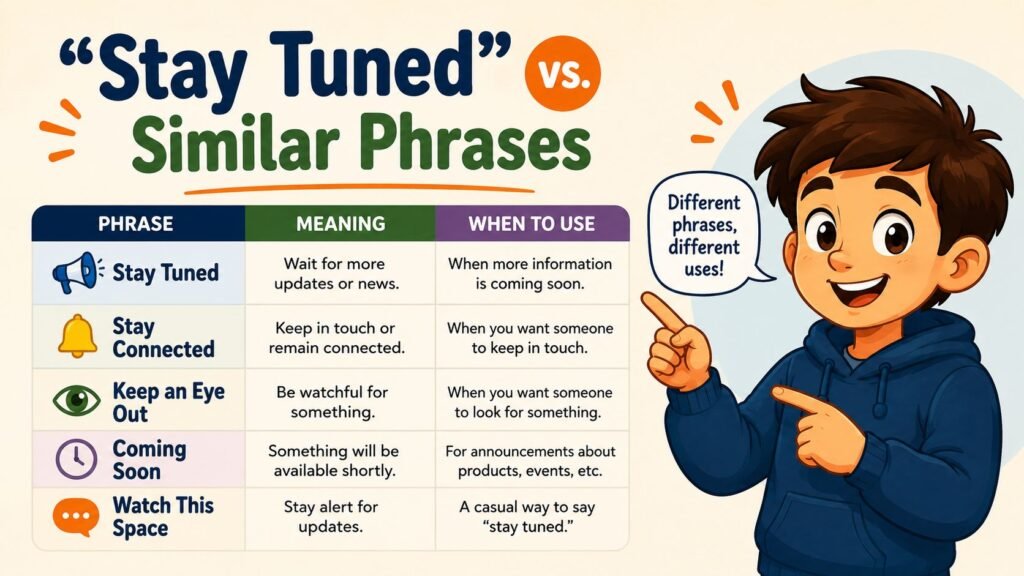
A few expressions get lumped in with “stay tuned” even though they carry slightly different shades of meaning. Understanding the distinctions helps you pick the right one.
Stay tuned vs. Stay posted “Stay posted” is actually a slight misuse — the correct traditional phrase is “keep me posted” or “I’ll keep you posted,” meaning someone will actively update you. “Stay tuned,” by contrast, puts the responsibility on the listener to keep paying attention, not on the speaker to deliver updates.
Stay tuned vs. Keep in touch “Keep in touch” is about maintaining an ongoing relationship or communication channel long-term (think: saying goodbye to a friend). “Stay tuned” is short-term and content-specific — it’s about a particular upcoming reveal or update, not a general relationship.
Stay tuned vs. Stay in the loop “Stay in the loop” implies being included in ongoing information sharing, often within a group or team (“I’ll keep you in the loop on the project”). “Stay tuned” is more one-directional — a broadcaster or brand speaking to an audience, rather than peers sharing updates with each other.
Here’s a side-by-side comparison:
| Phrase | Direction | Typical Context |
|---|---|---|
| Stay tuned | One-to-many (broadcaster to audience) | Media, marketing, announcements |
| Keep me posted | One-to-one (person to person) | Personal or professional updates |
| Stay in the loop | Group-based | Team communication, projects |
| Keep in touch | Mutual, ongoing | Personal relationships |
Why “Stay Tuned” Works
It’s worth pausing to ask: why has this specific phrase survived nearly a century of shifting media, from radio to TV to social platforms, without losing relevance? A few reasons stand out.
It’s short and rhythmic. Two syllables each, easy to say, easy to remember. Compare it to something clunkier like “please continue to monitor this channel for further developments” — technically similar in meaning, but nowhere near as catchy.
It taps into genuine curiosity. As mentioned earlier, humans are wired to seek closure on unfinished information. “Stay tuned” explicitly frames something as unfinished, which triggers that itch to find out what happens next.
It’s flexible across media. The phrase works identically whether you’re listening to AM radio in 1952 or scrolling Instagram in 2025. Few pieces of vocabulary age that gracefully across such different technologies.
It builds a sense of relationship. When a creator or brand says “stay tuned,” it implies an ongoing connection rather than a single transaction. That subtly encourages reader attention and viewer interest to persist beyond a single piece of content.
It’s low-pressure. Unlike aggressive marketing language, “stay tuned” doesn’t demand immediate action. It simply asks for patience and attention, which tends to feel more inviting than pushier alternatives.
Put together, these traits explain why “stay tuned” remains one of the most durable phrases in media communication, even as the platforms carrying it keep changing shape.
There’s also a simple explanation that gets overlooked: it doesn’t require translation into a new vocabulary every time technology shifts. When radio gave way to television, nobody needed to invent a fresh phrase — “stay tuned” carried over without friction. The same thing happened again when broadcast media gave way to digital content and online platforms. A phrase that can survive three separate media revolutions without sounding dated is rare, and that durability is exactly why copywriters, broadcasters, and everyday speakers keep reaching for it instead of retiring it in favor of something newer.
Common Mistakes to Avoid
Even a simple phrase like this one trips people up occasionally. Here are the mistakes worth watching for.
Using it in overly formal writing. Legal documents, official government notices, and highly formal business correspondence usually call for more neutral language, such as “further information will be provided” rather than “stay tuned.”
Writing “stay tune” instead of “stay tuned.” This is a surprisingly common typo. The correct form always includes the “-ed” ending, since “tuned” functions as a past participle here, not a base verb.
Overusing it until it loses impact. If every single social post or email ends with “stay tuned,” audiences eventually tune it out (no pun intended). Rotating in the synonyms covered earlier keeps your writing from feeling repetitive.
Using it without ever following through. This one’s more of a trust issue than a grammar issue, but it matters. If a brand or creator constantly says “stay tuned” for updates that never actually materialize, audiences learn to stop taking the phrase seriously. The phrase only works if the payoff eventually shows up.
Pairing it with the wrong preposition. Remember: “stay tuned to” pairs with a channel or source, while “stay tuned for” pairs with a specific piece of content or event. Mixing these up (“stay tuned to our next update” instead of “stay tuned for our next update”) is a small but noticeable grammar slip.
FAQs
Is “stay tuned” still commonly used today?
Yes — it’s more common than ever, especially across social media, email marketing, and streaming platforms, where creators use it constantly to hold audience attention.
Is “stay tuned” one word or two?
Always two words — “stay” and “tuned.” There’s no correct single-word or hyphenated version.
Can I use “stay tuned” in professional emails?
Yes, especially in marketing or team updates, but for formal legal or corporate notices, “further details will follow” reads better.
What’s a trending alternative to “stay tuned” on social media?
“Watch this space” and “more to come” are widely used right now, especially in short-form video captions and Instagram teaser posts.
Did “stay tuned” originally come from radio?
Yes — it started as a literal instruction to keep a radio dial locked on one frequency, long before it became a general expression.
Conclusion
So there you have it — the full stay tuned meaning, from its radio-dial roots to its life on social media today. Simple phrase, surprisingly rich history. It’s stuck around for a reason: it’s short, friendly, and it works.
Next time you type or hear it, you’ll know exactly what’s behind it. The stay tuned meaning isn’t just “wait a bit.” It’s an invitation to stay curious. That small nudge is why brands, broadcasters, and friends still reach for it, decade after decade.