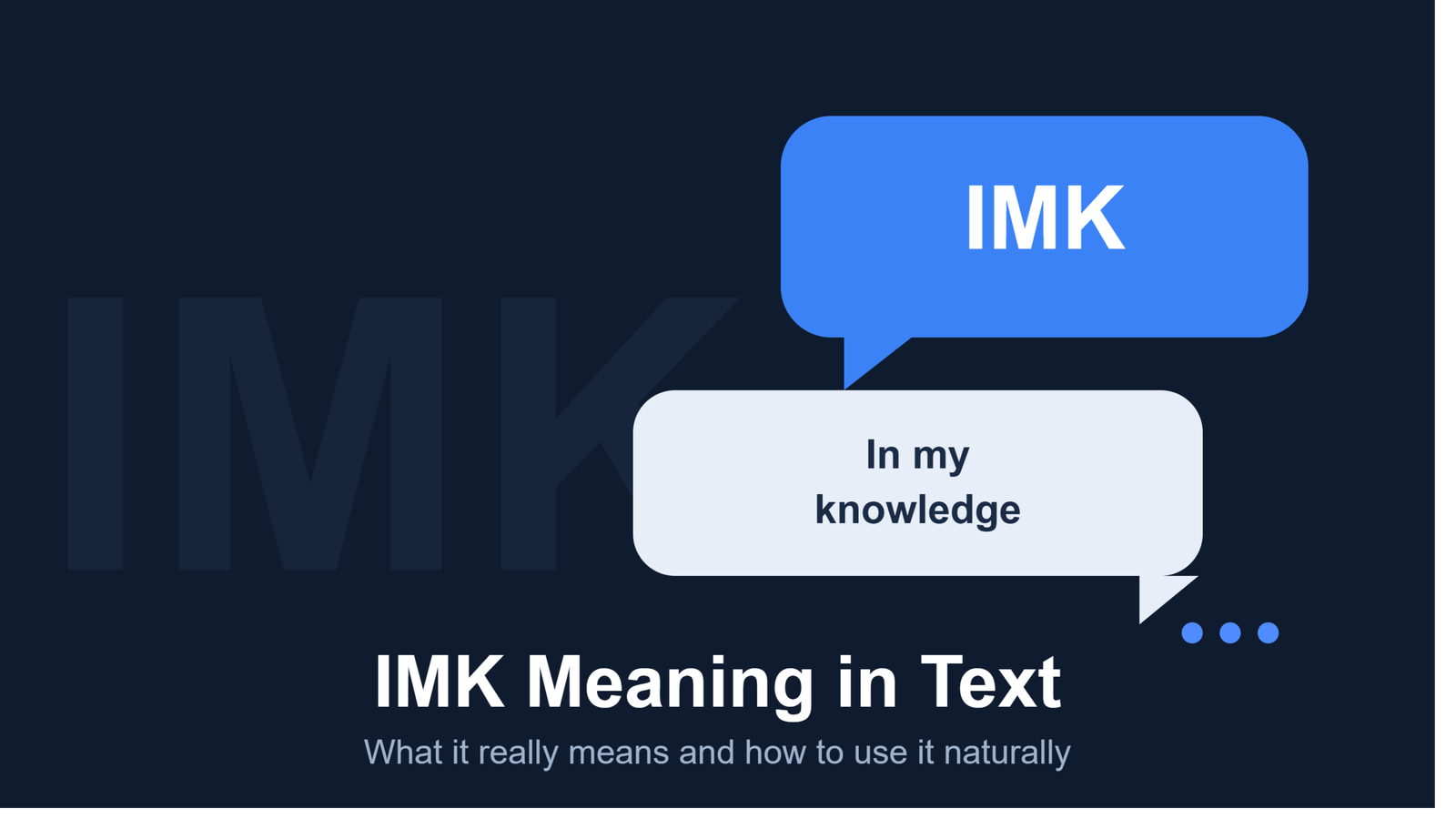
IMK meaning in text refers to “In My Knowledge,” a short abbreviation people use to share information they believe is true without claiming full certainty. It softens a statement, letting the reader know the sender is fairly confident but not 100% sure.
Texting moves fast, and so does slang. One tiny abbreviation can carry an entire tone shift, and getting it wrong makes you look out of the loop in seconds.
This guide breaks down every angle of IMK meaning in text, from its most common use to its rarer variations. You’ll learn how to spot the right meaning, avoid awkward mix-ups, and use IMK meaning in text the way real texters actually do.
What Does IMK Mean in Text?
At its core, IMK stands for “In My Knowledge.” People use it to soften a statement, signaling that what follows is based on personal understanding rather than confirmed fact.
Simple Breakdown
Here’s the quickest way to understand it:
| Letter | Stands For |
|---|---|
| I | In |
| M | My |
| K | Knowledge |
So when someone types “IMK, the store closes at 9,” they’re saying: “Based on what I know, the store closes at 9—but I’m not 100% certain.”
That small hedge matters. It’s the difference between stating a fact and sharing an impression.
Example
Here’s how it plays out in a real conversation:
Jordan: Does the gym have a pool? Casey: IMK, no. Never seen one there.
Casey isn’t guaranteeing anything. They’re offering their best understanding while leaving room to be wrong. That’s the entire function of this internet acronym in one exchange.
IMK Has More Than One Meaning (Don’t Skip This)
Here’s where a lot of guides get lazy. They give you one definition and call it a day. But IMK isn’t a single-meaning acronym—it shifts depending on who’s typing and what platform they’re using.
In My Knowledge — The Dominant Meaning
This is by far the most common IMK meaning across texting, social media, and online discussions. It works almost identically to “AFAIK” (as far as I know), just shorter and a bit more casual.
You’ll see it most often when someone answers a question they’re fairly confident about but haven’t verified recently.
I’ll Let You Know — A Real Alternate
Less common, but genuinely used: some people type IMK as shorthand for “I’ll let you know,” especially in fast typing or when autocorrect nudges things along. Context usually makes this obvious:
Alex: Are you coming tonight? Sam: IMK after I check my schedule.
Here, “IMK” clearly can’t mean “in my knowledge”—the sentence wouldn’t make sense that way. It means Sam will follow up later.
I Might Know — Occasional Casual Variant
A smaller subset of users type IMK to mean “I might know,” usually in response to a question where they’re unsure if they have the answer at all:
Riley: Anyone know a good electrician? Taylor: IMK, let me check.
This overlaps closely with “In My Knowledge” but leans more toward uncertainty about whether they have any relevant information at all, not just whether their information is accurate.
I’m Just Kidding — Rare, But Real
Rare, but it exists in certain regional or niche online communities. If a message suddenly feels sarcastic or joking and “IMK” doesn’t fit the usual pattern, this might be the intended meaning. It’s uncommon enough that you shouldn’t assume it without strong context clues.
How to Tell Which One Someone Means
Use this quick mental checklist:
- Does the sentence sound like an opinion or fact? → Likely “In My Knowledge”
- Is it responding to a question about future action? → Likely “I’ll Let You Know”
- Is it responding to “does anyone know…?” → Likely “I Might Know”
- Does the tone feel joking or sarcastic? → Possibly “I’m Just Kidding”
Context does almost all the heavy lifting here. Nobody memorizes a chart before replying—you just read the sentence around it.
IMK vs. Similar Slang
Texting shorthand overlaps constantly, and that’s where confusion creeps in. Here’s how IMK stacks up against similar abbreviations you’ve probably seen:
| Abbreviation | Meaning | Best Used When |
|---|---|---|
| IMK | In my knowledge | Sharing unverified but confident info |
| IMO | In my opinion | Sharing a subjective viewpoint |
| AFAIK | As far as I know | Formal version of IMK |
| IDK | I don’t know | Admitting no knowledge at all |
| ILY | I love you | Expressing affection |
Key Insight
The biggest mix-up happens between IMK and IMO. They look similar and get typed quickly without a second thought, but they mean different things:
- IMK = “This is what I understand to be true.”
- IMO = “This is my personal take or preference.”
Swap them by accident, and you might state an opinion like it’s a fact, or hedge a fact like it’s just your feelings. Small letters, but the meaning shift is real.
How People Actually Use IMK in Conversations
Understanding a definition is one thing. Watching how it actually shows up in digital conversations is another. Here’s where you’ll run into it most.
Casual Texting
Between friends, IMK shows up as a quick, low-effort hedge. It saves the sender from typing out “well, I’m not totally sure, but I think…” every single time.
Group Chats
In group settings, IMK often answers questions nobody wants to fully commit to. If five people are debating where to eat and someone throws in “IMK that place closed down,” it moves the conversation forward without anyone needing to Google it first.
Social Media Replies
On platforms like Instagram, X, or TikTok, IMK pops up in comment threads responding to trivia, debates, or fan theories. It’s a quick way to contribute without sounding overly confident.
Online Discussions
On Reddit threads and forums, you’ll see IMK used to answer niche questions—gaming mechanics, historical trivia, technical troubleshooting—where the responder has decent knowledge but isn’t citing a source.
Why People Prefer IMK
It’s short. It’s soft. It communicates humility without sounding unsure of yourself entirely. In fast-paced internet conversations, that balance is valuable.
Real Examples That Sound Natural
Theory only gets you so far. Let’s look at how this plays out in actual usage examples.
Answering a Question in a Group Chat
Maya: Is the concert still happening this weekend? Devon: IMK yeah, nothing’s changed on the site.
Making Plans With Friends
Priya: Does the trail loop back to the parking lot? Sam: IMK it does, did it last summer.
A Semi-Casual Work Message
Colleague: Do we still need sign-off from legal on this? You: IMK we don’t for internal docs, but I’ll double-check.
A Social Media Comment
“IMK this actor was originally cast for a different role before the switch.”
What Makes These Examples Effective
Each message pairs IMK with a short, direct follow-up. Nobody just types “IMK” and stops. The abbreviation works best as a lead-in, not a standalone answer.
The Subtle Tone Behind IMK
There’s more happening here than just information-sharing. Tone matters just as much as the words themselves.
When You Use IMK, You’re Saying
- “I’m being honest about my confidence level.”
- “I don’t want to sound like I’m lecturing you.”
- “I’m keeping this casual, not clinical.”
Tone Breakdown
| Signal | What It Communicates |
|---|---|
| Humility | You’re not claiming to be an expert |
| Casualness | You’re keeping the exchange relaxed |
| Honesty | You’re flagging uncertainty upfront |
Why This Tone Works
People respond better to hedged statements than confident wrong ones. Nobody enjoys being corrected after trusting a flat “yes” that turns out to be false. IMK builds in a small safety net for both people in the conversation.
When You Should Use IMK (And When You Shouldn’t)
Use IMK When
- You’re fairly confident but not certain
- The context is casual or semi-casual
- You want to soften a statement without sounding evasive
- You’re contributing to online discussions without citing a formal source
Avoid IMK When
- You’re communicating something safety-critical (medical, legal, financial)
- The setting is formal or professional
- You actually know the answer for certain (just say so directly)
- The recipient isn’t familiar with texting shorthand
Quick Checklist
- [ ] Is this casual enough for shorthand?
- [ ] Am I actually unsure, or do I know for certain?
- [ ] Does the other person understand common texting abbreviations?
- [ ] Would a formal phrase work better here?
If you hesitate on any of these, skip the abbreviation and type it out.
Common Mistakes and Misinterpretations
Even simple internet acronyms get misused constantly. Here’s what trips people up.
Confusing IMK With IMO
As covered earlier, this is the most frequent slip-up. Double-check before sending, especially in fast typing situations.
Using IMK for Facts
If you’re stating something you know for sure—verified, checked, confirmed—don’t hedge it with IMK. It weakens a message that didn’t need weakening.
Overusing It
Sprinkling IMK into every other sentence makes you sound perpetually unsure, even when you’re not. Save it for moments where the hedge actually matters.
Misreading Tone
Someone using IMK casually isn’t dodging the question. Reading too much uncertainty into it can come across as pushing for a level of confidence they never claimed to have.
Pro Tip
“If you wouldn’t say ‘as far as I know’ out loud in that sentence, don’t type IMK either.”
That one rule solves most of the confusion.
The Origin and Rise of IMK
Chat shorthand like this didn’t appear overnight. It grew out of decades of typing-speed culture.
Timeline Snapshot
| Era | Development |
|---|---|
| Late 1990s–2000s | AIM and early SMS popularize acronyms like AFAIK, IMO, IDK |
| 2010s | Smartphone texting accelerates shorthand adoption |
| Late 2010s–2020s | Shortened variants like IMK spread through group chats and social platforms |
Why IMK Gained Popularity
Character limits on early SMS plans pushed people toward abbreviation. Even after unlimited texting became standard, the habit stuck because shorthand is simply faster to type, and speed still matters in fast-moving conversations.
Cultural Insight
Digital slang evolves the way spoken slang always has: through repetition, convenience, and shared understanding within a community. IMK is a small piece of a much larger pattern of linguistic shortcuts shaping how younger generations communicate online.
Why Understanding IMK Actually Matters Today
It Improves Clarity
Knowing the difference between IMK and its lookalikes prevents miscommunication before it starts.
It Prevents Conflict
Misreading a hedge as a fact (or vice versa) causes unnecessary arguments, especially in group settings where tone is already hard to read.
It Keeps You Relevant
Texting shorthand shifts constantly. Staying current helps you follow conversations naturally instead of pausing to decode every message.
Real-World Impact
Miscommunication over small acronyms might seem trivial, but multiply that across dozens of daily messages, and small misunderstandings add up—especially in group chats, customer service exchanges, or fast-paced social dischttps://textmeaninghub.com/wp-admin/post.php?post=563&action=editussions.
Pro Tips to Sound Natural Using IMK
Practical Tips
- Pair it with a short explanation, not a bare answer
- Match the formality of the conversation
- Don’t chain multiple hedging acronyms together (“IMK IMO IDK”)
- Use punctuation naturally—don’t over-format a casual message
Example of Good Usage
“IMK the update rolled out last week, but check the app store to be sure.”
Example of Bad Usage
“IMK IMO IDK maybe???”
The second example buries the message under stacked uncertainty. Pick one hedge and commit to the sentence around it.
Case Study: How IMK Changes Conversation Tone
Let’s compare two versions of the same exchange to see the real difference this small abbreviation makes.
Version 1 (No Hedge):
Message: “The office is closed Friday.” Result: Reads as a confirmed fact. If wrong, the sender looks careless.
Version 2 (With IMK):
Message: “IMK the office is closed Friday, but I’d double-check the calendar.” Result: Reads as helpful and honest. If wrong, nobody blames the sender for misleading them.
This tiny shift changes how trustworthy and low-stakes a message feels. It’s a small piece of natural language, but it does real conversational work.
FAQs
FAQs: IMK Meaning in Text
What does IMK mean in text?
IMK usually stands for “In My Knowledge,” used to share information you believe is true without full certainty.
Is IMK the same as IMO?
No. IMO means “in my opinion” (a viewpoint), while IMK means “in my knowledge” (a fact you’re not 100% sure about).
Can IMK mean something other than “in my knowledge”?
Yes — it can also mean “I’ll let you know” or “I might know,” depending on the sentence.
Is it okay to use IMK in professional messages?
Generally no. Stick to “to my knowledge” in formal emails or workplace communication.
Is IMK commonly used in 2026?
Yes, it’s still active in casual texting, group chats, and social comments, though less common than IMO or IDK.
conclusion
Conclusion
Now you know the real IMK meaning in text. It’s simple once you break it down. Most times, it means “in my knowledge.” It’s a quick way to share info without sounding too sure. Context always helps you spot the right meaning.
Don’t overthink this small abbreviation. The IMK meaning in text changes slightly based on the message around it. Use it when you’re not 100% certain. Skip it when you know the facts for sure. Keep it natural, and your texts will always sound clear.