It looks like “Apna Keyword Likhy” is a placeholder that didn’t get swapped out for your actual keyword — based on your blog topic, I’ll treat that keyword as “poignant meaning.”
Poignant meaning refers to something that stirs a sharp, deeply felt emotional response, often tangled up with sadness, nostalgia, or bittersweet reflection. It’s not just about feeling something. It’s about feeling it hard enough that it lingers.
Some words fade the moment you close the book or lock your phone. This one doesn’t. It sneaks into old photographs, half-finished letters, and text messages you weren’t ready to read.
Understanding the poignant meaning changes how you notice the world. Suddenly, that quiet moment at a wedding or a stranger’s story on your feed carries real emotional depth, worth naming precisely.
Definition of Poignant: What Does Poignant Mean?
At its core, the definition of poignant describes something that stirs a sharp, deeply felt emotional response — usually one tied to sadness, loss, tenderness, or bittersweet reflection. It’s not just “sad.” It’s sadness (or sometimes joy) with an edge to it, something that lingers after the moment has passed.
Here’s a clean, dictionary-style breakdown:
| Detail | Information |
|---|---|
| Word | Poignant |
| Pronunciation | POYN-yuhnt |
| Part of speech | Adjective |
| Noun form | Poignancy |
| Adverb form | Poignantly |
| Core meaning | Evoking a keen sense of sadness, regret, or emotional depth |
| Typical use | Describing moments, memories, stories, or scenes — rarely people directly |
If you’re searching for a poignant explained in plain English, think of it this way: a poignant moment is one that pricks at your emotions. It doesn’t just touch you gently — it leaves a mark. That’s actually not a coincidence, and the reason why gets interesting once you dig into the word’s history.
A simple one-line way to remember the meaning of poignant: it’s emotional sharpness, not just emotional presence. Plenty of things make us feel something. Poignant moments make us feel it deeply.
Background and History: Where the Poignant Word Came From
Words rarely spring into existence out of nowhere, and poignant has one of the more literal backstories out there.
The word traces back to the Old French verb poindre, meaning “to prick” or “to sting.” That, in turn, comes from the Latin pungere, which also means “to prick” or “to pierce.” If that root sounds familiar, it’s because it’s related to other English words like “puncture,” “pungent,” and “point” — all of which carry some idea of sharpness or piercing.
Originally, English speakers used poignant in a fairly literal, physical sense — describing something sharp, stinging, or pungent, like a smell or a taste. Over centuries, the meaning shifted from the physical to the emotional. A “sharp” taste became a “sharp” feeling. By the time it settled into modern usage (roughly by the 16th century), poignant had transformed into the word we know today: something that pierces the heart rather than the tongue.
This shift isn’t unusual. Plenty of emotion-related words started as physical descriptions:
- Bitter — originally a taste, now also an emotion (bitter disappointment)
- Sharp — a physical edge, now used for sharp pain or a sharp memory
- Touching — literally about physical contact, now purely emotional
Poignant followed the same path, and honestly, it makes sense. Emotions often feel physical — a “pang” of guilt, a “stab” of jealousy, a “sting” of rejection. Language just caught up to what people already sensed in their bodies.
Poignant vs. Poignard vs. Pungent: Don’t Mix These Up
Because these words share a root, they trip people up constantly. Here’s a quick clarification:
- Poignant — emotionally sharp or moving (adjective)
- Pungent — a sharp, strong smell or taste, usually not emotional (think pungent garlic)
- Poignard — an actual dagger (a rarely used noun, mostly seen in historical or literary texts)
All three share that Latin root about piercing or sharpness, but only poignant carries an emotional meaning in everyday modern English. If someone says a curry is “poignant,” they’ve probably mixed it up with “pungent” — an easy but noticeable mistake.
Usage in Various Contexts: How Poignant Shows Up Everywhere
One reason poignant stays so popular is its flexibility. It fits naturally into formal writing, casual chats, and everything in between. Let’s look at where it actually shows up.
Poignant in Literature
Literary critics reach for this word constantly, and for good reason — fiction and poetry are built on emotional moments that need precise language. A poignant scene in a novel usually involves loss, memory, or a quiet realization rather than a dramatic plot twist.
Example sentence: “The final chapter delivers a poignant reminder that grief and love are often the same thing wearing different faces.”
Poetry, especially, leans on poignant because poems often work in small, condensed moments — a single image carrying enormous emotional weight.
Poignant in Film and TV
Film reviewers love this word because movies are designed to create exactly the kind of emotional impact poignant describes. Think about:
- A character’s final scene before an unexpected death
- A quiet reunion after years apart
- A child realizing a parent won’t be coming home
Example sentence: “The ending isn’t flashy, but it’s genuinely poignant — the kind of scene that stays with you long after the credits roll.”
Poignant in Everyday, Casual Conversations
This isn’t just a word for critics and novelists. It shows up plenty in casual conversations and everyday speech, especially when someone’s describing a personal memory or a meaningful life event.
Example sentence: “My grandmother’s speech at the wedding was so poignant — half the room was in tears.”
You’ll also hear it in spoken English during interviews, eulogies, and personal storytelling, where someone wants to convey that a memory carried real emotional depth, not just surface-level sentimentality.
Poignant in News and Journalism
Journalists often use poignant to describe human-interest stories — the kind built around real people’s lived experiences rather than statistics or policy details.
Example sentence: “Amid the coverage of the disaster, one poignant image captured the entire tragedy in a single frame.”
Poignant in Social Media and Texting Examples
Here’s where things get interesting. Social media has actually expanded how often people use this word in casual, everyday contexts. On online platforms like Instagram and Twitter/X, captions describing a nostalgic feeling, an old photo, or a farewell post frequently use “poignant” to signal that something is more than just sentimental — it’s emotionally weighty.
Texting examples show the same pattern. A friend might text:
“Just found my dad’s old letters in a box. Reading them is honestly poignant. Didn’t expect to cry over old handwriting.”
This kind of usage in messaging apps and chat examples proves the word has moved comfortably from formal writing into digital communication without losing its meaning. It hasn’t been watered down into slang — it’s just being used more often, in more places, by more people.
What Makes Something Poignant? The Emotional Mechanics Behind the Word
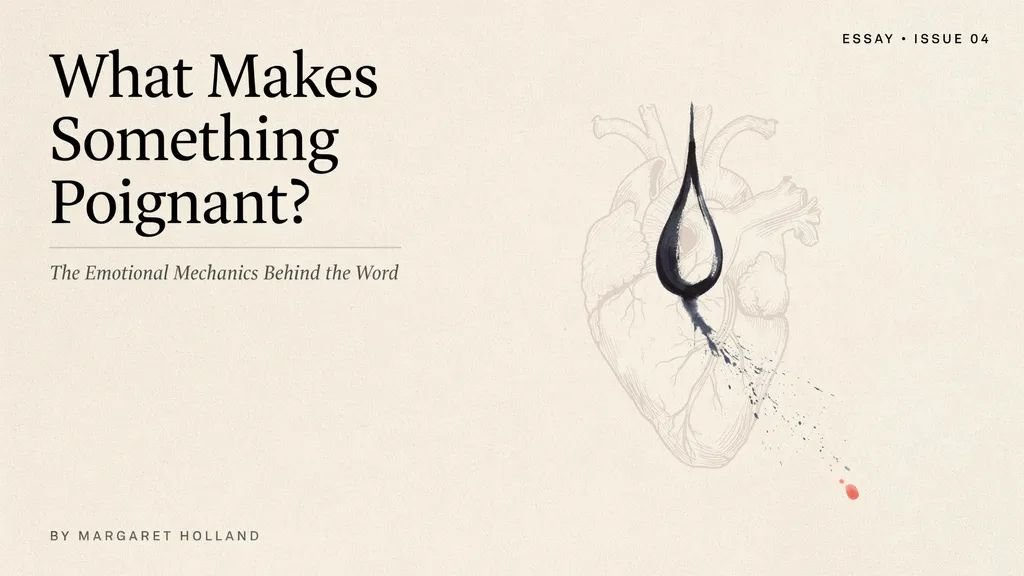
So what actually makes a moment poignant, rather than just “sad” or “sweet”? A few common ingredients tend to show up:
- Loss or absence — something that’s gone, or someone who’s no longer there
- Memory — a callback to the past that contrasts with the present
- Irony or timing — something happening too late, or right before a change
- Brevity — poignant moments are often small and quiet, not loud or drawn-out
- Unresolved longing — a feeling that isn’t neatly wrapped up
Here’s the key insight: poignancy usually lives in small, specific details rather than sweeping, dramatic gestures. A single object — an old photograph, a worn-out toy, a voicemail nobody deleted — often carries more emotional depth than an entire dramatic monologue.
As one well-known quote about writing puts it:
“The smaller the detail, the bigger the feeling it can carry.” — a principle echoed by writing instructors across creative writing programs everywhere.
That’s the mechanism behind why a two-line text about finding an old letter can feel more poignant than a three-page essay about grief in the abstract. Specificity does the emotional heavy lifting.
Similar Terms and Alternatives: Synonyms for Poignant (And Why They’re Not Interchangeable)
People often treat similar terms as if they’re fully interchangeable, but each one carries its own shade of meaning. Understanding these related words helps you pick the exact right one for what you’re trying to say.
| Word | Connotation | Intensity | Best Used For |
|---|---|---|---|
| Touching | Soft, gentle, sentimental | Low–Medium | Sweet, kind gestures |
| Moving | Broader emotional stirring, can include inspiration | Medium | Speeches, inspiring stories |
| Heartrending | Intense grief or sorrow | High | Tragic events, deep loss |
| Heartbreaking | Similar to heartrending, tilts toward devastation | High | Painful news, tragedy |
| Bittersweet | Mixed emotions — joy and sadness together | Medium | Nostalgic endings, farewells |
| Evocative | Triggers memory or vivid imagery | Medium | Descriptive writing, sensory detail |
| Poignant | Sharp emotional impact, often bittersweet | Medium–High | Meaningful, layered emotional moments |
A few clarifications on these comparable terms:
- Touching is softer and more sentimental. A card from a child is touching. A soldier’s final letter home is poignant.
- Moving is broader — it can apply to inspiring speeches, not just sad ones. Poignant leans more specifically toward sadness or bittersweet emotion.
- Heartrending and heartbreaking are more intense. These describe outright grief, while poignant often carries a gentler, more reflective sadness.
- Bittersweet overlaps heavily with poignant, but it specifically emphasizes the mix of joy and sorrow — happiness and sadness sitting side by side. Poignant doesn’t always require joy in the mix; sometimes it’s just sharp, quiet sadness.
- Evocative is about triggering vivid memory or imagery, and doesn’t necessarily involve sadness at all. A poignant memory is usually evocative, but not every evocative description is poignant.
Knowing these distinctions matters if you want your writing to sound precise rather than repetitive. Swapping in “touching” when you really mean “poignant” softens your sentence more than you might intend.
How to Use Poignant Correctly in a Sentence
Grammar-wise, poignant typically modifies moments, memories, scenes, or stories — not people directly. You wouldn’t usually say “she is poignant.” Instead, you’d say her expression, her words, or her story was poignant.
Correct usage patterns:
- “It was a poignant reminder that…”
- “In a poignant moment, she…”
- “The photograph carries a poignant sense of…”
- “His poignant description of…”
Common sentence starters that work well:
- A poignant reminder that time doesn’t wait for anyone
- In a poignant twist, the letter arrived one day too late
- There’s something poignant about an empty chair at the table
Common Mistakes People Make With This Word
A few common mistakes to watch out for:
- Overusing it for anything mildly sad. Not every sad thing is poignant. A minor inconvenience isn’t poignant — it’s just annoying. Reserve the word for moments with real emotional weight.
- Using it for purely happy news with no bittersweet edge. A promotion announcement isn’t poignant unless there’s some layered emotion attached (like, say, a parent who didn’t live to see it).
- Confusing it with “pungent.” As mentioned earlier, this mix-up happens often enough to be worth repeating.
Common Misconceptions and Clarifications About Poignant
There’s a fair amount of confusion floating around about this word. Let’s clear up the biggest misunderstandings.
Misconception 1: Poignant Always Means “Sad”
This is probably the most common misconception out there. While sadness is often involved, poignant technically requires emotional sharpness, not sadness specifically. A moment can be poignant because it’s touching, ironic, nostalgic, or even quietly joyful with an undercurrent of loss.
Misconception 2: It’s the Same as “Pungent”
Covered above, but worth repeating because this incorrect usage happens constantly, especially in casual writing and quick texts where autocorrect doesn’t help matters.
Misconception 3: Poignant Can’t Apply to Humor
Actually, dark comedy and bittersweet humor can absolutely be poignant. Think of a joke that makes you laugh and then immediately makes your chest tighten because it’s true. That layered reaction — humor plus emotional depth — is a classic example of poignancy showing up somewhere unexpected.
Misconception 4: It’s Only for Formal or Literary Writing
As covered in the social media and texting sections above, this word has fully entered casual, everyday digital communication. It’s not reserved for novels and eulogies anymore.
For clarification, here’s a simple test: ask whether the moment leaves a lasting emotional trace, not just a passing reaction. If yes, “poignant” probably fits.
Regional Differences in How Poignant Is Used
Compared to slang terms or regional dialect words, poignant shows relatively little variation across English-speaking regions. It’s a standard, widely recognized word in American, British, Australian, and Canadian English alike, without major shifts in meaning.
That said, a few subtle language variations exist:
- British English tends to use “poignant” slightly more often in formal journalism and literary criticism compared to casual speech.
- American English has embraced the word more casually in recent years, especially online, where it shows up in captions, reviews, and personal storytelling.
- Australian and Canadian English generally mirror British usage patterns, favoring it in more reflective or narrative contexts.
Unlike many slang terms tied to specific local expressions, poignant doesn’t carry regional baggage or shifting definitions depending on where you are. Wherever it’s used across various English dialects, the core meaning stays remarkably consistent — which is part of why it translates so cleanly across cultural contexts, media, and writing styles.
Poignant in Online Communities: Discord, Reddit, and Beyond
Beyond casual texting, poignant shows up frequently in online communities built around media discussion and shared storytelling. On Reddit, especially in book, film, and writing-focused subreddits, you’ll see it constantly in post titles and comments:
“This scene from the finale was one of the most poignant moments in the entire series.”
On Discord, particularly in gaming forums and fan communities discussing narrative-heavy games, players use the word to describe emotionally resonant story beats, character deaths, or unexpected plot resolutions.
Internet groups and digital communities centered around books, shows, and personal essays lean on this word because it communicates something more specific than “sad” or “good” — it signals emotional craftsmanship, the sense that a creator built something intentionally moving rather than accidentally sappy.
This organic spread across online platforms shows that poignant isn’t fading into obscurity — if anything, digital culture has given it new life, letting it thrive in social networking spaces alongside its traditional home in literature and journalism.
Is Poignant Suitable for Professional Communication?
Yes — and this is one area where the word genuinely shines. Poignant works well across many forms of professional communication, particularly when the content involves narrative, reflection, or human experience.
Where It Fits Naturally in Business Writing
- Obituaries and tributes — describing a life or legacy with emotional accuracy
- Corporate retrospectives — annual reports or company history pieces that include real human stories
- Speeches — particularly retirement speeches, farewells, or milestone celebrations
- Formal reviews or critiques — arts, culture, or media commentary in a business or publication context
- Professional email — when appropriately reflective, such as announcing a colleague’s departure after many years
Example in workplace communication:
“As we celebrate twenty years of service, we want to share a few poignant memories from team members who’ve worked alongside her throughout her career.”
This kind of formal communication benefits from the word because it signals sincerity without sliding into over-the-top sentimentality.
Where It Might Feel Out of Place
- Casual business emails about scheduling, deadlines, or routine updates
- Technical writing, reports, or documentation
- Corporate language focused purely on metrics, KPIs, or logistics
Using “poignant” in a meeting agenda email would feel oddly dramatic. Save it for writing that’s meant to reflect, honor, or emotionally connect — that’s where it earns its keep in workplace communication.
FAQs
1. What does “poignant” mean in simple terms?
It means something that creates a sharp, deeply felt emotional response, often tinged with sadness or nostalgia.
2. Is “poignant” the same as “sad”?
Not exactly. Poignant requires emotional sharpness or depth, while something can be sad without leaving a lasting emotional mark.
3. Can “poignant” be used in professional writing?
Yes, it fits well in reflective contexts like eulogies, retrospectives, and speeches, but it feels out of place in routine business emails.
4. What’s a common mistake people make with this word?
Confusing “poignant” with “pungent,” which actually describes a strong smell or taste, not an emotion.
5. Is “poignant” commonly used on social media today?
Yes, it’s frequently used in 2026 across Instagram captions, Reddit posts, and texts to describe nostalgic or emotionally weighty moments.
Conclusion
The poignant meaning comes down to one simple idea: some moments hit deeper than others. They carry sadness, memory, or love all at once, and they stay with you. That’s what makes this word so useful. It names a feeling most of us know but rarely put into words.
Once you understand the poignant meaning, you’ll notice it everywhere. In old photos. In quiet goodbyes. In a single line of text from a friend. Language works best when it captures real emotion, and this word does exactly that.