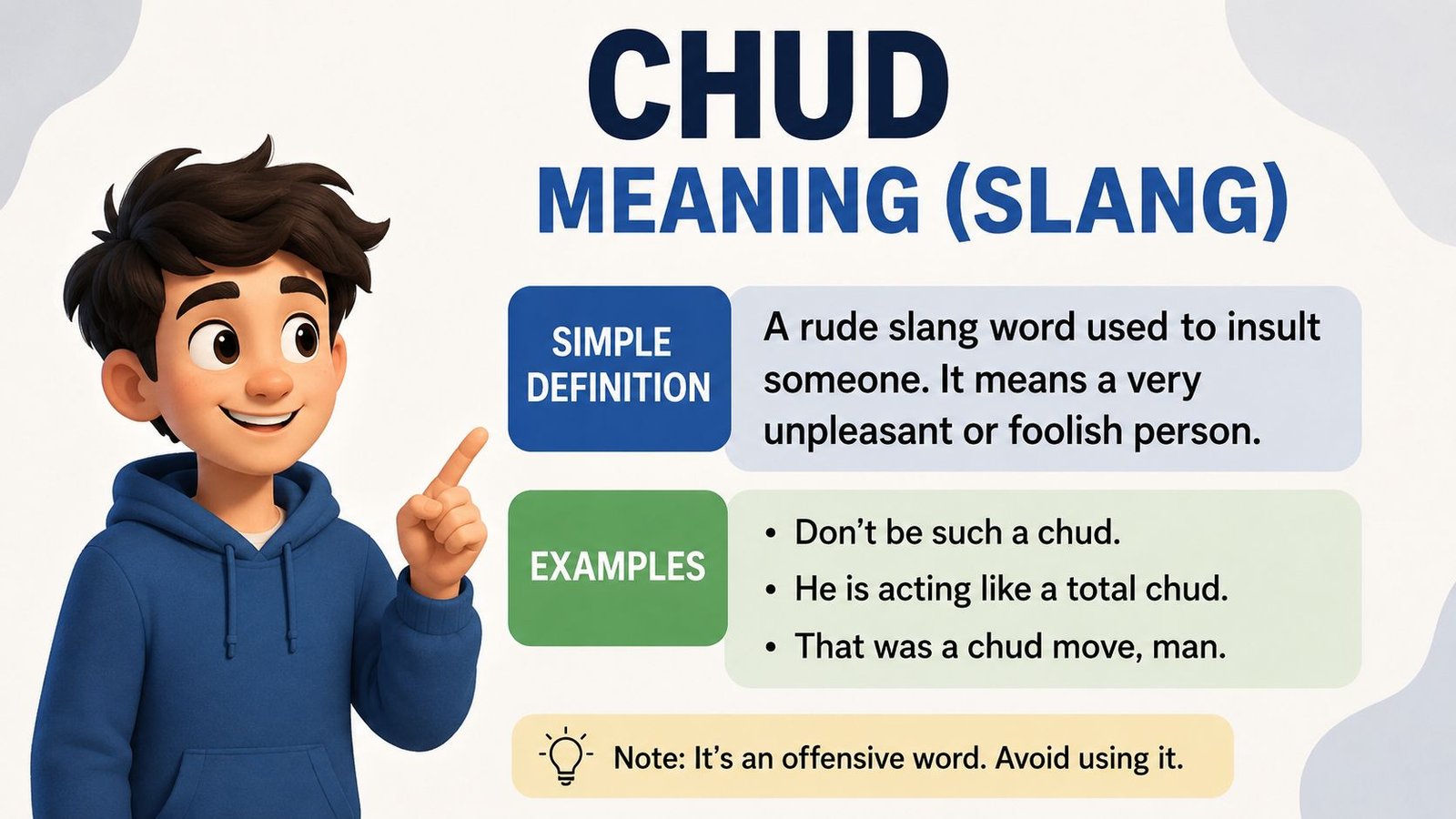
Chud meaning slang refers to a piece of modern internet vocabulary with three distinct uses: a political jab at reactionary views, a general insult for an unpleasant person, and a newer, self-deprecating label for feeling unproductive.
Four letters, three meanings, one word that can go from playful to brutal in the same scrolling session. That shape-shifting quality is exactly what makes “chud” one of the most misunderstood terms floating around Reddit, X, and TikTok right now.
Born from a forgotten 1984 horror movie and reshaped by memes, podcasts, and Gen Z humor, this slang term’s real story is far stranger than its casual, everyday use suggests.
Quick Answer
“Chud” is internet slang with three distinct meanings, and the one that applies depends entirely on context. Here’s the short version:
- A political insult — usually thrown by left-leaning users at someone with far-right, reactionary, or bigoted views.
- A general insult — meaning an unattractive, foolish, unpleasant, or antisocial person, with zero political meaning attached.
- A self-deprecating label — a newer, softer use where people call themselves a chud for being unproductive, lazy, or stuck in a rut.
The word technically stands for Cannibalistic Humanoid Underground Dweller, borrowed from a 1984 horror movie, but almost nobody using it today is thinking about that cult film. Instead, they’re using a term that’s drifted so far from its original meaning that the acronym is basically trivia at this point. Keep reading, because knowing which version someone means is the whole game here.
What Does Chud Mean in Text?
In texting slang and chat messages, “chud” almost never refers to the movie monster anymore. When you see it in a text message, a Discord chat, or a Reddit thread, it’s functioning as a modern derogatory slang term aimed at a person, not a literal creature.
Here’s the thing that trips people up: the same four letters can be a harsh online insult in one thread and a lighthearted joke in the next. A friend texting “I’ve been such a chud today, haven’t left my bed” is being self-deprecating. Someone commenting “what a chud” under a stranger’s political rant is being genuinely hostile. Context matters more with this word than with almost any other piece of modern slang, because the emotional temperature swings from “playful” to “contemptuous” without changing spelling.
A few quick signals to look for:
- Is it aimed at a stranger or at the speaker themselves? Self-directed usually means joking. Other-directed often means insult.
- Is there a political topic nearby? If the conversation involves elections, ideology, or a culture-war debate, the political sense is probably in play.
- What’s the platform? Gaming chats and meme pages lean toward the general-insult sense. Political Twitter and Reddit debate threads lean toward the political sense.
Chud Full Form
People often ask what the word’s full form or abbreviation actually stands for, expecting something modern. It’s not. The acronym predates the internet insult by decades.
C.H.U.D. stands for Cannibalistic Humanoid Underground Dweller.
That’s the full form, straight from a 1984 movie of the same name — a low-budget horror film about mutated, flesh-eating creatures living in New York City’s sewer system after being exposed to illegally dumped radioactive waste. The film’s tagline warned that these Underground Dwellers weren’t “staying down there anymore,” which is honestly a pretty fitting metaphor for how the word itself crawled up from obscure movie trivia into everyday internet vocabulary.
Here’s a fast breakdown of the original meaning versus what it means now:
| Aspect | Original Meaning (1984) | Current Internet Meaning |
|---|---|---|
| What it referred to | Fictional mutant creatures living underground | A real person, insulted online |
| Tone | Horror/monster movie villain | Insult, joke, or self-deprecating label |
| Where it appeared | A B-movie horror film | Reddit, X, Discord, TikTok, gaming chats |
| Political meaning | None | Sometimes strongly political |
| Still commonly known? | Mostly forgotten outside film buffs | Extremely common in internet culture |
So if someone asks “what’s the stands for?”, you can answer factually — but don’t expect the person calling someone a chud online to actually know or care about the movie. The abbreviation survived; the context around it didn’t.
Chud Meaning Slang in Different Contexts
This is where most confusion happens, because chud meaning slang shifts depending on where you encounter it. Below are the four settings you’re most likely to run into the word, with what it typically means in each.
Online Arguments
In online debate and comment sections, “chud” is most often the political version. It’s used as a shorthand insult for someone perceived as holding reactionary opinions, outdated social views, or a rigid ideology the speaker disagrees with. You’ll see it a lot in political discussions on platforms like X and Reddit, typically aimed at men, and typically used by people on the political left as a stand-in for words like “reactionary” or “bigot,” but with more mockery baked in.
It’s rarely a calm, measured critique. It signals frustration, anger, or outright contempt for the other person’s political beliefs, and it’s meant to shut down rather than open up a conversation.
Gaming Communities
In gaming chats, especially competitive multiplayer games, “chud” usually drops the politics entirely. Here it functions as a general insulting term for a teammate or opponent who’s playing badly, being obnoxious, or just generally annoying. Think of it as sitting somewhere between “noob” and “troll” in gaming culture — less about skill level, more about attitude.
Online gamers will toss it around in voice chat or text chat as a quick jab: “stop being such a chud and push the objective.” It’s blunt, casual, and usually forgotten five minutes later.
Meme Culture
Meme culture is arguably where the word picked up the most staying power, largely thanks to the Chudjak — a variant of the Wojak meme character. The Chudjak is drawn with short black hair, furrowed eyebrows, square glasses, and a receding chin, designed specifically to visually mock a certain type of online reactionary. This character spread across meme pages and meme community spaces fast, and it did more to cement the political meaning of “chud” than the word alone ever could.
One popular format, “Nothing Ever Happens,” shows the Chudjak betting everything on the idea that some feared political event won’t occur — a running joke about complacency and denial. These viral jokes and meme trends turned “chud” from a niche insult into something even casual internet users recognize on sight.
Social Media
Across social media broadly — think X (Twitter), TikTok, and YouTube comments — you’ll see all three meanings collide. A TikTok about “chud summer” (the self-deprecating, unproductive-person sense) might be one video away from a heated X thread using the strictly political sense. Social media conversations move fast, and the word gets recycled across totally different tones within the same scrolling session.
This is exactly why understanding the online platforms you’re on — and reading the surrounding digital communication — matters more than memorizing a single fixed definition.
Is Chud Rude, Offensive, or Neutral?
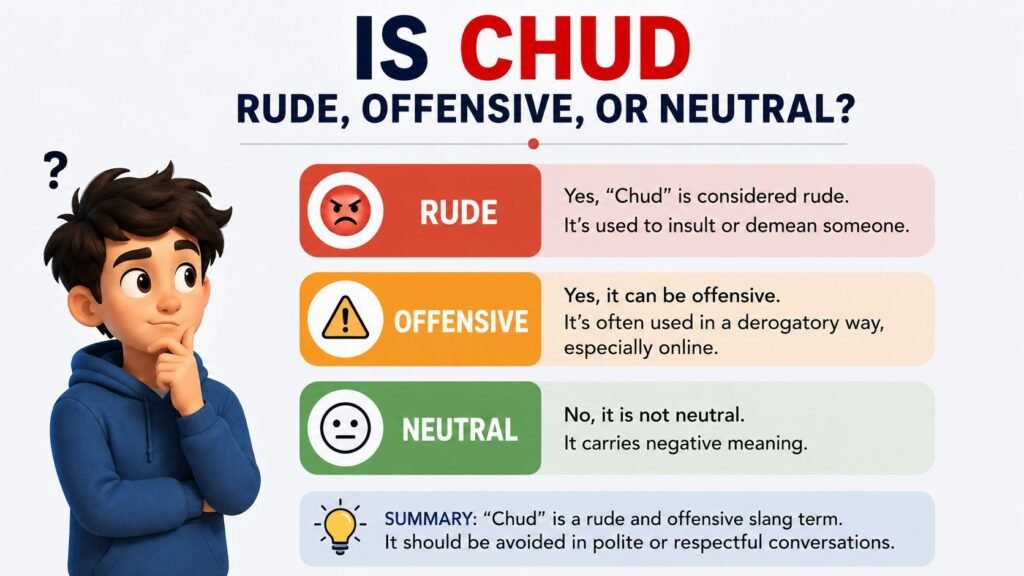
Short answer: it depends heavily on which sense is being used and who it’s aimed at. But let’s be specific, because “it depends” isn’t very useful on its own.
- Political sense: This is a genuine offensive word in most contexts. It’s a negative label meant to dismiss someone’s political views entirely, often lumping in assumptions about their intelligence, looks, and personal hygiene along with their beliefs. It’s closer to harassment than banter when aimed at a stranger.
- General insult sense: Still an insulting term, still capable of hurting feelings, but usually lighter than a targeted political attack. It’s closer to calling someone a “jerk” or a “loser” than a slur.
- Self-deprecating sense: This one is genuinely closer to neutral, even affectionate. Calling yourself a chud for staying inside all summer is self-aware humor, not offensive language.
Tone Comparison
| Sense | Typical Target | Emotional Weight | Would You Say It to a Coworker? |
|---|---|---|---|
| Political insult | A stranger’s beliefs | High — hostile, dismissive | Absolutely not |
| General insult | A player, a rude person | Medium — casual jab | Not in professional conversations |
| Self-deprecating | Yourself | Low — joking, ironic | Only with close friends, never at work |
A good rule of thumb: if you wouldn’t be comfortable explaining the joke to your manager, it doesn’t belong in workplace communication or formal discussions. This word, in basically every sense, stays firmly in casual, personal spaces.
Where Is Chud Commonly Used?
“Chud” thrives in online chats and rarely shows up anywhere formal. Here’s a rundown of where you’ll actually encounter it:
- Reddit — political subreddits, gaming subreddits, and meme subreddits all use different senses of the word
- X (Twitter) — mostly the political sense, especially in reply threads and quote-tweets
- Discord — heavily gaming-context, used in gaming chats between teammates
- TikTok — a mix of meme explainer content and the newer self-deprecating “chud summer” trend
- YouTube comments — often political, sometimes just general mockery of a video’s subject
- Meme pages across Instagram and Twitter, usually tied to the Chudjak character
You will not see this word in business communication, customer service chats, or anywhere that calls for respectful language. It’s strictly an internet culture term, and using it outside casual online platforms is a fast way to look unprofessional.
Real-Life Conversation Examples
Seeing the word in actual sentences makes the different senses click faster than any definition can. Here are examples across common situations.
Friendly
“Bro I’ve been such a chud this week, haven’t answered a single text.”
This is the self-deprecating sense — light, joking, no malice involved. It’s basically shorthand for “I’ve been lazy and unreachable,” said with a laugh.
Casual
“Ignore that guy in the comments, he’s just some chud looking for a reaction.”
Here it’s a dismissive, general insult — not necessarily political, just labeling someone as not worth engaging with.
Argumentative
“Only a chud would think that policy makes sense.”
This is squarely the political sense. It’s an online insult aimed at dismissing someone’s political beliefs without actually debating the substance of what they said.
Gaming
“Stop feeding, you absolute chud, we’re never gonna win this game.”
A classic gaming chats example — frustration at a teammate’s performance, no politics involved whatsoever.
Social Media
“Chud summer is over, back to being a functioning adult on Monday.”
A TikTok-style example of the newer, self-aware sense, treating “chud” almost like a temporary identity or phase rather than a permanent insult.
Emotional and Psychological Meaning
Beyond the dictionary definition, the word carries real emotional weight depending on how it’s deployed. In its political and general-insult forms, calling someone a chud is a way of expressing disagreement, frustration, or anger without engaging in an actual argument — it’s a conversation-ender dressed up as a joke. Psychologically, it functions similarly to name-calling in any argument: a shortcut past nuance, aimed at signaling group identity (“I am not like that person”) more than describing the target accurately.
The self-deprecating version works almost in reverse. Using “chud” to describe your own unproductive stretch is a way of controlling the narrative before someone else can criticize you first — a defense mechanism wrapped in humor. It softens frustration with yourself into something manageable and even funny, rather than something shameful.
Origin and Background of the Slang
The word’s history is longer and stranger than most people assume. Here’s the real timeline:
- 1984 — The movie C.H.U.D. releases, a cult film about Underground Dwellers mutated by radioactive waste in New York’s sewers. The acronym is purely fictional at this point.
- Early 2000s — Online forums (including Usenet and early message boards like Something Awful) start using “chud” as a generic insulting term for an unattractive, foolish, or repulsive person — completely detached from politics.
- 2010s — The podcast Chapo Trap House popularizes “chud” specifically as a jab at reactionary, far-right internet users, and the word spreads across Reddit and X in this political sense.
- Mid-2020s — The Chudjak meme (a Wojak variant designed to visually mock this same type of user) cements the political meaning in meme culture, spreading across meme pages everywhere.
- 2025–2026 — A third sense emerges, especially among college students and on TikTok: a self-deprecating label for feeling unproductive, stuck, or “stagnant,” as seen in campus media coverage of “chud summer” as a shared, ironic identity.
According to linguistic commentary on the shift, much of modern slang gets appropriated from unrelated origins and gradually expanded until the new use overtakes the old one entirely — which is exactly what happened here. The original meaning (fictional sewer monsters) is now basically irrelevant trivia; the digital language meaning is what people actually communicate with.
Comparison with Similar Slang
“Chud” doesn’t exist in a vacuum — it’s part of a whole ecosystem of internet insult vocabulary. Here’s how it stacks up against similar terms:
| Term | Core Meaning | Political? | Typical Platform |
|---|---|---|---|
| Chud | Reactionary person / unpleasant person / unproductive self-label | Sometimes | Reddit, X, TikTok, Discord |
| NPC | Someone perceived as thoughtless or repeating talking points | Sometimes | X, TikTok |
| Chad | The confident, successful opposite of a chud in meme culture | No | Meme pages, Reddit |
| Troll | Someone deliberately provoking others online | No | All platforms |
| Boomer | An older, out-of-touch person | Rarely | X, Facebook, Reddit |
The clearest contrast is chud vs. Chad — in meme trends, these two terms are practically designed as opposites, with “Chad” representing confidence and success and “chud” representing the exact opposite. Unlike “troll,” which describes behavior (deliberately stirring conflict), “chud” describes a perceived type of person, which is part of why it can feel more personal and more like a genuine negative label than situational trolling.
When to Use and When to Avoid It
You Might See It Used
- In casual online chats between friends, joking about laziness or a bad day
- In gaming chats venting frustration at a teammate
- In political comment sections as a dismissive jab
- On meme pages referencing the Chudjak character
Avoid Using It
- In professional conversations or business communication of any kind
- Directed at someone you don’t know well, especially about their appearance or political beliefs
- In mixed company where the political implication could be read as harassment
- Any context governed by strict community guidelines around respectful communication
Polite Alternatives
If you want to express the same idea without the offensive language baggage, try:
- Instead of the political sense: “reactionary,” “someone with controversial opinions,” or simply naming the specific belief you disagree with
- Instead of the general-insult sense: “rude,” “unpleasant,” or “difficult to deal with”
- Instead of the self-deprecating sense: “unproductive,” “in a slump,” or “taking it easy”
Why Do People Use This Slang?
People reach for slang terms like this one for a few clear reasons. First, it’s efficient — one word replaces a longer explanation of someone’s perceived ideology or personality. Second, it signals belonging; using the right internet culture terms at the right time shows you’re plugged into a particular online community, whether that’s a gaming culture Discord or a political Twitter circle. Third, in its newer self-deprecating form, it gives people a lighthearted way to acknowledge a rough patch without sounding genuinely down on themselves.
There’s also a performance element. On social networking platforms, especially in online debate, calling someone a chud isn’t really meant to change their mind — it’s meant to signal to everyone else watching that the speaker rejects that person’s views. It’s audience-directed as much as target-directed.
Impact of Using Slang in Communication
Benefits
- Quick emotional shorthand — conveys tone and attitude fast, which suits the pace of online discussions
- Builds in-group identity — using shared modern slang correctly signals you understand a community’s norms
- Adds humor — especially in the self-deprecating sense, it can defuse tension around personal shortcomings
Drawbacks
- Escalates conflict — in online arguments, it often replaces actual reasoning with mockery, making disagreements more personal and less productive
- Risk of misreading tone — because the word has three meanings, it’s easy for someone to take genuine offense at what was meant as a joke, or vice versa
- Can violate platform rules — used aggressively enough, it can cross into harassment, which many platforms’ community guidelines explicitly prohibit
Is It Safe for Social Media?
Generally, yes, in casual and self-deprecating contexts — it’s extremely common across TikTok, Reddit, and X, and won’t get flagged just for appearing in a post. However, if it’s used repeatedly and aggressively toward a specific person, it can start to resemble targeted harassment, which does risk moderation action on most online platforms. As with most offensive word choices, the safety line isn’t the word itself — it’s the pattern of behavior around it. A one-off joke about your own unproductive week is fine. Repeatedly aiming it at one person’s replies is a different story.
Common Misunderstandings
It Has a Modern Full Form
Some people assume the acronym was invented recently to fit internet culture. It wasn’t — it’s directly lifted from a 1984 movie, decades before the internet insult existed. The stands for is old horror-movie trivia, not a clever modern backronym.
It Always Refers to Politics
This is probably the most common mix-up. Plenty of uses — especially in gaming communities and self-deprecating TikTok content — have absolutely nothing to do with political views. Assuming every use is political will make you misread a lot of harmless jokes as hostile ones.
Everyone Finds It Funny
Because the word shows up so often in meme culture, it’s easy to assume it’s always lighthearted. It isn’t. In heated online arguments, it functions as genuine contempt, not comedy, and treating it as always-a-joke can come across as tone-deaf if someone’s genuinely upset.
Variations and Types
The word has spawned a handful of related forms across internet expressions:
- Chudjak — the meme character representing the political sense visually
- Chud-off — informal, competitive events (real and joking) where people lean into the self-deprecating identity
- Chuddy / chude — casual, less common spelling variants seen in texting slang
- “Chud brain” — describing someone’s thinking as foolish or closed-minded, tied to the general-insult sense
How to Respond When Someone Uses It
If someone calls you a chud, the right response depends entirely on tone:
- If it’s clearly a joke (friends, gaming chat, low-stakes): laugh it off or throw a similarly light jab back. Taking it too seriously in a joking context can kill the mood unnecessarily.
- If it’s political and hostile: you don’t owe a reaction. Engaging with online insults in a heated thread rarely leads anywhere productive — disengaging or reporting under a platform’s community guidelines is often the better move if it escalates into harassment.
- If you’re unsure: ask directly. “Wait, are you joking or actually annoyed?” cuts through ambiguity faster than guessing, and it’s a perfectly normal thing to ask given how differently this word gets used.
Regional and Cultural Usage
The term originated in American internet culture but has spread well beyond U.S. borders, particularly through English-speaking internet users on global platforms like Reddit and X. It’s especially common in Anglophone gaming and meme spaces in the UK, Canada, and Australia, largely because gaming communities and meme community spaces are international by nature. The political sense tends to stay closest to U.S. and UK political contexts, since it originally referenced specific American and British political movements, while the general-insult and self-deprecating senses translate more freely across English-speaking internet culture regardless of country.
A Quick Case Study: Watching the Meaning Shift in Real Time
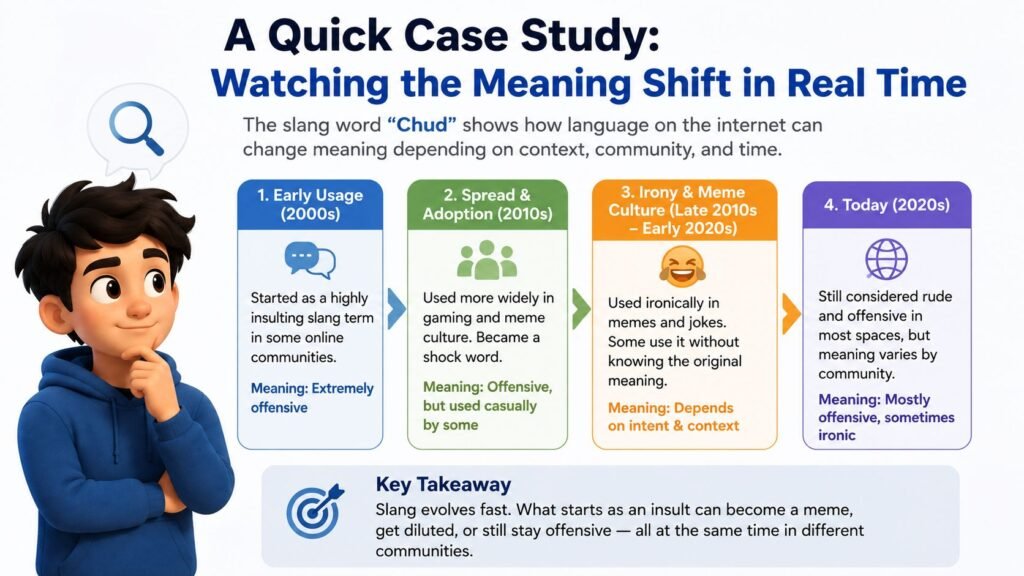
To see just how fast this word can flip meanings, it helps to look at one real pattern that played out across social media in 2025 and 2026. A user posts a photo comparing two public figures side by side, framing it as a joke about appearance and political affiliation. The replies split almost instantly into two camps: one group uses “chud” as a political insult, mocking the figure’s ideology and controversial opinions; the other group treats the whole exchange as meme culture fodder, more interested in the joke format than the actual politics.
Scroll further down the same thread, and you’ll likely find someone using the word in a completely unrelated, third way — joking that they feel like “a total chud” for spending the whole thread doom-scrolling instead of doing something productive. Three uses of the same four letters, three different registers, all in one comment section. This is exactly why treating “chud” as having a single fixed meaning leads to so much confusion: the word doesn’t carry one emotional payload, it carries whichever one the audience and tone of a specific reply assign to it.
This pattern isn’t unique to one platform. Similar splits show up in YouTube comments under political content, in Discord servers where a joke thread turns briefly serious, and in TikTok comment sections responding to explainer videos about the term itself. The lesson for anyone trying to use — or understand — this word is the same every time: read the room before you read the definition.
Chud in Professional and Formal Settings
It’s worth stating plainly, since it comes up often: this word has no place in workplace communication, formal discussions, customer-facing messaging, or any setting where respectful language is expected. Even in its mildest, self-deprecating sense, it’s still slang built on an insult, and using it around colleagues, clients, or in official written communication risks looking unprofessional at best and offensive at worst.
If you’re drafting anything for business communication — an email, a report, a formal message — and you’re tempted to describe someone as unproductive or reactionary, reach for standard vocabulary instead: “underperforming,” “resistant to change,” “holding an unconventional viewpoint,” or simply describe the specific behavior you’re referring to. Digital etiquette in professional spaces hasn’t caught up to casual internet slang, and it likely never will, because the word’s entire identity is built around being blunt, mocking, and informal — the opposite of what formal communication calls for.
FAQs
What does chud mean in slang?
It’s an internet insult for someone seen as reactionary, boorish, or ignorant — often aimed at far-right or bad-faith posters online.
What does CHUD stand for?
Cannibalistic Humanoid Underground Dweller, taken from the 1984 horror film C.H.U.D.
Is chud always about politics?
Not always — it’s frequently political, but it’s also used generally for trolls, toxic gamers, or foolish behavior with no political angle at all.
Is it okay to use chud casually with friends?
It can land as a joke among close friends, but it still carries a dehumanizing edge and can easily read as mean-spirited outside that circle.
Where did chud become popular online?
It spread through forums, Reddit, and X/Twitter over the 2000s–2010s, gaining another push from the Chapo Trap House podcast and the Chudjak meme.
Conclusion
Chud meaning slang comes down to context. It can be a sharp political jab, a general insult, or just a joke about being lazy. The word’s roots trace back to a 1984 horror movie, but its meaning today has little to do with monsters.
Understanding chud meaning slang helps you read the internet better. You’ll know when someone’s joking and when they’re not. Next time you spot this word online, you won’t need to guess. You’ll already know exactly what it means.