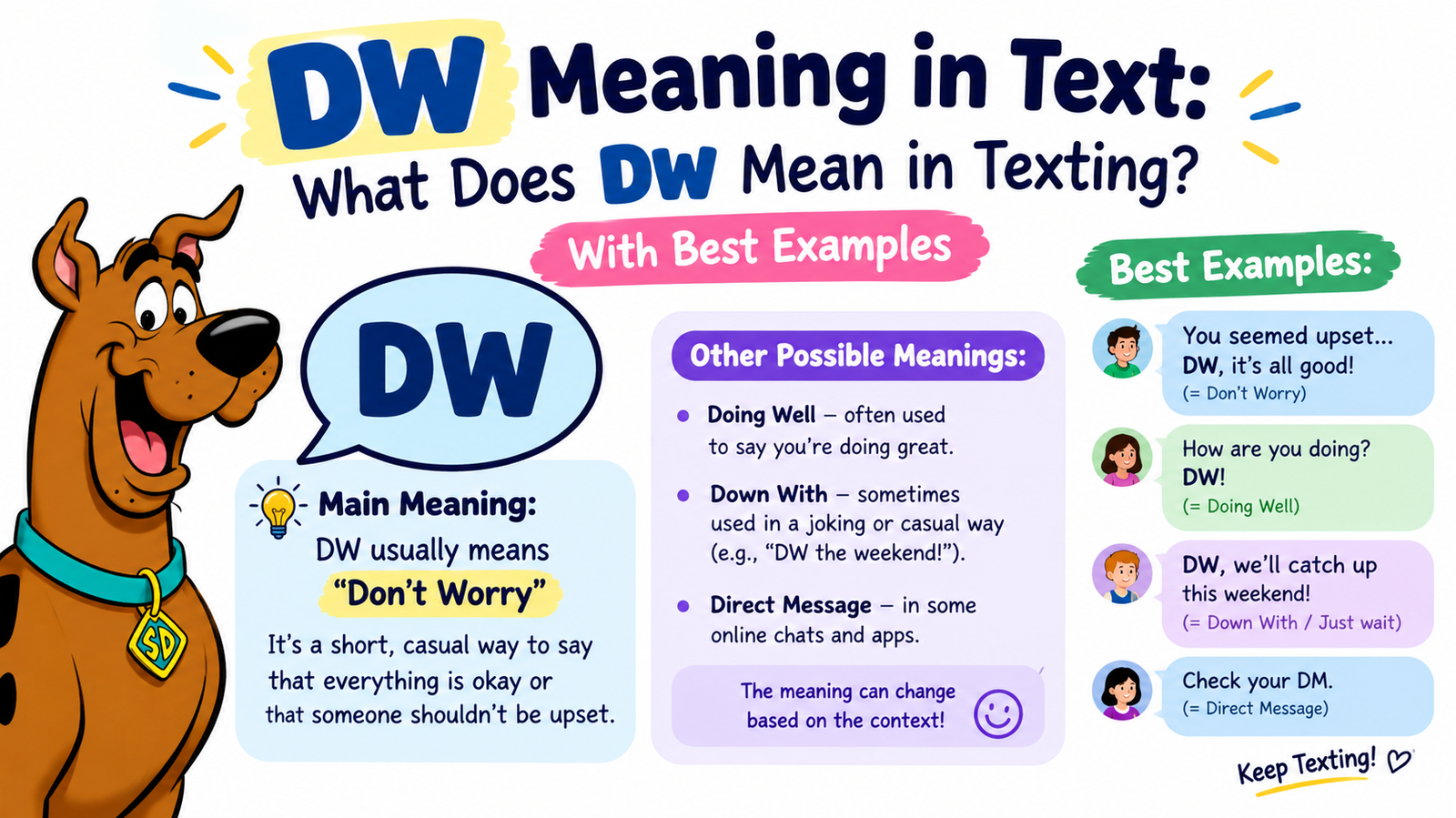
The /dw-meaning-in-text/ is simple. DW stands for “don’t worry.” People type it in chats to calm a friend or wave off a small mistake. It’s a quick, friendly texting abbreviation.
Two tiny letters can save an awkward moment. One “dw” can turn a guilty apology into a smile. That’s the quiet magic of chat shorthand.
Still, the /dw-meaning-in-text/ isn’t always black and white. Tone, emoji, and punctuation change how “dw” feels. It also has other meanings, like Dear Wife and Doctor Who. Keep reading to decode every version with real message examples.
What Does DW Mean in Texting?
DW is a texting abbreviation for “don’t worry.” People type it to calm a friend, wave off an apology, or take a task off someone’s plate. The DW meaning in texting stays the same on iPhone, Android, and every major app.
Think of it as a verbal pat on the shoulder. It’s fast and it’s friendly. That’s why you’ll see it in everyday conversations all day long.
Quick DW Definition
| Detail | Answer |
|---|---|
| DW definition | Don’t worry |
| Type | Initialism (a shortened phrase) |
| Typical tone | Warm to neutral |
| Formality | Informal |
| Closest matches | NW (no worries), NP (no problem) |
| Sample text | “Sorry I’m late!” → “dw, I just got here too” |
Common Spelling Variants
People rarely stop at two letters. Here are the forms you’ll meet most often:
- dw or DW (capitalization changes nothing)
- dw about it (a gentle brush-off)
- dw abt it or dw bout it (extra-casual versions)
- dw!! (added punctuation signals warmth)
- dw dw or dwdw (repeated for extra comfort)
Lowercase wins by a mile. Capital letters can make the message feel louder than intended.
Is DW Slang or an Abbreviation?
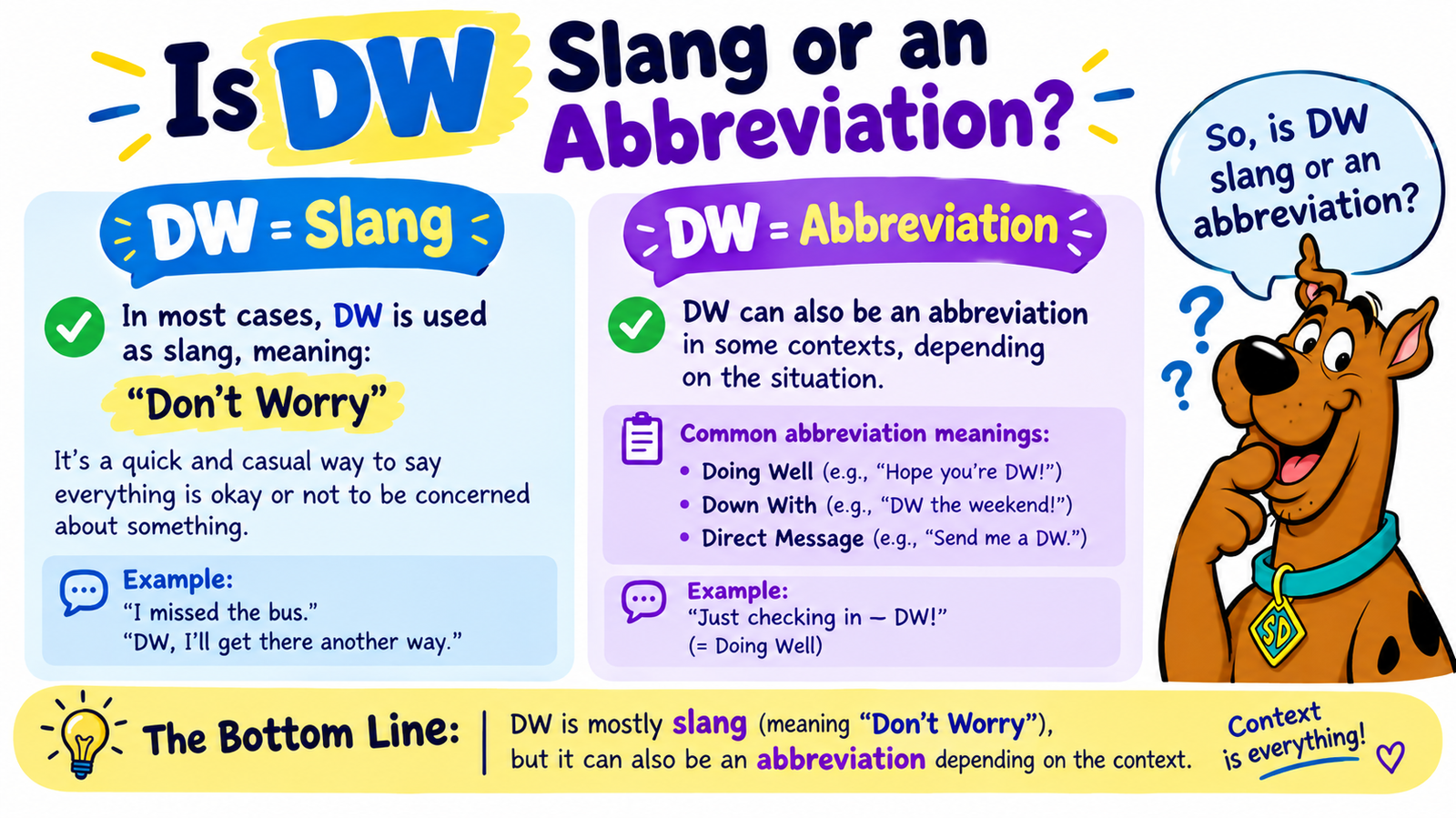
It’s both. Strictly speaking, DW is an initialism. You read each letter on its own: “dee-double-u.” Compare that with an acronym like NASA, which people pronounce as a word.
Still, DW lives in the world of texting slang. Nobody says it out loud much. It exists on screens. That makes it a classic piece of digital slang and chat shorthand.
The DW abbreviation also counts as an internet abbreviation because it spread through chat rooms, forums, and apps before landing in everyday phones.
Where Did DW Come From?
No one has documented the first use of DW. Anyone who gives you an exact date is guessing. What we do know is the backdrop.
The first SMS went out on December 3, 1992. Engineer Neil Papworth sent “Merry Christmas” to a Vodafone director. Early messages also had a hard cap of 160 characters, according to the SMS history on Wikipedia. Older phones made typing slow too. You had to tap a number key several times to get one letter.
So people trimmed everything. “Don’t worry” became “dw” for the same reason “laughing out loud” became “lol.” Short wins. The habit stuck even after touchscreens arrived.
How People Use DW in Messages
Real DW texting examples fall into four buckets. Each one shows a different job the abbreviation does in casual texting.
Replying to an Apology
This is the most common use. It’s also where apologizing in chat meets reassurance.
Her: omg sorry I forgot to text you back
You: dw, I figured you were busy
The “dw” tells the other person the mistake doesn’t matter. It closes the topic fast.
Reassuring a Worried Person
Friend: I think I bombed that quiz
You: dw you’ll be fine, you studied all week
Here dw works as reassurance. It’s the written version of “no need to worry.” Add a reason and the message feels more real.
Brushing Off a Small Inconvenience
Coworker: Sorry the file’s a little messy
You: dw about it, I’ll clean it up
Nothing dramatic happened. The reassuring message keeps things light.
Offering to Handle Something
Roommate: Did anyone grab the milk?
You: dw I’ll pick it up on my way home
In this case DW means “I’ve got this.” It signals that you’ll take responsibility. That makes it one of the most useful texting responses for group chats.
DW Meaning in Chat Across Platforms
The DW meaning in chat doesn’t change from app to app. Context does. Take a look:
| Platform | Meaning of DW | What to expect |
|---|---|---|
| iMessage and SMS | Don’t worry | Plain text, often lowercase |
| Don’t worry | Often paired with a thumbs-up or smiley | |
| Snapchat | Don’t worry | Quick, casual, sometimes in all caps |
| Instagram direct messages | Don’t worry | Usually followed by an emoji |
| TikTok comments | Don’t worry | Short reassurance on someone’s post |
| Forums and Reddit | Don’t worry or Dear Wife | Check the community first |
DW Meaning on Snapchat
DW meaning on Snapchat matches the standard meaning. Snapchat chats move fast and vanish quickly. That makes short replies like “dw” perfect. It’s one of the most common pieces of Snapchat slang for calming a friend.
For example, a friend snaps you a photo of a spilled coffee with “sorry I’m late.” You reply “dw lol.” Done.
WhatsApp Slang and iMessage Expressions
On WhatsApp, “dw” lands the same way. Over two billion people use the app, so the abbreviation travels across countries. As WhatsApp slang goes, it’s very safe.
The same applies to iMessage expressions. Apple’s Messages app has supported chat since 2011. Users add tapbacks like a thumbs-up to a “dw” message, which softens the tone.
Instagram, TikTok, and Other Social Media Chats
On Instagram direct messages and TikTok comments, “dw” often comes with an emoji. These social media chats lean on emoji meanings to set the mood. A 😊 says “truly no big deal.” A 🙄 says something else entirely.
Most social media abbreviations follow that pattern. The letters give the message. The emoji gives the feeling.
DW Meaning from a Girl (and a Guy)
Many people search for DW meaning from a girl. The answer is plain. DW means “don’t worry” no matter who sends it. Gender doesn’t change the definition.
What does change the message is the person, the history, and the moment. Look at these three things instead:
- Relationship: A close friend’s “dw” feels casual. A new crush’s “dw” can feel like a test.
- Timing: A quick reply feels warm. A reply after hours of silence feels cooler.
- Surrounding words: “dw babe!!” reads very differently from a lone “dw.”
Flirting and Dating Context
In relationship texting, “dw” usually softens an awkward moment. Say you cancel a date at the last minute. A reply of “dw, we’ll reschedule 😊” signals warmth.
However, a bare “dw” after a heartfelt apology can feel flat. That’s where message interpretation gets tricky. Look at the person’s usual style before you read too much into it.
Here’s a simple guide for romantic communication:
- Warm “dw” + emoji + plan = the person’s fine
- Short “dw” + no follow-up = possibly neutral or busy
- “dw.” with a period = could signal annoyance (check other clues)
What Tone Does DW Carry?
Texting tone lives in tiny details. Two letters can sound kind or cold. The same “dw” changes with punctuation, emoji, and length.
| Message | Likely tone |
|---|---|
| dw!! it’s all good 😊 | Warm and sincere |
| dw about it | Neutral and casual |
| dw | Quick or busy |
| dw. | Possibly clipped or annoyed |
| dw, seriously, stop apologizing | Caring and a little playful |
What Shifts the Tone
Four things move the needle:
- Punctuation: Exclamation points warm things up. Periods can cool them down.
- Emoji: A smiley adds comfort.
- Length: A long apology met with two letters can sting.
- History: Someone who always texts short isn’t being cold.
Sincere vs. Clipped
Sincere “dw” messages usually come with extra detail. “dw, it happens to everyone” shows effort. A clipped “dw” shows less. It may mean nothing. People often type fast while busy.
When in doubt, don’t assume the worst. Ask a simple question like “all good?” That one line clears up most confusion.
Other Meanings of DW
The other meanings of DW matter if you read forums, watch TV, or shop for tools. Most don’t appear in private texts. Still, they cause plenty of mix-ups.
Dear Wife
On parenting forums, DW means Dear Wife. Mumsnet is a good example. Its community also uses DH (dear husband), DS (dear son), and DD (dear daughter). A post like “DW is picking up the kids” has nothing to do with worry.
Dishwasher
In home talk, DW often means dishwasher. Rental and real estate listings use it all the time. “Updated kitchen with DW” tells you the unit comes with the appliance.
Doctor Who
Fans use DW for Doctor Who, the BBC science fiction series. The show first aired on November 23, 1963. It’s one of the longest-running sci-fi shows in television history.
Deutsche Welle
Deutsche Welle is Germany’s international broadcaster. It publishes news at dw.com in dozens of languages. Journalists and news readers commonly shorten it to DW.
Dynasty Warriors
Dynasty Warriors is a video game series from Koei Tecmo. It’s based on the Chinese historical novel Romance of the Three Kingdoms. In gaming chats “DW” almost always points here.
Dragon Warrior
Dragon Warrior is the name North American players first saw on the original Dragon Quest games for the NES. Square Enix later restored the Dragon Quest name. Older gamers still use the old title.
DeWalt Tools
DeWalt tools use “DW” at the start of many model numbers. A table saw labeled DW745 is a good example. In a hardware thread DW often means the brand.
How to Tell Which DW Someone Means
Look at the setting first. It solves the puzzle nearly every time.
| Where you see it | Likely meaning | Why |
|---|---|---|
| Reply to an apology | Don’t worry | Matches the situation |
| Reply to a stressed message | Don’t worry | Reassurance fits |
| Parenting forum post | Dear Wife | Common forum shorthand |
| Gaming chat | Dynasty Warriors or Dragon Warrior | Game topic |
| TV fandom thread | Doctor Who | Show discussion |
| Rental listing | Dishwasher | Appliance list |
| News discussion | Deutsche Welle | Source reference |
| Hardware store thread | DeWalt | Model prefix |
Rule of thumb: In a private text chat, DW means “don’t worry” almost every time.
DW vs. NW and Other Texting Alternatives
A quick abbreviation comparison helps. Several common chat expressions look alike but act differently.
| Abbreviation | Stands for | Best used for | Tone |
|---|---|---|---|
| DW | Don’t worry | Reassuring someone | Warm |
| NW | No worries | Replying to thanks or apologies | Relaxed |
| NP | No problem | Replying to a favor | Friendly |
| NVM | Never mind | Dropping a topic | Neutral to cool |
| IDC | I don’t care | Showing indifference | Can sound harsh |
DW vs. NW
DW vs. NW is the question people ask most. Both soothe. DW is proactive. You use it before someone panics. NW is reactive. You say it after someone apologizes or thanks you.
For example, “dw, I’ll handle it” comes first. “nw, happy to help” comes after a thank you. In practice, most people swap them freely. Don’t stress over it.
DW vs. NP
“NP” means no problem. It fits favors and small tasks. “Can you send me that link?” gets “np.” DW fits worry. NP fits help.
DW vs. NVM
NVM is where mix-ups happen. “NVM” ends a topic. “DW” comforts. Sending “nvm” when you mean “dw” can sound dismissive.
DW vs. IDC
IDC signals you don’t care. That can hurt. Replying “idc” to someone who apologized might read as cold. If you want to soothe, pick DW.
How to Reply to DW
Most “dw” messages need no reply at all. Still, a short answer feels polite. Good conversation etiquette often means closing the loop.
Easy Replies
These casual replies work in nearly every case:
- “Thanks!”
- “Appreciate it”
- “You’re the best”
- “Thanks for being so chill”
- “Phew, thank you 😅”
Each one works as a thanks for reassurance. They’re short and sincere.
When You Don’t Need to Reply
Skip the reply when the “dw” ends a small matter. A forgotten milk carton doesn’t require a speech. A thumbs-up reaction can do the job.
When to Follow Up
Follow up when the “dw” feels cold. That’s true especially after something important. Try this:
You: Thanks. Are we good?
It’s direct and kind. It also invites an honest answer.
Case Studies: DW in Real Life
These are illustrative texting scenarios. They show how one small abbreviation can shape a whole conversation.
Case Study: The Late Reply
Maya replies to her friend six hours late. She writes three apologetic lines. Her friend answers: “dw!! I was napping anyway 😂”
What happened: The punctuation and emoji signaled warmth. Maya relaxed.
Lesson: Look for extra signals around the letters.
Case Study: The Slack Reschedule
A manager asks a teammate to move a meeting. The teammate replies: “dw, I’ll shift it to Thursday and update the invite.”
What happened: DW took the problem off the manager’s plate. The follow-up detail made the message professional.
Lesson: DW works at work when the culture is casual. Pair it with action.
Case Study: The Quiet Hurt
Jordan writes a long, honest apology after missing a friend’s birthday dinner. The reply: “dw.”
What happened: The friend didn’t feel “fine.” The short answer hid hurt feelings. Jordan called later and the real talk happened there.
Lesson: A bare “dw” after something emotional deserves a follow-up. Don’t take it at face value.
Is DW Formal or Informal?
DW is informal language. It fits casual texting with friends, family, and relaxed coworkers. Skip it in client emails, job applications, and formal notes.
Here are better swaps for professional spaces:
| Informal | More polished |
|---|---|
| dw | Please don’t worry |
| dw about it | No need to worry about it |
| dw I’ve got it | I’ll take care of it |
| dw it’s fine | That’s no trouble at all |
These texting alternatives keep the warmth. They also keep you professional.
Mistakes to Avoid When Using DW
Small slip-ups cause big misunderstandings. Watch for these:
- Sending it to someone upset about something serious. A two-letter reply can feel dismissive.
- Using it in a professional email. It reads as too casual.
- Assuming everyone knows it. Older relatives may not understand text abbreviations.
- Mixing it up with NVM or IDC. Those carry different tones.
- Overusing it. Constant “dw” can feel like a brush-off.
Tips for Using DW Naturally
Good use of DW comes down to a few habits.
- Add a reason. “dw, it happens” feels more caring than “dw.”
- Pair it with emoji. A smiley sets the texting tone fast.
- Match their energy. Long message in, short message out can feel cold.
- Know your audience. Friends get “dw.” Clients get full sentences.
- Say more when it matters. Serious moments need real words.
Alternatives Worth Knowing
When you want fresh friendly messages, try these:
- “No worries”
- “It’s all good”
- “No need to worry”
- “Don’t stress”
- “You’re good”
- “All good, promise”
These texting expressions all deliver the same comfort. Switching them up keeps your online conversations natural.
FQAs
What does DW mean in text?
DW stands for don’t worry. People use this texting abbreviation to reassure someone or wave off an apology.
How do you reply to DW?
A short “thanks!” or “appreciate it” works best. Skip the reply if the “dw” closed a small matter.
What’s the difference between DW and NW?
DW means “don’t worry” and comforts someone ahead of time. NW means “no worries” and usually answers a thank-you or an apology.
Can DW mean something else?
Yes. On forums it can mean Dear Wife, and in other settings it can mean Dishwasher, Doctor Who, Deutsche Welle, or Dynasty Warriors. In private texts it almost always means “don’t worry.”
Is DW okay to use in professional messages?
Only with casual coworkers. For formal emails, write “no need to worry” or “I’ll take care of it” instead
Conclusion
Now you know the /dw-meaning-in-text/ story. DW stands for “don’t worry.” People use it to calm friends and brush off small mistakes. It’s quick and friendly. It also works on Snapchat, WhatsApp, and iMessage. Pair it with a smiley and the message lands even softer.
Remember that tone matters. A warm emoji makes “dw” feel kind. A bare “dw.” can feel cold. Small words carry big feelings. When the moment is serious, type the full phrase. Keep the /dw-meaning-in-text/ tips in mind and you’ll text with confidence.