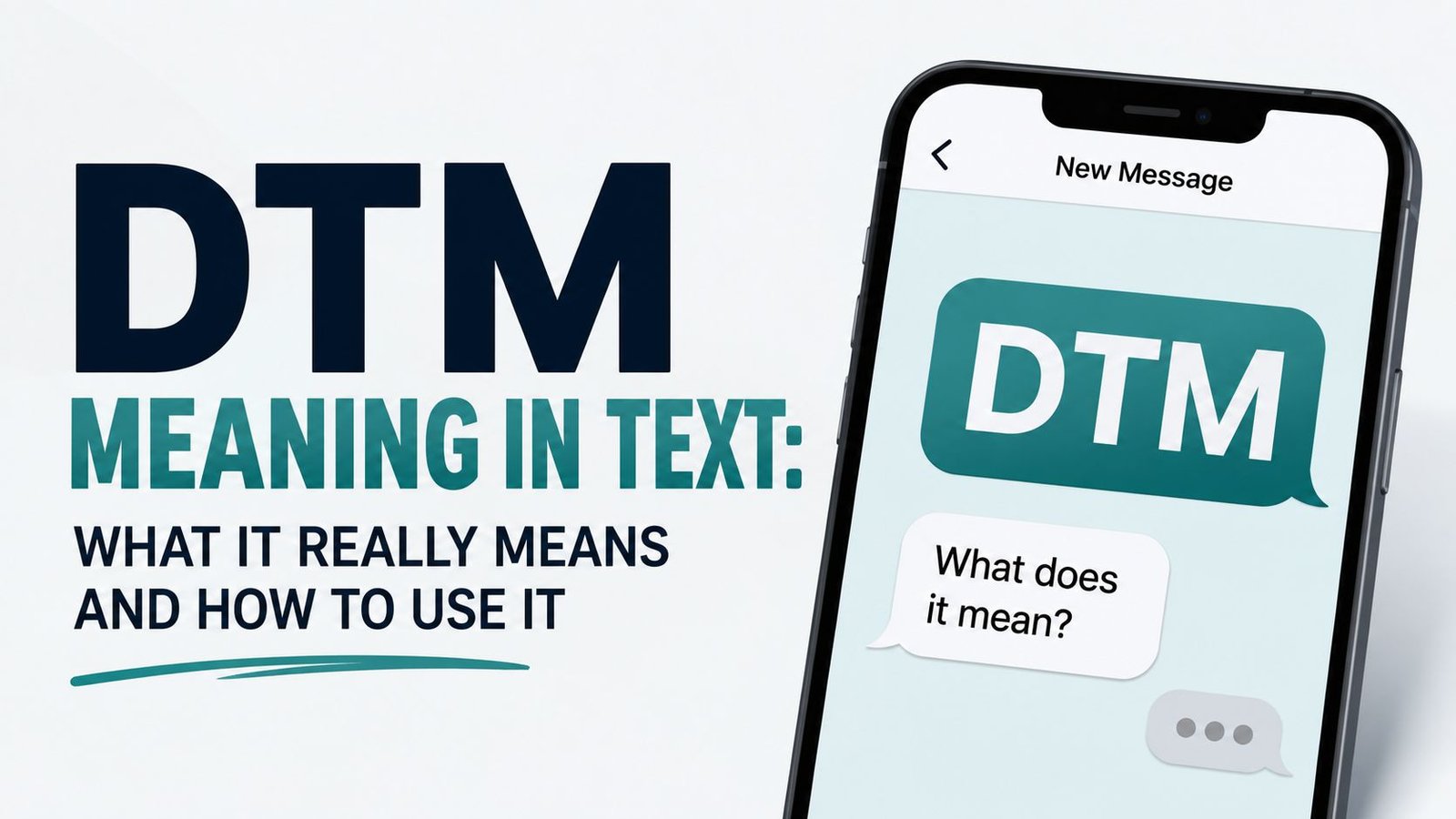
DTM meaning in text shifts depending on who’s texting and why. Most often, it stands for “Down To Meet,” a casual way of saying you’re up for hanging out. It can also mean “Dead To Me,” “Don’t Text Me,” or “Doing Too Much,” each carrying a completely different emotional weight packed into the same three letters.
One acronym, four meanings, and zero warning labels — that’s the trap. Misread it once, and a casual invite turns into an awkward apology, or worse.
Texting shorthand moves fast, and DTM sits right at the center of that chaos. Context, punctuation, and platform all quietly shape which version someone means. Once you learn to spot those signals, decoding DTM becomes second nature, and every future text lands exactly the way it’s meant to.
Quick Answer
DTM most commonly means “Down To Meet,” especially on dating apps and in casual hangout texts. But depending on the conversation, it can also mean “Dead To Me,” “Don’t Text Me,” or “Doing Too Much.” There’s no universal rule — the right meaning depends entirely on context, platform, and who sent it.
| Acronym | Meaning | Typical Vibe | Common Platform |
|---|---|---|---|
| DTM | Down To Meet | Friendly, casual, low-pressure | Dating apps, texting |
| DTM | Dead To Me | Cold, final, dramatic | Texting, group chats |
| DTM | Don’t Text Me | Blunt, boundary-setting | Texting, DMs |
| DTM | Doing Too Much | Playful or annoyed callout | TikTok, Instagram comments |
If you remember nothing else from this article, remember this: DTM is a texting acronym with no fixed meaning. It’s a chameleon. The words around it do all the heavy lifting.
What Does DTM Mean in Text?
Before you can use DTM correctly, you need to understand each definition on its own terms. Think of these as four separate words that just happen to share the same three letters. Here’s the full DTM definition breakdown, one meaning at a time.
Doing Too Much
This is the “you’re being extra” version of DTM. Someone breaks this out when another person’s reaction, effort, or behavior is way bigger than the situation calls for.
Example text:
“She posted a 10-slide carousel about her ex getting a new haircut. She’s DTM fr.”
Doing Too Much gets used as a light roast between friends just as often as it gets used as a genuine criticism. It covers everything from exaggerating a minor inconvenience to full-on dramatic behavior that nobody asked for. If someone sends 15 texts in a row over something small, that’s a textbook DTM moment.
This meaning overlaps heavily with modern call-out culture and reaction culture — the tendency to publicly flag when someone’s response feels performative or over-the-top. It’s rarely mean-spirited. Usually, it’s affectionate teasing wrapped in three letters.
Dead To Me
This is the heaviest of the four meanings, and it’s not one you throw around lightly. Dead To Me signals that a relationship, friendship, or connection has hit a final rejection point. There’s no ambiguity here — it’s about as close to a breakup text as three letters can get.
Example text:
“After what he did at the party, he’s DTM. I’m done.”
People reach for this version of DTM after a serious betrayal, a relationship fallout, or some kind of trust violation that feels unforgivable in the moment. It’s an emotional boundary stated as fact, not really up for discussion.
One important nuance: DTM as “Dead To Me” is often said in the heat of the moment. It doesn’t always mean forever — but the person saying it wants it to feel that way right now.
Don’t Text Me
Short, blunt, and impossible to misread once you know it. Don’t Text Me is a direct request to stop messaging, and it usually shows up at the end of an argument or an unwanted conversation.
Example text:
“We’re not doing this again. DTM.”
This is pure texting etiquette enforcement — a way of setting a texting boundary without writing out a whole paragraph. It’s the digital version of “leave me alone.” Unlike “Dead To Me,” this version is about message limit and personal space, not necessarily the end of the relationship itself. Someone can say “DTM” today and text you again in a week once things cool down.
Down To Meet
This is the most common meaning you’ll run into, especially anywhere people are making social plans or a meetup invitation. Down To Meet signals genuine interest in getting together — no drama attached.
Example text:
“I’m around this weekend if you’re DTM for coffee.”
This version of DTM shows up constantly in online dating, casual friend group planning, and even professional networking contexts (though it’s rare there). It communicates available to meet energy in the fastest way possible. If a match on a dating platform sends this after a few days of chatting, it’s usually a good sign — they want to move things from a match conversation into real life.
Where DTM Comes From
Slang doesn’t appear out of nowhere, even if it feels that way sometimes. Each version of DTM has its own rough origin story, and knowing them helps explain why the meanings diverged so much.
Down To Meet likely grew directly out of the older, more explicit acronym “DTF,” which had circulated in online dating and hookup culture for years. As dating apps like Tinder and Bumble went mainstream and casual texting norms shifted, a softer, more PG version emerged — one that signaled genuine interest in hanging out without the same loaded connotation. DTM filled that gap.
Dead To Me has been a spoken phrase for decades, long before texting existed. It’s dramatic, quotable, and blunt — the kind of line people already said out loud in real arguments. Texting just shortened it down for speed, the same way “TTYL” shortened “talk to you later.” Once acronym culture took over group chats and DMs, condensing an already-common phrase was inevitable.
Don’t Text Me followed the same path. It’s a phrase people already used constantly, and constant repetition in fast-paced chat threads is exactly the kind of pattern that gets compressed into shorthand.
Doing Too Much has roots in AAVE (African American Vernacular English) and has been part of broader internet culture and Gen Z slang for years, well before it got tied to a three-letter acronym. As TikTok and Instagram comments became the main stage for calling out over-the-top behavior, “DTM” became the fast way to type it without spelling out the full phrase every time.
Bottom line: DTM isn’t one acronym with one history — it’s four separate phrases that happened to compress down to identical letters, and internet culture never bothered to sort them into separate acronyms.
It helps to compare this to how other online slang develops. Most acronyms start as a shortcut for something people were already typing out constantly — “LOL,” “BRB,” and “TTYL” all follow that same pattern. DTM is unusual because it converged from four separate directions at once, rather than evolving from a single root phrase. That’s part of why it causes more confusion than most text abbreviations: there was never one committee deciding what it should mean. It just happened, the way most web jargon happens — organically, messily, and differently depending on which corner of the internet you were standing in when you first saw it.
Why DTM Confuses So Many People
If you’ve ever felt genuinely stuck trying to decode a text, you’re not imagining things. DTM is one of the more legitimately ambiguous entries in the current slang dictionary of texting shorthand, and there’s a real reason for that.
Most texting acronyms carry one dominant meaning with maybe a rare secondary use. DTM breaks that pattern entirely — it has four genuinely common meanings, each tied to a completely different emotional register. That’s rare. Compare it to something like “SMH” (shaking my head), which almost always means the same thing regardless of platform or sender. DTM offers no such consistency.
There’s also a generational layer here. Older texters who grew up with “Dead To Me” as a spoken phrase might default to that reading, while someone who came up entirely on dating apps might never even consider that meaning exists. Modern slang doesn’t spread evenly — it spreads through specific communities first, and DTM’s four meanings likely developed somewhat independently across different corners of internet culture before crossing paths.
How Capitalization and Punctuation Change DTM’s Meaning
Here’s something most guides skip entirely, and it’s genuinely useful: how you type DTM changes how it reads.
- “dtm?” (lowercase, question mark) — almost always Down To Meet. It reads as an invitation, low stakes, casual.
- “DTM.” (all caps, period, no explanation) — usually Dead To Me or Don’t Text Me. The caps add weight; the period adds finality.
- “DTM lol” or “DTM 😭” — nearly always Doing Too Much. The added laughter softens it into a joke, not a real accusation.
- “dtm rn” (“right now”) — typically Down To Meet, asking about immediate availability.
- A standalone “DTM” with zero context after an argument — read this one carefully. It’s very likely Don’t Text Me or Dead To Me, and responding with a joke here can backfire badly.
Punctuation in texting works like tone of voice does in speech. A period at the end of a short text often reads as cold or final, while a question mark or emoji softens things into something friendlier. Capitalization in text does similar work — all caps can signal emphasis, frustration, or seriousness depending on what surrounds it.
This is exactly why context clues matter more than the acronym itself. The letters never change. Everything else does.
How to Tell Which Meaning Someone Means
You don’t need to guess. There’s a simple framework you can run through in about three seconds:
- Who sent it? A match from a dating app almost never means Dead To Me. A friend you just had a falling out with almost never means Down To Meet.
- What was the conversation about right before? DTM after “want to grab food Saturday?” is Down To Meet. DTM after “you seriously did that behind my back?” is not.
- What’s the tone of the rest of the message? Emojis, lowercase letters, and casual phrasing point toward the lighter meanings. Cold, short, all-caps, or silence-heavy messages point toward the heavier ones.
- What platform is this on? (More on this below — platform alone can narrow things down fast.)
Conversation context is doing 90% of the interpretive work here. The acronym is just a placeholder — the real information lives in everything around it. If you ever read a DTM text and genuinely can’t tell which meaning fits, the safest move is to just ask: “wait, DTM as in…?” It takes two seconds and saves you from replying to a breakup with a thumbs-up emoji.
DTM Meaning by Platform
Where a message shows up changes what DTM probably means before you’ve even read a single other word. Different social apps have developed their own informal defaults, shaped by what people typically talk about there.
On Snapchat and Texting
Snapchat slang and regular text message conversations lean heavily toward Down To Meet and Don’t Text Me, since these platforms are built around one-on-one, personal conversations — the exact context where making plans or setting boundaries comes up most.
On TikTok and Instagram Comments
TikTok slang and Instagram slang skew hard toward Doing Too Much. Comment sections are public performance spaces, and calling out someone’s dramatic reaction to a video is a huge part of the culture there. You’ll see “DTM” dropped under videos of people overreacting to minor things constantly.
On Dating Apps
Here, DTM almost always means Down To Meet. Dating apps exist specifically to move conversations toward real-life plans, so the acronym naturally gravitates toward that meaning. If you see it on Tinder, Hinge, or Bumble, you can be about 95% confident that’s what’s meant.
On Discord and Group Chats
Discord slang and group messaging contexts are the wild card. Discord server conversations, gaming chats, and larger messaging groups can produce any of the four meanings depending on the community and the specific conversation thread. A gaming Discord planning a session might use “DTM” for Down To Meet (meet up in a voice channel). A friend group chat mid-argument might use it for Dead To Me.
Why Platform Changes the Meaning So Much
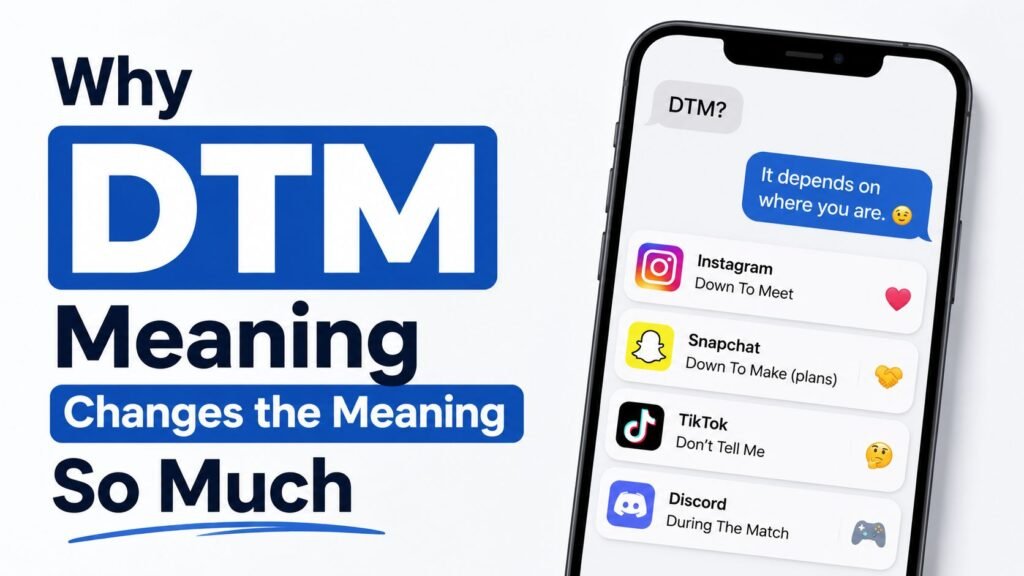
Every platform has its own built-in purpose. Dating apps exist to arrange meetups. TikTok comments exist for public reaction and callouts. Group chats and DMs exist for ongoing personal relationships, which means they can carry the full emotional range — from planning a hangout to ending one. Digital communication always inherits some of its meaning from the space it happens in, and DTM is a perfect example of that rule in action.
Think of it this way: a hammer and a paintbrush are both tools, but you’d never confuse which one belongs on a construction site versus an art studio. Platforms work the same way with slang. The tool (the acronym) stays identical, but the job it’s doing changes completely depending on where you’re standing.
Here’s a side-by-side breakdown of how the DTM meaning shakes out across common social apps:
| Platform | Most Likely Meaning | Why |
|---|---|---|
| Tinder / Hinge / Bumble | Down To Meet | Built around arranging real-life dates |
| iMessage / WhatsApp | Down To Meet or Don’t Text Me | Personal one-on-one context, could go either way |
| TikTok comments | Doing Too Much | Public callout culture dominates |
| Instagram comments | Doing Too Much | Similar public reaction dynamic |
| Discord (gaming servers) | Down To Meet (voice chat/session) | Community coordination focus |
| Discord (friend groups) | Any of the four | Personal relationships, full emotional range |
| Group texts | Dead To Me or Doing Too Much | Often where drama and callouts play out |
WhatsApp slang in particular tends to mirror regular texting patterns closely, since the app is mostly used for one-on-one and small group personal conversations rather than public posting. That makes it one of the more “neutral” platforms — the meaning leans almost entirely on the specific conversation rather than any platform-wide default.
DTM in Real Conversations — Examples
Reading isolated definitions only gets you so far. Seeing DTM inside actual text conversation flow makes the pattern click faster.
Down To Meet example:
Sam: “Hey! Free Thursday?” Jordan: “Yeah I’m DTM, what time works?”
Dead To Me example:
Alex: “I heard what you told everyone about me.” Riley: “You’re DTM. Don’t reach out again.”
Don’t Text Me example:
Casey: “Can we just talk about it?” Morgan: “No. DTM. I mean it this time.”
Doing Too Much example:
Comment under a video: “Bro cried over a parking spot 💀 DTM”
Notice how in every single case, the acronym itself gives you almost zero information on its own. The words before and after it are doing all the work. That’s the single most important thing to remember about DTM slang — it’s a container, not a message.
Case Study: The Same Acronym, Two Very Different Outcomes
Scenario one: Two friends, Taylor and Devon, had been texting on and off after meeting at a mutual friend’s party. Devon sent, “no plans this weekend, DTM if you’re around 👀.” Taylor replied “same!” and they ended up grabbing dinner Saturday. Down To Meet, read correctly, led straight to plans.
Scenario two: A different pair, Morgan and Jamie, had a blowup over a canceled plan. Jamie texted “wow, can’t believe you did that.” Morgan responded with a single line: “DTM.” No emoji, no explanation, sent an hour after the fight cooled to silence. Jamie tried replying with a laughing emoji, assuming it was a joke — and it wasn’t. The relationship stayed tense for weeks afterward because the tone got misread.
The lesson: identical three letters, completely opposite outcomes, and the difference came down entirely to context, timing, and the emotional temperature of the conversation leading up to it.
When to Use DTM (and When Not To)
Use DTM when:
- You’re replying to a meetup invitation and want a fast, casual yes (“DTM this weekend!”)
- You’re joking with friends about someone being excessive or over-the-top (Doing Too Much)
- You’re firmly setting a texting boundary after a real conflict and mean it
- You’re texting someone who already uses DTM regularly and you know how they use it
Avoid DTM when:
- You’re texting someone new who might not know all four meanings — spell it out instead to avoid confusion
- The situation is emotionally serious and deserves a real sentence, not shorthand (breakups, serious conflict, apologies)
- You’re in a professional or semi-formal context — chat abbreviation like this reads as too casual
- You’re not actually sure which meaning fits your own intention — vague slang in a tense moment tends to make things worse, not better
A good rule of thumb: the more emotionally serious the message, the less you should rely on ambiguous shorthand. Save DTM for situations where either a) the context is crystal clear, or b) the stakes are genuinely low.
How to Respond to DTM
Knowing what DTM means is only half the battle — knowing how to reply matters just as much. Here’s what to send back depending on which meaning fits.
If it means Down To Meet:
- “Yes! What time works for you?”
- “DTM too, let’s figure out a day”
- A simple 👍 or “bet” also works fine in casual chat language
If it means Dead To Me:
- Avoid jokes or casual emojis — this isn’t the moment
- “I hear you. I’m sorry, and I understand if you need space.” keeps things respectful
- If you disagree with being cut off, a calm “can we talk about this when you’re ready?” leaves the door open without pushing
If it means Don’t Text Me:
- Respect it. Don’t send another message right after.
- If it’s genuinely urgent, one short, respectful text acknowledging the request is fine — repeated messages will only make things worse
- Give it real time before reaching out again, if you reach out at all
If it means Doing Too Much:
- Play along if it’s clearly a joke: “I KNOW, I know 😭”
- If it’s a genuine callout, a simple “yeah fair, my bad” defuses things fast
The biggest mistake people make is replying with the wrong tone — treating a Dead To Me text like a joke, or treating a Doing Too Much comment like a serious accusation. Match the emotional register of the original message, and you’ll almost always land the response right.
DTM vs. Similar Slang
DTM isn’t the only ambiguous texting acronym out there. Here’s how it stacks up against other common ones people mix it up with.
| Acronym | Meaning | How It Differs From DTM |
|---|---|---|
| DTF | Down To… (explicit hookup intent) | More sexually direct; DTM’s “Down To Meet” version is the tamer cousin |
| TBH | To Be Honest | Used to preface an opinion, not to set plans or boundaries |
| IDGAF | I Don’t Give A F*** | Expresses apathy; doesn’t carry DTM’s relationship-ending or planning function |
| GTG | Got To Go | Signals leaving a conversation, not ending a relationship |
| NGL | Not Gonna Lie | Prefaces honesty, unrelated to meetups or boundaries |
| HMU | Hit Me Up | Similar to Down To Meet, but more general — works for texting, not just meeting |
The closest cousin to DTM is genuinely HMU, since both can signal openness to hanging out. The difference is subtle: HMU is an open invitation to reach out at all, while DTM (Down To Meet) responds more specifically to an already-proposed plan.
Common Mix-Ups
A few recurring mistakes show up again and again with this acronym, and they’re worth flagging directly:
- Confusing DTM with DTF — these are not interchangeable. DTM’s dating-related meaning is casual and platonic-friendly; DTF is explicit. Mixing them up in a real conversation can send a very wrong signal.
- Reading “Doing Too Much” as an insult when it’s playful — tone and platform usually clarify this, but out of context it can sting unnecessarily.
- Missing the shift from Don’t Text Me to Dead To Me — these two overlap in tone (both are boundary-related), but one is temporary and one is meant to feel permanent. Confusing them can make an already tense situation worse.
- Assuming DTM always means the same thing a person used last time — someone might use “DTM” for Down To Meet on Monday and Doing Too Much on Wednesday. Slang meaning is contextual every single time, not locked to a person.
Who Actually Uses DTM
DTM sits firmly in Gen Z slang and younger millennial internet culture, though usage patterns differ slightly by meaning:
- Down To Meet skews toward late teens through early 30s, especially on dating apps and casual social texting
- Dead To Me and Don’t Text Me show up across a wider age range, since they’re built on phrases that predate texting entirely
- Doing Too Much is most concentrated among teens and young adults active on TikTok and Instagram comment sections
It’s rare to see DTM used in professional online communication — email, workplace chat tools, and formal messaging almost never carry this kind of shorthand. It belongs almost entirely to personal, casual social media communication.
Variations You Might See
DTM shows up in a few stretched or modified forms depending on the platform and the person typing it:
- dtmm — an emphasized version, usually of Down To Meet (“dtmm this weekend fr”)
- DTM? — a question mark version, almost always Down To Meet, phrased as an actual ask
- DTM af — intensified Doing Too Much, meaning “extremely over the top”
- big dtm energy — a newer, more playful phrase built off the Doing Too Much meaning, used to describe a whole vibe rather than a single action
- lowercase dtm vs DTM — as covered earlier, lowercase generally softens the message while all caps adds weight
None of these variations are universal or dictionary-official — they’re trending slang, which means they shift fast and don’t always carry over between friend groups or platforms.
FAQs
Is DTM still commonly used in 2026?
Yes, it’s still active across texting, dating apps, and social comments, though “Down To Meet” and “Doing Too Much” remain the two most frequent uses today.
Does DTM mean the same thing on every dating app?
Pretty much — on Tinder, Hinge, and Bumble, DTM almost always means “Down To Meet,” since these apps are built around arranging real-life dates.
Is DTM more common among Gen Z or older users?
Gen Z drives most current usage, especially the “Doing Too Much” and “Down To Meet” meanings, while older texters lean more toward “Dead To Me.”
Can DTM mean something different in a business or work chat?
It rarely appears in professional messaging at all — DTM stays almost entirely in casual, personal texting and social platforms.
Is there a single “correct” definition of DTM?
No, there isn’t one official meaning; it genuinely depends on context, platform, and the relationship between the people texting.
Conclusion
DTM meaning in text really comes down to one thing: context rules everything. The same three letters can invite you somewhere, end a friendship, set a boundary, or call out drama. No single definition fits every text. Read the situation first, then decide what DTM actually means.
Once you understand DTM meaning in text, texting gets a lot less confusing. You’ll catch the right tone faster and reply with confidence. No more guessing games. No more awkward mix-ups. Just clear, easy communication, one text at a time.