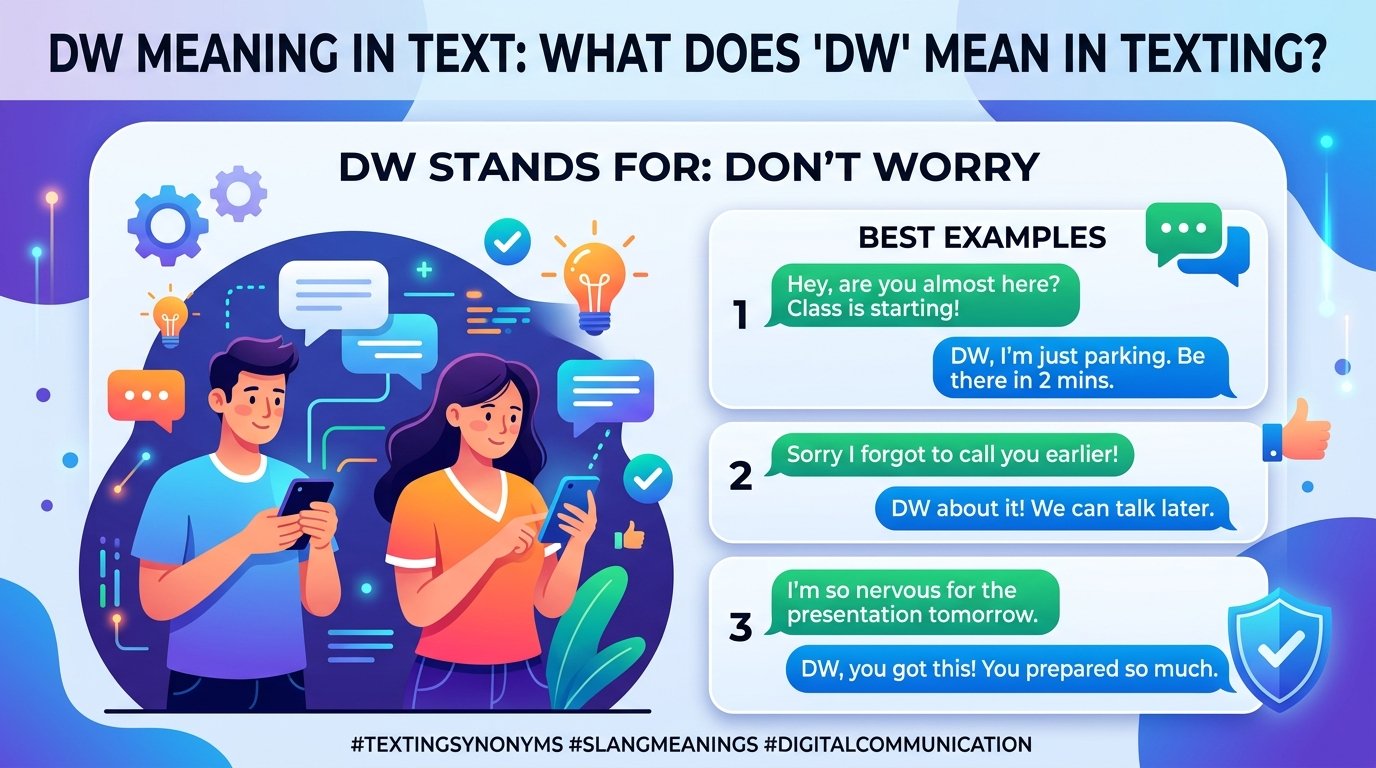
The /dw-meaning-in-text/ is simple: DW stands for “don’t worry.” People use this texting abbreviation to reassure a friend or forgive a small mistake in text messages and online chats.
Two tiny letters can melt tension in seconds. One quick “dw” turns an awkward apology into a smile. You don’t need a single extra word.
Still, /dw-meaning-in-text/ has more layers than you’d expect. Tone, punctuation, and platform all change how it lands. Even a period can change the mood. DW can also mean Dear Wife, dishwasher, or Doctor Who. Read on and you’ll never misread it again.
What Does DW Mean in Texting?
Here’s the short answer to what does DW mean in texting: it means don’t worry. That’s the whole DW definition. Someone sends it to say, “You’re fine. Nothing to stress about.”
People type it as “dw” or “DW.” Both versions carry the same meaning of DW. Lowercase feels relaxed and quick. Uppercase can feel a bit louder or more emphatic.
Here’s a quick exchange:
You: Sorry, I forgot to bring your charger.
Friend: dw, I have a spare.
The reply takes two seconds to type. It also does a lot of work. It forgives the mistake and fixes the problem in one short line.
Quick Definition Box
| Detail | Answer |
|---|---|
| Abbreviation | DW |
| Stands for | Don’t worry |
| Type | Initialism (letters said one by one) |
| Part of speech | Interjection or reassurance phrase |
| Tone | Reassuring, casual |
| Formality | Informal |
| Example | “dw, I’ll handle it.” |
That’s the DW meaning in texting in a nutshell. Everything below adds depth.
Is DW Slang or an Abbreviation?
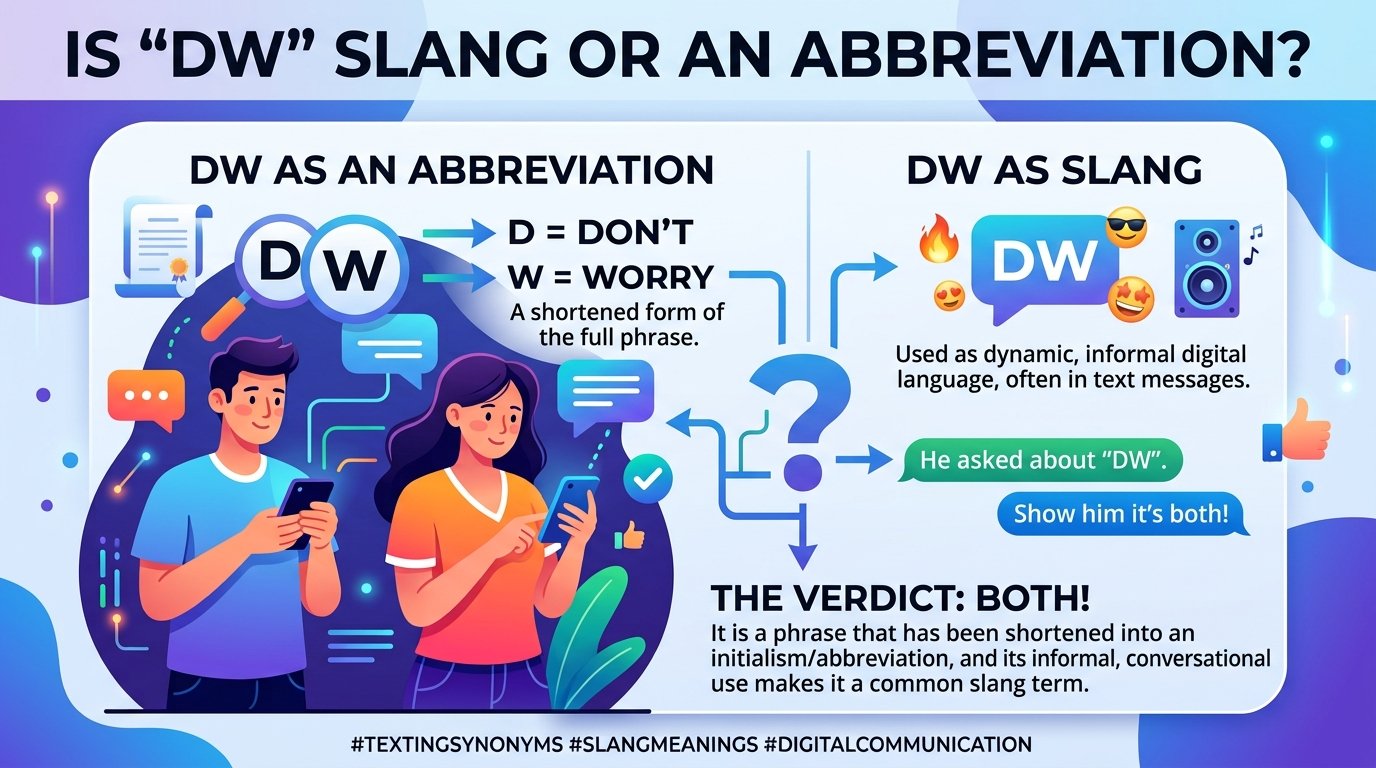
Both labels fit, but one fits better. The DW abbreviation is an initialism. It takes the first letter of each word in “don’t worry” and squeezes them together. BRB, IDK, and OMG work the same way.
Is it DW slang? Sort of. It lives in the world of informal language. You’d text it to a friend. You wouldn’t print it in a business report. Still, it isn’t a fresh invention like a trendy slang word. Think of it as steady texting shorthand rather than a passing fad.
Where Did DW Come From?
No one can point to a first use. Nobody recorded the moment a person typed “dw” for the first time. What we do know explains why it caught on.
Early mobile phones capped a single SMS at 160 characters. The first text message went out on December 3, 1992. It read “Merry Christmas.” Phone keypads were slow too. Typing one letter could take several taps. People shortened everything to save time and space.
That pressure gave birth to SMS language. Abbreviations like “gr8,” “u,” and “np” spread fast. DW rode the same wave. Today, unlimited texting has erased the old limits. Even so, the shorthand stuck because it still feels quick and friendly.
You can read more about the history of the format on the SMS page at Wikipedia.
How People Use DW in Messages
You’ll see DW in messages in a handful of repeat situations. Each one has its own flavor. Let’s walk through them.
Answering an Apology
This is the classic use. Someone owns a mistake. You wave it off.
Them: Sorry I forgot to call you back.
You: dw, it’s fine.
The reply tells them the matter is closed. It keeps things light. Nobody has to write a paragraph.
Calming Someone Who’s Worried
Sometimes DW works as a hug in text form. Your friend spirals. You steady them.
Them: I think I bombed that interview.
You: dw, you’ll hear back soon.
Here, don’t worry comes with a bit of encouragement. Adding a few extra words makes it feel kinder.
Waving Off a Small Inconvenience
Running late happens to everyone. DW removes the guilt.
Them: I’m 10 minutes behind.
You: dw, I just got here.
Notice the extra detail. “I just got here” proves you mean it. The message sounds real instead of polite.
Taking Charge of a Task
DW also means “I’ve got this.” Someone raises a question. You settle it.
Them: Did anyone book the table?
You: dw, I’ve got it.
In this case, the phrase promises action. It tells the group to stop fretting.
Closing a Topic
Sometimes people text “dw about it” to end a thread. It says, “Drop it. We’re good.”
Them: I still feel bad about the mix-up.
You: dw about it.
Careful here. Without a warm word, that line can sound curt. Tone matters, and we’ll cover it soon.
Punctuation and Spelling Variants
Small changes shift the vibe. Text slang works like body language. A period, an emoji, or a pair of exclamation points changes how the line lands.
| Version | What it usually signals |
|---|---|
| dw | Relaxed, neutral, quick |
| DW | Slightly more emphatic |
| dw!! | Warm, enthusiastic reassurance |
| dw lol | Light and playful |
| dw about it | Firm, sometimes closing the topic |
| dw 🙂 | Friendly and sincere |
| dw. | Flat or clipped; can feel cold |
The period is the sneakiest one. Many people treat a period at the end of a short text as a sign of seriousness. So “dw.” can read as “I’m done talking about this.” Add a smiley and the sting disappears.
DW Meaning by Platform
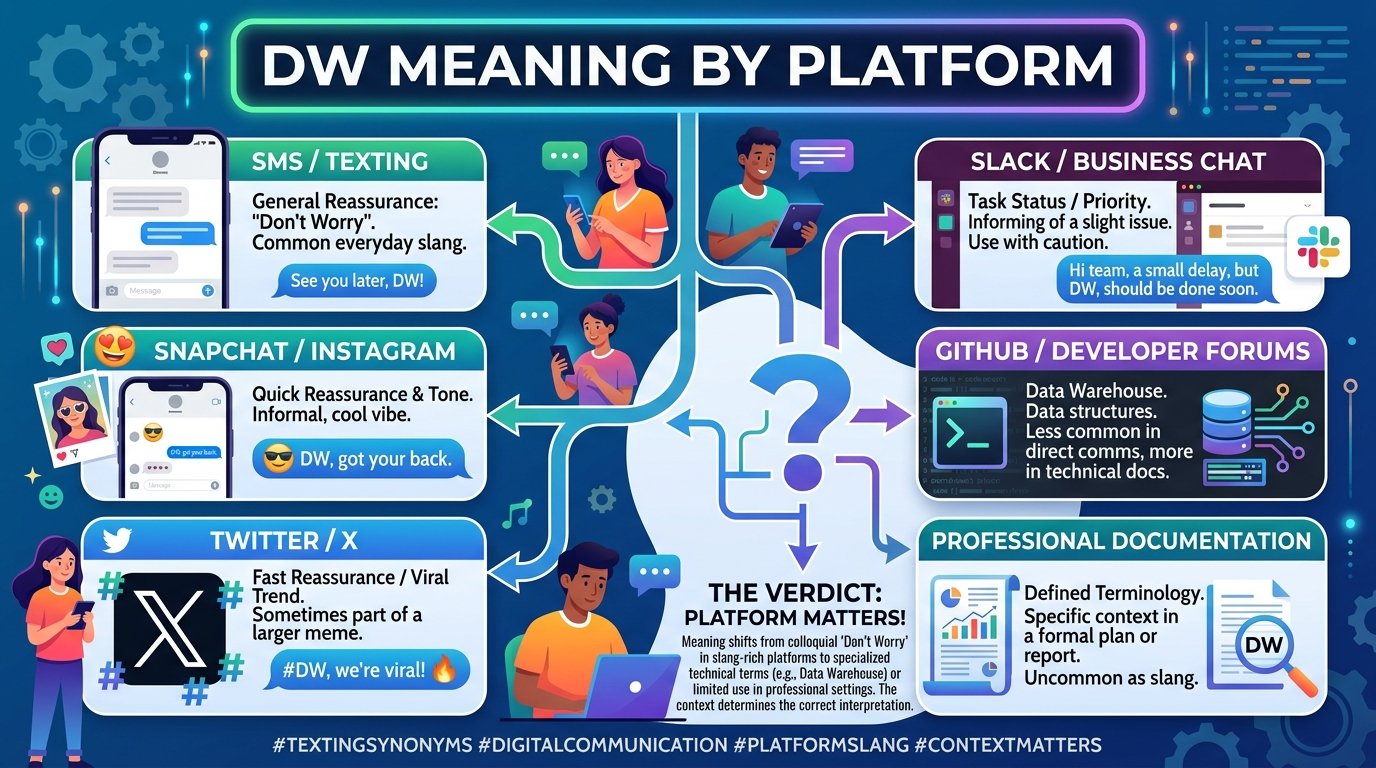
Does DW meaning in chat change from app to app? No. The words behind it stay the same. What shifts is the surrounding culture.
- Text messages: Relaxed and common. Most people understand it right away.
- WhatsApp: Popular among friends and family. Voice notes often replace it for longer comfort.
- Snapchat: Fast and casual. DW fits the quick-reply style.
- Instagram DMs: Common in friendly chats. Often paired with an emoji.
- Discord: Gamers use it often. It can also hint at game titles (more on that below).
- Slack: Fine in casual team threads. Spell it out for formal updates.
Across every app, instant messaging rewards speed. That’s why this chat abbreviation thrives. It does a big job in two letters.
Other Meanings of DW
Context decides which meaning applies. Most of the time, it’s “don’t worry” in a chat. Outside a chat, the letters can point somewhere else entirely. Here are the other meanings of DW you might run into.
| Meaning | Where you’ll see it | Clue to spot it |
|---|---|---|
| Dear Wife | Parenting and family forums | Sits near DH, DS, DD |
| Dishwasher | Home listings, recipes, appliance talk | Kitchen or house topic |
| Doctor Who | TV fan chats | Talk of Doctors, TARDIS, episodes |
| Deutsche Welle | News and media | Links to dw.com |
| Data Warehouse | IT and analytics | Databases, reports, pipelines |
| Dynasty Warriors / Dragon Warrior | Gaming | Console or PC game talk |
| DeWalt model numbers | Tool reviews | Numbers like DW745 |
Dear Wife
On many family and parenting forums, members use short labels for relatives. DH means “dear husband.” DS means “dear son.” DD means “dear daughter.” And DW means Dear Wife.
A post might read, “DW and I are planning a trip.” You won’t mistake it for “don’t worry” there. The forum setting gives it away.
Dishwasher
In home listings, DW often stands for dishwasher. A rental ad might say “Updated kitchen with DW and granite counters.” That’s a real estate shorthand. It saves space in a short listing.
Doctor Who
Fans use DW for Doctor Who, the long-running British sci-fi series. The show first aired on the BBC on November 23, 1963. That makes it one of the longest-running science fiction programs in television history. You can visit the official BBC page for Doctor Who to learn more.
Deutsche Welle
Deutsche Welle is Germany’s international broadcaster. It started radio broadcasting in 1953. It now publishes news in dozens of languages online at dw.com. Even its web address uses the letters. If someone shares a “DW article,” this is probably what they mean.
Data Warehouse
In IT, Data Warehouse is a central system that stores data from many sources for reporting and analysis. Teams abbreviate it as DW or DWH. A data analyst might say, “We load the sales numbers into the DW every night.” That’s a very different sentence from “dw, it’s fine.”
Dynasty Warriors and Dragon Warrior
Two video game franchises share the abbreviation. Dynasty Warriors is a hack-and-slash series from Koei. Its first game arrived in 1997. Dragon Warrior was the North American name for the early Dragon Quest games. The first one landed on the NES in 1989.
DeWalt Model Numbers
DeWalt power tools often carry model numbers that begin with DW. The DW745 compact table saw is one well-known example. If a reviewer says “the DW745 cuts clean,” they aren’t telling you to relax. You can browse the brand at dewalt.com.
How to Tell Which DW Meaning Someone Intends
Clues are everywhere. You just need to know where to look. Start with the topic. Then check who’s talking and where.
After an Apology or Mistake
If someone just said sorry or confessed a slip, it’s almost surely don’t worry.
When Someone Sounds Stressed
A nervous message followed by “dw” means comfort. No question.
In Family-Forum Posts
If the thread mentions kids and spouses, think Dear Wife.
In Gaming, TV, or Home Topics
Quick Decoder
| Clue | Likely meaning |
|---|---|
| Follows “sorry” or “oops” | Don’t worry |
| Appears next to DH, DS, DD | Dear Wife |
| Listed in a rental ad | Dishwasher |
| Mentioned with TARDIS or Daleks | Doctor Who |
| Linked to a news site | Deutsche Welle |
| Used in analytics talk | Data Warehouse |
| Paired with a number like 745 | DeWalt model |
What Tone Does DW Carry?
The words say “don’t worry.” The tone says how much they mean it. This is where text message meaning gets tricky. You can’t hear a voice or see a face. You only have punctuation, timing, and length to go on.
| Message | Likely feel |
|---|---|
| “dw!” | Warm and encouraging |
| “dw.” | Flat or clipped |
| “dw about it” | Firm; may close the topic |
| “dw, I’ve got you” | Supportive and sincere |
What Shifts the Tone
Several things push a message one way or the other:
- Punctuation: Exclamation marks warm things up. Periods cool them down.
- Emoji: A smile or heart softens the line.
- Message length: A longer reply feels more caring than a bare “dw.”
- The sender’s usual style: Some people always text in short bursts. Compare it with their normal pattern.
- Timing: An instant reply feels casual. A very late one can feel distant.
Sincere vs. Clipped
Here’s a rule of thumb. If the person is genuinely upset, a bare “dw” can sound dismissive. It seems to say, “I don’t have time for your feelings.” Add a few words instead. “dw, I know you’re stressed. We’ll sort it out” lands much better.
Does DW Always Mean Don’t Worry?
No. In casual chats it almost always does. Outside chats, the DW acronym changes with the field. Gamers think of Dynasty Warriors. Tool fans think of DeWalt. Analysts think of data warehouses.
The word “acronym” is a small trap here. Strictly speaking, an acronym is read as a word, like NASA. DW is read letter by letter. So it’s an initialism. Most people use the terms loosely anyway.
Using DW with Friends, Family, and Coworkers
Who you text changes how you should text. The same two letters can feel perfect in one chat and sloppy in another.
Friends and Family
This is the home turf of casual messages. DW fits naturally. Your sister, your best friend, and your cousin will all get it. Use it freely.
Workplace Messages
In digital communication at work, the rule is simple: match the room. A relaxed Slack thread can handle “dw.” A message to a client or a senior leader needs full words. Write “No problem at all” or “Please don’t worry about it.”
Case Study: The Slack Reschedule
This example is an illustration, not a real conversation.
A project manager named Dana needs to move a team meeting. Her teammate Marcus writes:
Marcus: Sorry, I can’t make 2 p.m. tomorrow. Can we shift it?
Dana: dw, 3 p.m. works. I’ll update the invite.
The tone works. The channel is casual. The two coworkers know each other. Dana also adds action after the DW. She solves the problem instead of just waving it off.
Now picture the same exchange with a new client:
Client: Sorry, I need to move our call.
Dana: dw.
That reply would feel abrupt and a bit careless. Dana should write, “No problem at all. What time works for you?”
How to Reply to DW
Replying is easy. Often you don’t have to.
When You Don’t Need to Reply
If the matter is closed, you can leave it. The DW ended the topic. A thumbs-up reaction works if you want to acknowledge it.
Quick Reply Options
If you want to respond, try one of these:
- “Thanks!”
- “Appreciate it.”
- “You’re the best.”
- “Thanks for understanding.”
When to Follow Up
Follow up if the tone felt off. For instance, a flat “dw.” after a big mistake might hide hurt feelings. A short check-in helps: “Thanks. Just checking we’re good?” Likewise, follow up if the problem still seems open. A DW doesn’t always fix the issue itself.
DW vs. Similar Texting Expressions
Many similar texting expressions carry related meanings. Some feel nearly identical. Others feel quite different. Here’s how they compare.
| Expression | Stands for | Typical feel |
|---|---|---|
| DW | Don’t worry | Reassuring |
| NW | No worries | Easygoing, friendly |
| NP | No problem | Casual, helpful |
| NBD | No big deal | Playing it down |
| NVM | Never mind | Dropping a topic; can feel cold |
| IDC | I don’t care | Dismissive or blunt |
DW, NW, NP, and NBD sit in the same friendly family. They all calm things down. NVM and IDC are different. “NVM” often signals that someone gave up on explaining. “IDC” tells you they truly don’t care or want to look like they don’t.
A quick example makes the gap clear:
Them: Sorry about the late reply.
You: dw. (Warm.)
You: idc. (Cold, even rude.)
DW vs. NW
NW means “no worries.” It responds to something. DW means “don’t worry.” It can also come before a problem to prevent worry. “dw, I’ll be there” is natural. “nw, I’ll be there” sounds a bit off.
DW vs. NP
NP means “no problem.” You usually say it after a favor or thank-you. DW covers apologies and fears, so it has a wider reach.
DW vs. NVM
NVM ends a conversation. DW soothes one. They don’t swap well.
DW vs. IDC
IDC dismisses. DW comforts. Don’t mix them up.
Is DW Formal or Informal?
DW is informal. It belongs in friendly chats and quick messages. It doesn’t belong in formal email, cover letters, or client notes.
The quick rule: if you’d wear jeans to the conversation, DW is fine. If you’d wear a suit, spell it out. Good formal swaps include “Please don’t worry,” “There’s no need to apologize,” and “It’s no trouble at all.”
Mistakes to Avoid When Using DW
Even a tiny abbreviation can backfire. Watch out for these slips.
- Using it when someone needs a real answer. If a friend asks, “Are we still on for Friday?” a bare “dw” doesn’t answer anything.
- Sending a bare “dw” to someone upset. Add a few caring words.
- Using it in formal email. It looks careless.
- Skipping context in a mixed-meaning space. On a gaming server or a tool forum, spell it out so people don’t read it as a game or a model number.
- Overlooking the period. “dw.” can feel cold. Drop the dot or add a smile.
Alternatives Worth Knowing
Variety keeps your messages fresh.
- No worries: Friendly and widely understood.
- All good: Relaxed and breezy.
- No problem: Slightly more polished.
- It’s fine: Neutral.
- Don’t sweat it: Warm and playful.
- You’re good: Gentle and casual.
FQAs
What does DW mean in texting?
DW stands for “don’t worry.” People use it to reassure a friend, forgive a small mistake, or close a topic.
Is DW still used in 2026?
Yes. This texting abbreviation remains common in text messages, WhatsApp, Snapchat, Instagram DMs, and Discord. Its short form keeps it handy for quick replies.
What are the other meanings of DW?
Context decides. DW can mean Dear Wife on family forums, dishwasher in home listings, Doctor Who among TV fans, Deutsche Welle in news, or Data Warehouse in IT.
What’s the difference between DW and NW?
DW means “don’t worry” and often comes before a problem. NW means “no worries” and usually answers one. Both feel friendly and casual.
Is it okay to use DW at work?
It’s fine in casual team chats like Slack. Spell it out in client emails or messages to senior leaders. Try “No problem at all” or “Please don’t worry about it.”
Want me to add schema markup for these FAQs or swap in different questions?
Conclusion
The /dw-meaning-in-text/ is simple. DW means “don’t worry.” People use it to calm nerves and shrug off small mistakes. It’s quick, friendly, and easy to type. It keeps chats light. You’ll see it in texts, chats, and DMs every day.
Spell it out at work. Use it with friends and family. Bookmark /dw-meaning-in-text/ for a quick refresher. Now you can text with confidence.