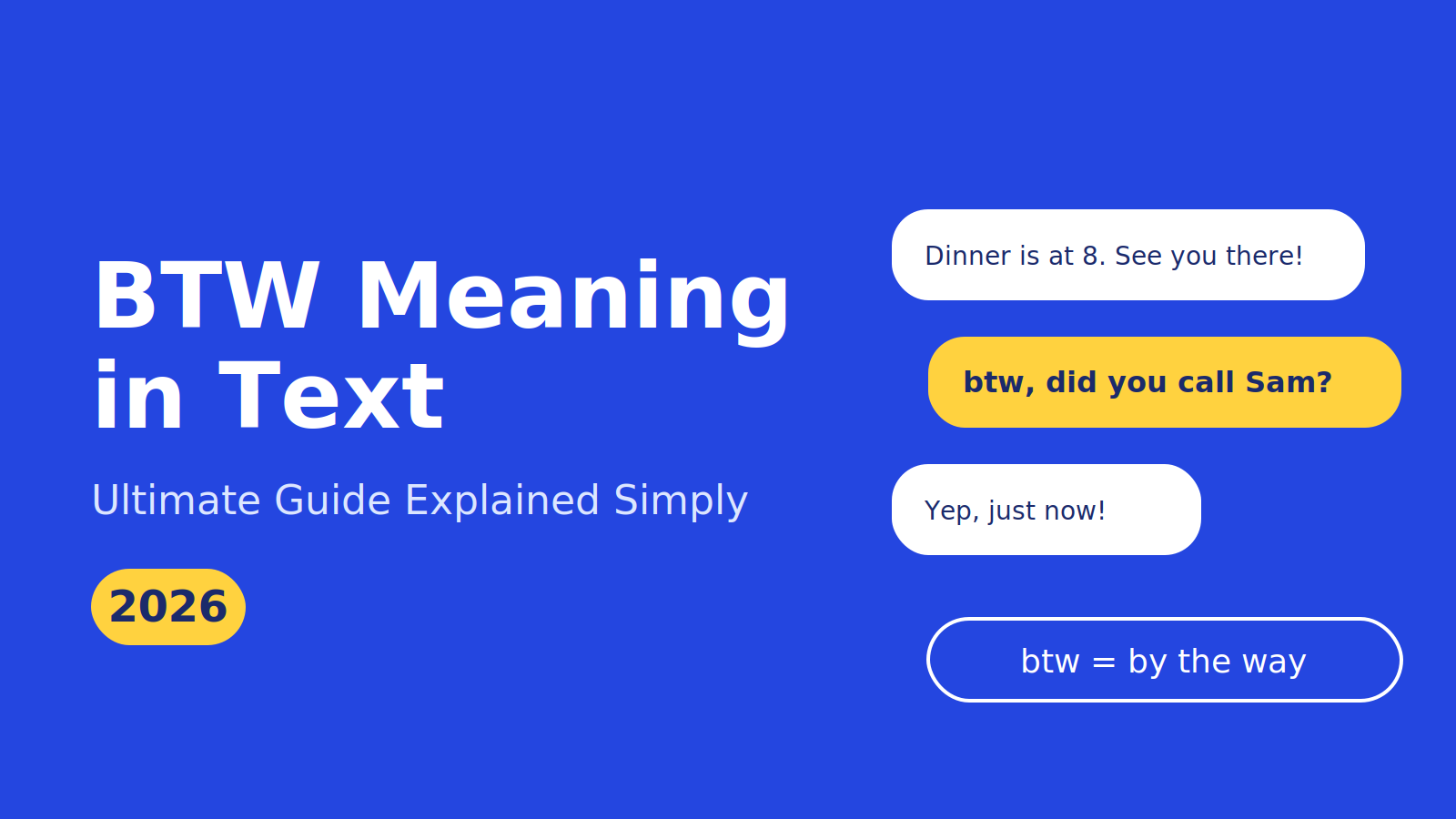
The BTW meaning in text is “by the way.” People type it to add a side note, shift to a new topic, or slip in a quick reminder without making a fuss.
Three letters. Zero effort. Yet that tiny abbreviation can soften a request, smooth a topic change, and keep a chat flowing like a well-oiled machine.
Here’s the surprise. The BTW meaning in text shows up in a 1981 Usenet post, long before smartphones existed. Today it fits casual chats, social media comments, and workplace messaging alike. This guide shows you how to use it, when to skip it, and which swaps sound best.
What Does BTW Mean in Text?
BTW is shorthand for “by the way.” In BTW in texting, it introduces something that isn’t the main point of your message. Think of it as a verbal sticky note. You attach it to a conversation without derailing it.
Here’s the quick answer. BTW means “by the way.” People use it to add additional information, make a topic change, or drop a gentle reminder in casual conversations.
BTW Definition at a Glance
The BTW abbreviation meaning is simple, but a few details help. This table sums up the basics.
| Detail | Answer |
|---|---|
| Full form | By the way |
| Type | Initialism (you read each letter) |
| Formality | Informal |
| Common channels | Text messages, chats, comments, workplace chat |
| Main jobs | Side notes, topic shifts, light reminders |
| Accepted spellings | BTW, btw, Btw |
Major dictionaries agree on the core meaning. Dictionary.com lists it as an abbreviation of “by the way,” used especially in emails and text messages.
How People Write and Say BTW
You’ll see the meaning of BTW written three ways. Capital letters (BTW) feel emphatic. Lowercase (btw) feels relaxed. A capital first letter (Btw) usually appears at the start of a sentence in an email or post.
All three mean the same thing. Lowercase simply fits the vibe of modern text message shorthand.
Spoken aloud, people say each letter: “B-T-W.” Even so, most people just say “by the way” out loud. The abbreviation belongs to online messaging more than to speech.
Other Meanings of BTW You Might Run Into
Context matters. In the Netherlands and in Afrikaans-speaking regions, BTW also stands for value-added tax, or VAT. Wiktionary lists this meaning for both languages.
So if you spot “BTW” on an invoice from a Dutch company, don’t expect a casual aside. It’s a tax line.
Here’s an easy rule. If the abbreviation sits in a chat, it means “by the way.” If it sits next to prices and totals, it means tax.
BTW Abbreviation Origin and Internet Slang History
Most people assume BTW is a product of smartphones. It’s much older. The story of this abbreviation is also a window into internet slang history and the broader online slang evolution that shaped how we type today.
The 1981 Usenet Sighting
Many articles claim BTW started in 1989. The evidence points earlier. Wiktionary cites a June 1981 post in a Usenet group called fa.unix-wizards. The writer used “BTW” to tack on a quick note about a promotion and a new contact person.
Network World adds another clue. The article says BTW appears in the first Jargon File, which dates to 1981.
That’s a strong pair of data points. It places the abbreviation in the early days of electronic communication, long before the web.
The 1989 Dictionary Date and FidoNews
So why does 1989 keep popping up? Etymonline says BTW was in use by 1989. That’s the earliest date reference works commonly give.
Wiktionary also quotes a May 1989 issue of FidoNews, a newsletter for hobbyist bulletin board systems. That issue defined BTW as “by the way.”
Here’s a clean timeline.
| Year | What happened | Where it’s documented |
|---|---|---|
| 1981 | “BTW” appears in a Usenet newsgroup post | Wiktionary |
| 1981 | BTW listed in the first Jargon File | Network World |
| 1989 | FidoNews defines BTW as “by the way” | Wiktionary |
| 1989 | Earliest commonly cited dictionary dating | Etymonline |
Case Study: What the 1981 Post Teaches Us
Look closely at that first Usenet use. The writer finished the main message about a book license. Then they added a side note about a coworker’s promotion.
Sound familiar? That’s exactly how people use BTW in texting today. The function hasn’t changed in more than 40 years. Only the device did.
That’s rare in digital language history. Many abbreviations fade or change meaning. BTW kept doing the same job.
The Phrase Is Older Than Computers
Here’s another twist. Network World quotes language researcher Ben Zimmer, who says BTW and FYI both existed long before computers. Writers have shortened “by the way” on paper for ages.
The internet didn’t invent the habit. It gave the habit a home and a name.
Why Short Forms Spread So Fast
Early networks were slow and costly. Typing less saved time, so chat abbreviations thrived. Later, SMS slang pushed brevity even further, because early phone texts had tight character limits.
Today, nobody needs to save keystrokes. Yet we still type “btw.” Why? Because shorthand carries tone. It signals that you’re relaxed and the point is small.
That staying power says a lot about texting culture.
How BTW Is Used in Conversations
Now let’s get practical. BTW in texting does three main jobs. Each one supports smooth conversational flow.
Adding Additional Information
The most common use is a side note. You’ve made your main point. Now you want to add extra details without making them the headline.
Here’s an example:
“I’ll bring the chips. btw, Maya can’t make it Saturday.”
The main message is the chips. The extra detail rides along quietly.
This works well because it frames supplementary information as optional. The reader knows the note matters less than the main message. It’s additional context that doesn’t demand a big reaction.
Changing Topics Smoothly
BTW is also a gentle pivot. Instead of jumping to a new subject, you use it as a conversation transition.
For example:
“That concert was unreal. btw, did you finish that report?”
Notice how the shift feels softer. The abbreviation says, “I know we were talking about something else, but this just came to mind.”
Wikipedia’s entry on BTW makes a helpful distinction. BTW introduces a new, usually minor topic. FYI, by contrast, passes along a fact you think the other person should know. That difference matters when you’re shifting topics in informal chats.
Other transition phrases do similar work, such as “speaking of which” or “on another note.” BTW is simply the shortest.
Slipping in a Reminder or Request
BTW can also soften a nudge. Compare these two messages.
- “Send me the file tonight.”
- “btw, can you send me the file tonight?”
The second one feels friendlier. It tucks the request into relaxed communication instead of delivering it as a command.
That makes BTW a handy tool for follow-up information, too. You can use it to circle back to something you forgot earlier.
Where BTW Sits in a Message
You can place it three ways.
- At the start: “BTW, the meeting moved to 3.”
- In the middle: “I’m leaving now, btw, so text me if plans change.”
- At the end: “Thanks again for dinner, btw.”
The start is the most common spot. It works like a spoken “oh, one thing.”
On punctuation, add a comma after BTW when it opens a sentence. Skip the period in quick texts. Nothing about the abbreviation requires special capitalization afterward.
BTW Examples in Text Messages and Everyday Discussions
Examples make the rule stick. These show BTW in texting across everyday discussions and friendly conversations.
| Situation | Example text | What BTW signals |
|---|---|---|
| Making plans | “See you at 8. btw, parking is free after 6.” | Helpful extra |
| Switching topics | “Loved that show. btw, did you call Sam?” | New, minor subject |
| Reminder | “btw, rent is due Friday.” | Gentle nudge |
| Gratitude | “btw, thanks for the ride yesterday.” | Casual afterthought |
| Final note | “Good luck tomorrow! btw, text me after.” | Last small ask |
| Sharing news | “Dinner was great. btw, they’re opening a second location.” | Fun side fact |
| Logistics | “I’ll be late, btw. Start without me.” | Added context |
| Question | “btw, are you free next weekend?” | Low-pressure question |
Dictionary.com also shows BTW in news-style writing. Its example sentences include travel tips that start with “BTW:” to flag a handy detail. That tells you the abbreviation isn’t limited to texting.
Sounds Natural vs. Sounds Off
A quick comparison shows the sweet spot.
Natural: “Got your package. btw, it’s on the porch.”
Off: “btw, I have terrible news. Our flight was canceled.”
The second example buries urgent news under a casual label. When something matters, lead with it. BTW belongs to personal messaging where the detail is secondary.
BTW in Social Media Communication
Short formats love short words. That’s why BTW thrives in social media communication, from comment threads to group chats.
Here’s how it shows up across online posts and social networking.
- Comments and replies: People add a clarification without writing a whole new post.
- Direct messages: It softens extra questions in online conversations.
- Group chats: It lets someone slip in logistics without interrupting the flow.
- Instagram captions: Writers sometimes use it to add a playful aside after the main caption.
- TikTok acronyms and comments: Viewers use it for quick extra thoughts under videos.
Treat this as social media slang with a stable meaning. Unlike trendier terms, BTW doesn’t shift from platform to platform. That makes it safe across internet chats and web communication.
Casing carries tone here. A lowercase “btw” in a comment feels breezy. An all-caps “BTW” in a post can feel like a deliberate spotlight on the extra point.
Most internet expressions come and go. BTW sticks around because it fits every format, from a reply to a long post.
Tone and Intent Behind BTW
Does BTW sound friendly or rude? Usually, friendly. It reads as neutral, light, and low-pressure.
Still, tone depends on context. Here’s a quick guide.
- Neutral: “btw, the store closes at 9.” Pure information.
- Friendly: “btw, you looked great in those photos!” A warm aside.
- Pointed: “Thanks for the update. btw, you forgot to include me last time.” A sharp remark in a casual wrapper.
That third example shows how writers sometimes use BTW to deliver a critique while keeping a polite surface. Readers pick up on it through the surrounding words.
So what should you do? If you mean to be kind, keep the aside brief and warm. If you’ve got a real complaint, say it directly rather than hiding it behind a casual label.
That small choice shapes your digital conversations. It also protects trust in virtual interactions, where tone is easy to misread.
Common Texting Mistakes People Make With BTW
Even a simple abbreviation causes communication mistakes. Here are the most common texting errors and their fixes.
Using BTW for the Main Point
Mistake: “btw, I’m moving to Denver next month.”
Fix: Lead with it. “Big news: I’m moving to Denver next month.”
A major announcement shouldn’t hide behind a casual label.
Mixing Up BTW and FYI
Mistake: Using BTW when you mean to pass along a must-know fact.
Fix: Use FYI for information the reader should have. Use BTW for side notes.
This is a classic case of acronym confusion.
Stacking Too Many BTWs
Mistake: “btw, the date changed. btw, bring snacks. btw, call me.”
Fix: Combine the points in one message, or use a short list.
Too many asides make your message feel scattered.
Using BTW in Formal Writing
Mistake: Putting “BTW” in a client proposal.
Fix: Write “by the way” or choose a formal substitute.
This is abbreviation misuse at its most visible. It also hurts credibility in professional writing.
Using BTW When There’s No Side Note
Mistake: “btw, I’ll meet you at noon” as the only message in the chat.
Fix: Drop it. BTW needs a main message to sit beside.
All of these are forms of incorrect slang usage. The good news? Each one is easy to fix once you spot it.
BTW vs FYI and Other Texting Acronyms
BTW has plenty of cousins. Knowing the differences keeps your texting acronyms sharp. This table covers common text abbreviations you’ll see beside it.
| Acronym | Stands for | Use it when |
|---|---|---|
| BTW | By the way | Adding a side note or minor new topic |
| FYI | For your information | Passing along something the reader should know |
| FWIW | For what it’s worth | Offering a thought with modest weight |
| OTOH | On the other hand | Introducing a contrast |
| IMO | In my opinion | Marking a view as your own |
| PS | Postscript | Adding a final note to a letter or email |
| TBH | To be honest | Signaling a candid comment |
BTW vs FYI
This is the pair people confuse most. According to Wikipedia, the two are interchangeable in casual chats but not in formal ones. FYI points out a fact you want the reader to notice. BTW slides in a minor extra.
FYI also tends to feel more formal. You’ll see it in work emails more often than BTW.
BTW vs PS
A postscript sits at the end of a letter or email. BTW can sit anywhere. Plus, PS feels deliberate and a bit old-fashioned, while BTW feels spontaneous.
BTW vs FWIW
FWIW signals that you’re offering an opinion or suggestion. BTW adds information. One expresses modesty, and the other adds a note.
Understanding these Internet terminology differences makes your chat abbreviations sound natural instead of random.
Is BTW Okay to Use at Work?
Short answer: sometimes. Context and audience decide. Workplace messaging runs on different rules than texting with friends.
This table gives a practical guide.
| Channel | Verdict | Why |
|---|---|---|
| Team chat (Slack, Teams) | Usually fine | Quick, casual office chat |
| Email to coworkers | Depends | Check your team’s tone |
| Client or executive email | Spell it out | Needs polish |
| Reports and proposals | Avoid | Calls for formal communication |
| Official letters | Avoid | Formal correspondence standards |
Work Chat vs Work Email
Most teams treat chat as relaxed. A quick “btw, the call moved to 2” fits right in. Email feels more formal, so the same note might read better as “By the way, the call moved to 2.”
The safest tip is to mirror the other person. If your manager writes casually, you can too. If they write in full sentences, follow their lead.
Sample Messages Written Both Ways
Team chat: “Thanks for the update! btw, can you share the slides?”
Client email: “Thank you for the update. By the way, could you share the slides when you have a moment?”
Both say the same thing. The second suits business writing and professional emails better.
A Fair Note on Limits
Workplace norms vary a lot. A startup might love abbreviations. A law firm might ban them. Treat these tips as a starting point, then adjust for your own corporate communication culture.
In business messaging, your goal is clarity. When in doubt, write the full phrase. It never hurts, and it always keeps your workplace language safe and clear.
Alternatives to BTW by Tone
Sometimes you want a swap. These options work across professional communication and casual settings.
| Tone | Options |
|---|---|
| Casual | “oh, and,” “side note,” “random, but” |
| Neutral | “by the way,” “one more thing,” “also” |
| Formal | “incidentally,” “on a related note,” “as an aside” |
Here’s how they look in action.
- Casual: “Side note, the café has a new menu.”
- Neutral: “One more thing: parking is limited.”
- Formal: “Incidentally, the deadline has moved to Friday.”
Each swap changes conversational flow slightly. Casual options feel playful. Formal ones suit professional writing and work emails.
Pick the version that matches your audience, and your message will land the way you intend.
Is BTW Still Used in 2026?
Yes. And its staying power is the interesting part.
Dictionaries still list it. Dictionary.com shows it with current examples from journalism and everyday writing. People still use it in digital messaging, workplace chat, and online communication across every age group.
Why hasn’t it faded? A few reasons stand out.
- It does a specific job. No other short word marks a side note as cleanly.
- It’s easy to understand. Nearly everyone recognizes it.
- It fits every platform. Chats, comments, and emails all accept it.
- It carries tone. It tells readers the point is small.
Unlike many trendy terms, BTW isn’t tied to a moment. It’s a durable piece of digital communication. More than 40 years after the first documented uses, it still works the same way.
That says something about virtual communication in general. The tools change. The need for a quick, friendly aside doesn’t.
FAQs
BTW Meaning in Text: Frequently Asked Questions
What Does BTW Mean in Text?
The BTW meaning in text is “by the way.” You use it to add a side note, change the topic, or drop a quick reminder in casual conversations.
What Is the Difference Between BTW and FYI in Texting?
BTW in texting adds a minor side note or new topic. FYI shares a fact the reader should know, and it sounds a bit more formal, according to Wikipedia.
When Did the BTW Abbreviation Start?
The earliest documented use of the BTW abbreviation is a June 1981 Usenet post, per Wiktionary. Reference works like Etymonline commonly cite 1989.
Can You Use BTW in Work Emails and Workplace Messaging?
Yes, in casual workplace messaging like team chat. For clients, executives, or formal correspondence, write out “by the way” instead.
What Does BTW Mean in Dutch?
In Dutch and Afrikaans, BTW stands for value-added tax (VAT), per Wiktionary. In an English chat, the meaning of BTW is still “by the way.”
conclusion
BTW Meaning in Text: Final Thoughts
The BTW meaning in text is simple. It stands for “by the way.” You use it to add a side note, change the topic, or share a quick reminder. It sounds friendly and relaxed. People have used it since 1981.
Knowing the BTW meaning in text helps you write with confidence. Use it in casual chats and team messages. Skip it in formal emails and reports. Match your tone to your reader. Keep it short and sweet. Your message will land well.