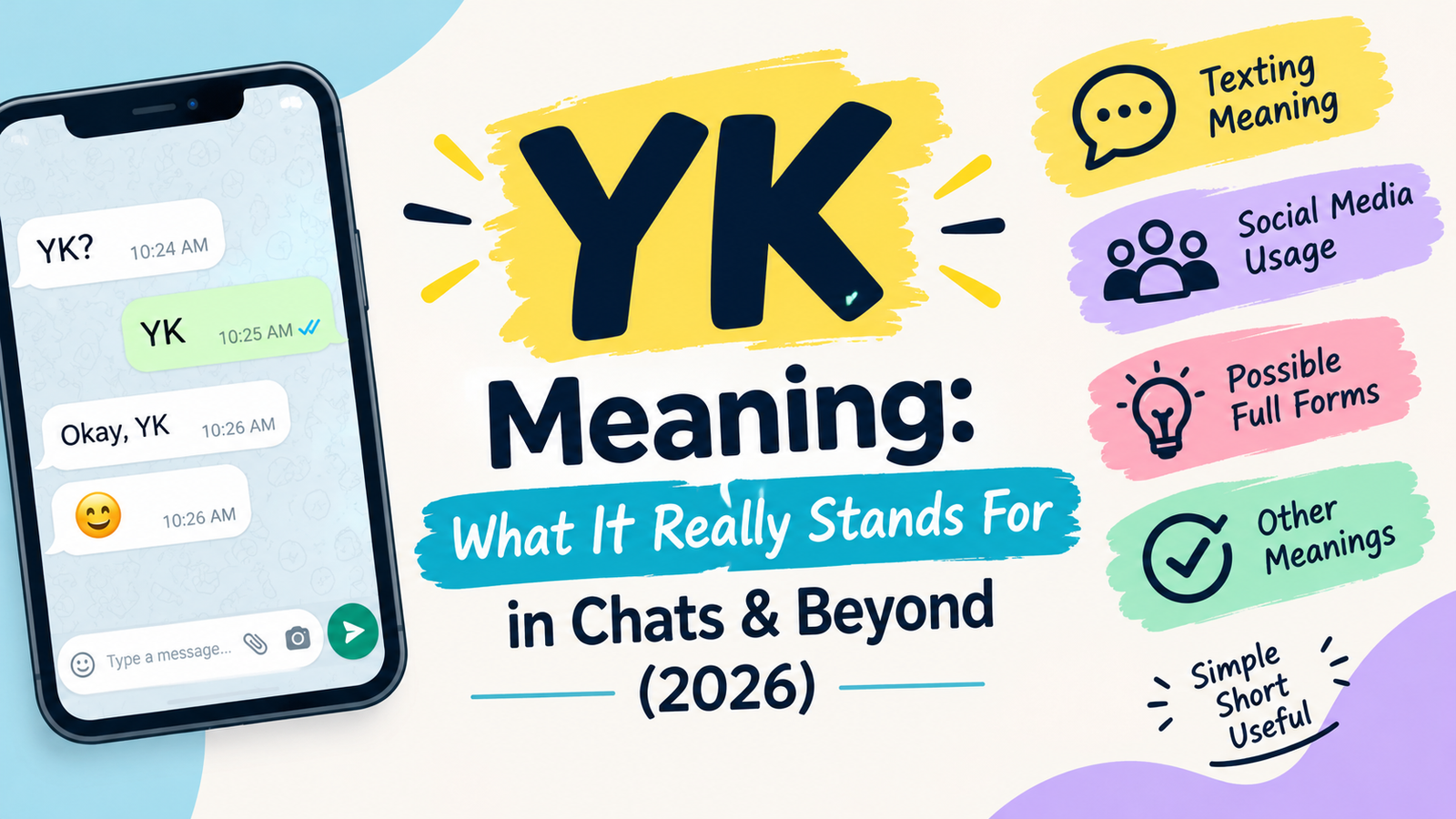
The YK meaning is simple: “you know.” This two-letter YK abbreviation works as a casual cue in texts, comments, and chats. People type it to check that you’re following along.
Two letters can flip a message’s whole mood. One tiny “yk” sounds warm in one chat and dismissive in another. You’ve probably typed it without a second thought.
The YK meaning also stretches beyond simple filler. Linguists file “you know” under discourse markers. It shapes tone in dating app messages and group chats too. Learn where it fits and where it flops. Master the YK meaning and you’ll sound natural everywhere.
Key Takeaways
- The YK meaning is “you know,” a shortened form of a common spoken phrase.
- YK in texting works as a filler, a check-in, or a softener.
- Capitalization changes nothing. “yk,” “Yk,” and “YK” all match.
- Skip it in formal writing and professional emails.
- Don’t confuse it with YKW, YKWIM, or IYKYK.
- No reliable source gives a dated first use of the abbreviation.
- Only low-quality pages claim it means “you’re kidding.”
YK Meaning & Definition: What Does YK Stand For?
Let’s start with the basics. YK stands for “you know.” It’s a YK abbreviation that grew out of spoken English. You type two letters instead of eight characters (the two words plus the space). That’s a 75% cut.
Quick reference:
| Item | Detail |
|---|---|
| Abbreviation | YK |
| Stands for | You know |
| Type | Initialism and conversational filler |
| Tone | Casual and friendly |
| Common spots | Texts, DMs, comments, Discord |
| Formal use | Avoid |
So when someone asks what does YK mean, you can answer in one line. It means “you know.” The meaning of YK stays the same on every platform. Only the tone shifts.
YK Meaning in Text: Short for “You Know”
Think about how you talk. You say, “It’s been a long week, you know?” You don’t mean the listener holds secret information. You’re inviting them to nod along.
That’s the you know meaning in conversation. It assumes shared understanding. In text, YK carries the same job. It’s text message slang with a spoken-word soul.
You’ll see it do three things:
- Bridge ideas. “It’s been a long week, yk?”
- Nudge for agreement. “That place is overrated, yk.”
- Soften a statement. “I’m just tired, yk.”
Many texting abbreviations replace whole words. This one replaces a verbal habit. That’s why it feels so natural.
Is YK a Filler Word or a Discourse Marker?
Both labels fit. Linguists sort speech fillers into two groups. “Um” and “uh” are filled pauses. “You know,” “I mean,” and “like” are discourse markers. One study of filler words ran a factor analysis and landed on exactly that split. The researchers grouped “I mean,” “you know,” and “like” as discourse markers and treated “uh” and “um” as filled pauses. You can read the details in the Laserna study summary.
Here’s the surprise. Teachers once called these phrases empty. Traditional views treated such items as fillers with no function. Modern analysis assigns them jobs like topic changes, hedging, and backchanneling. The Wikipedia entry on discourse markers lays out that shift.
Why does this matter for you? Because the YK meaning isn’t just “you know.” It’s also a signal about how the sentence should land. Each discourse marker shapes the speech patterns around it.
Researchers have mapped what “you know” does:
| Function | What it does | Chat example |
|---|---|---|
| Checks understanding | Confirms the listener follows | “That makes sense, yk?” |
| Appeals for agreement | Invites a nod | “Mondays are rough, yk.” |
| Softens a claim | Hedges a strong opinion | “I’m not a fan, yk.” |
| Buys thinking time | Fills a beat | “I was gonna say, yk, we could go.” |
The first row has direct support. One summary notes that “you know” invites listeners to make inferences, and other research says it confirms understanding. A Pacific Standard report covers it. Another source adds a social angle. Linguist Handford says fillers help conversations feel more polite. In his words, they play “a really important politeness function.” The full quote sits in The Swaddle’s piece on filler words.
There’s also academic proof of range. A 2005 conference paper studied real face-to-face talk. It found that “you know” appears often and does many jobs, depending on tone, position, and the relationship between speakers. Its keywords include labels such as appealer, empathizer, and monitor.
How Tone and Punctuation Change the YK Meaning
Text strips out your voice. So tone indicators like commas and question marks do the heavy lifting. A tiny mark can flip the YK meaning from a shrug to a real question.
YK as a Statement vs. YK as a Question
Compare these two:
- “I’m over it, yk.” This one assumes the reader gets it.
- “I’m over it, yk?” This one asks for confirmation.
The first is a statement of shared feeling. The second is a soft check-in. Reply accordingly.
Mid-Sentence YK vs. End-of-Sentence YK
Mid-sentence, YK acts as a pause. “I was thinking, yk, we should leave early.” The reader barely registers it.
At the end, it works as a hook. “We should leave early, yk.” Now it invites a response. The communication context decides how strong that invitation feels.
Lowercase vs. Caps
Case doesn’t change the definition. Lowercase feels relaxed. Caps add punch. “YK I can’t stand that show” sounds more emphatic than “yk I can’t stand that show.” Same words. Different volume.
Where Did YK Come From? Origin of the YK Abbreviation
Now for the history. Here’s the honest version.
Origin of the YK Meaning in Spoken English
The phrase “you know” is far older than any phone. Researchers have tracked it in speech for decades. Deborah Schiffrin’s 1987 book Discourse Markers popularized the term and named “you know” as a core example. That’s nearly four decades of formal study.
You also hear it constantly in everyday conversation. The 2005 paper mentioned above found it frequent in authentic dialogue. So the abbreviation didn’t invent a habit. It captured one.
How Texting Constraints Shaped Shorthand
Early phones forced brevity. The SMS standard capped messages at 160 characters. The first text message went out in December 1992. Typing on number pads was slow too.
Those limits shaped text shorthand and chat abbreviations. People cut vowels. They swapped words for initials. Even after limits loosened, the habit stuck. Instant messaging rewards speed. Thumbs reward fewer taps.
That’s how digital communication produced a long list of common abbreviations. “You know” became YK for the same reason “by the way” became BTW. It saves effort without losing meaning.
What Can and Can’t Be Proven About YK’s First Use
Here’s where many sites invent stories. Don’t trust them.
| Claim | Status |
|---|---|
| YK stands for “you know” | Confirmed by consistent usage |
| “You know” is an established discourse marker | Confirmed by linguistics research |
| A specific person coined YK | No reliable source |
| YK started on a specific platform on a specific date | No reliable source |
Compare that with a related term. Dictionary.com says IYKYK has appeared on social media since at least 2009, with growth in the mid-2010s. You can verify it on the Dictionary.com IYKYK entry. Pusha T’s 2018 track “If You Know You Know” then pushed the longer phrase further into the mainstream.
YK has no such dated record. If a page gives you an exact birthday for it, be skeptical.
How People Use YK in Real Chats
Usage depends on the room. Let’s walk through four common ones.
Casual Texting Between Friends
This is home turf. In casual text messaging, YK works like a verbal elbow nudge. It fits texting between friends, everyday texting, and quick informal messages.
Three patterns show up again and again:
- Venting: “Work was a lot today, yk.”
- Bonding: “Same thing happened to me, yk.”
- Hedging: “I might skip tonight, yk, I’m wiped.”
Case study (illustrative scenario): Maya texts her roommate, “Cooking again, yk? I’m so over takeout.” Her roommate replies, “Yes. Pasta night.” The YK didn’t ask for new facts. It asked for company. The reply gave it.
Social Media Captions & Comments
On social media captions, brevity wins. Short fillers give a post a relaxed voice. That works across Instagram captions, TikTok comments, and Snapchat posts.
Examples:
- Caption: “Sunday reset, yk.”
- Comment: “this song hits different, yk”
- Story reply: “Same, yk.”
This is social media slang in its simplest form. It supports online engagement because it sounds human. Readers reply to a voice that feels like a friend’s. Meanwhile, social media lanhttps://textmeaninghub.com/wp-admin/post.php?post=733&action=editguage shifts quickly. A harmless filler like this rarely draws attention.
YK Meaning in Gaming and Group Chats
Speed matters in gaming communication. During a match, players can’t type full sentences. In Discord chats and multiplayer chat, quick phrases keep strategy moving.
You’ll see lines like:
- “We should push mid, yk.”
- “He always does that, yk.”
In group chats and other messaging groups, YK also builds rapport. It treats every member as someone who already gets the joke. That’s why it spreads easily through online conversations among friends.
Workplace Chats and Why to Skip YK There
Here’s where it gets risky. Workplace messaging sits between casual and formal. Tools like Slack feel relaxed. But your message may reach managers, clients, or HR.
Rule of thumb: if you’d say “you know” in a presentation, type the full phrase. Better yet, cut it.
| Setting | OK to use YK? | Better choice |
|---|---|---|
| Friend group chat | Yes | Keep it |
| Team chat with close coworkers | Sometimes | “You know” or nothing |
| Professional emails | No | Clear, complete sentences |
| Business communication with clients | No | Direct, polished wording |
| Academic writing | No | Formal phrasing |
Remember, professional language values clarity. Fillers dilute it. In formal writing, even the spoken version, “you know,” usually gets edited out.
YK Meaning in Context: Real Examples You Can Copy
Reading definitions helps. Reading real lines helps more. Use these as models.
Texting Examples
| Message | What it means |
|---|---|
| “I’m so tired, yk.” | I’m exhausted and I’d like you to relate |
| “Let’s grab food, yk, somewhere cheap.” | Casual suggestion with a soft landing |
| “That movie was long, yk?” | Checking whether you agree |
| “yk I was kinda hoping you’d call.” | Opening up with a gentle lead-in |
| “She’s nice, yk, just not my type.” | Softening an opinion |
| “yk how it is.” | Shared understanding assumed |
| “Honestly, yk, I’m fine.” | Downplaying a feeling |
| “We got this, yk.” | Encouragement with a friendly nudge |
Comment Section Examples
- “Best episode of the season, yk.”
- “Why is this so accurate, yk?”
- “Me every Monday, yk.”
- “This is the energy we need, yk.”
- “Not gonna lie, yk, I replayed it five times.”
Notice the pattern. Each comment sounds like someone chatting beside you. That’s the appeal of chat language.
Same Sentence, Different Punctuation
| Version | How it reads |
|---|---|
| “I’m fine yk” | Flat, slightly dismissive |
| “I’m fine, yk.” | Reassuring and casual |
| “I’m fine, yk?” | Seeking confirmation |
| “I’m fine yk??” | Anxious or doubtful |
One more case. Case study (illustrative scenario): Dev messages a friend, “Bombed that quiz, yk.” The friend can read it two ways. It might be a joke. It might be a sad confession. The friend replies, “Rough. Want to talk?” That’s a smart move. When the communication context is unclear, a gentle question beats a guess.
YK Meaning on Dating Apps and in Flirty Chats
Dating chats have their own rhythm. People mix humor, warmth, and a little risk. Some online dating slang fits well there. Other pieces feel lazy. The question is where YK lands.
On Tinder, Bumble, and Hinge, early messages carry a lot of weight. Tone matters even more than usual.
What YK Signals in a Dating Conversation
In dating app messages, the YK meaning stays the same. It’s still “you know.” But the effect changes. It can signal ease. It can also signal that you’re hedging.
When used well, it says:
- I’m relaxed.
- I assume we’re on the same page.
- I’m inviting a casual reply.
That works for flirting over text when the mood is light. “Not gonna lie, yk, your dog is the real star here” sounds playful.
It carries no hidden romantic code. It’s not a secret signal of interest. It simply makes a line sound more conversational.
Example Openers and Replies
Here’s how it can look in Tinder messages, Bumble conversations, and Hinge openers:
| Platform | Opener | Possible reply |
|---|---|---|
| Hinge | “Your trail photo, yk, I need that spot.” | “Ha, it’s a bit of a hike. Want details?” |
| Tinder | “Coffee person or tea person, yk?” | “Coffee. Strong. Yours?” |
| Bumble | “That bookshelf says a lot, yk.” | “Ha, it’s my pride. Read anything good lately?” |
| Any app | “Long week, yk. Tell me something fun.” | “Okay, I tried pottery. It went badly.” |
Case study (illustrative scenario): Priya opens a Hinge chat with, “Your pasta prompt, yk, I’m sold.” The match answers with a joke about his sauce. The filler worked because the line had real content. The YK just made it sound human.
When It Backfires
YK can hurt in a few ways:
- Vague openers. “Hey, yk” says nothing.
- Overuse. Three YKs in one message feel nervous.
- Mismatched tone. A serious topic needs plain words.
- Zero substance. The filler can’t replace a real question.
A good test works well. Remove the YK. If the message still has a point, keep it. If not, rewrite.
Other YK Meaning Claims: What’s Real and What’s Not
Search the term and you’ll find odd claims. Let’s sort them out.
Is YK Short for “You’re Kidding”?
Some pages say so. Their evidence is thin. No major dictionary or linguistics source supports it. The claim appears mostly on low-quality aggregator sites.
Could someone type it that way? Sure. People invent shorthand all the time. But treat it as rare and unverified. If a friend sends “YK?” after shocking news, the intended meaning is probably “you know?” or “really?” Ask when unsure.
YK as Initials, Usernames, and Artist Names
Not every YK is slang. Sometimes it’s someone’s initials. Sometimes it’s a username or a stage name. Look at the surrounding text. A capitalized “YK” next to a name usually points to a person or brand.
YK vs. YKK
YKK is a different thing. It’s the name of a zipper company. YKK is the Japanese manufacturer whose name comes from Yoshida Kogyo Kabushikigaisha. You’ll see it stamped on zipper pulls. People confuse the two because they’re one letter apart.
Does YK Have a Sexual Meaning?
No. Searchers ask this a lot. But there’s no recognized sexual meaning. The abbreviation means “you know.” If someone uses it in a flirty chat, the flirting comes from the other words.
Common YK Mistakes & Misconceptions
Even simple slang trips people up. The YK meaning is easy to learn. Using it well takes a little care. Here are the five biggest slips.
Assuming It Always Means “You’re Kidding”
Don’t default to that reading. The vast majority of uses mean “you know.” Read the sentence first.
Mixing It Up With YKW, YKWIM, or IYKYK
These look alike but differ. YKW means “you know what.” YKWIM means “you know what I mean.” IYKYK means “if you know, you know.” They’re cousins. They aren’t twins.
Using It in Formal Writing
Cover letters, reports, and client emails need clean language. A filler abbreviation looks careless. Spell it out or cut it.
Overusing It
Too many fillers weaken your message. If every sentence ends with YK, the reader tunes it out. Use it once per chat at most.
Ignoring Age and Audience
Not everyone reads text shorthand fluently. Some older relatives may find it confusing. Many younger users don’t blink. Match your audience. If you’re unsure, write the full phrase.
YK vs. Similar Slang: Meaning Compared
The YK meaning often gets mixed up with look-alike terms. This table clears up the confusion. These internet acronyms share letters but not purpose.
| Term | Stands for | Tone | Example |
|---|---|---|---|
| YK | You know | Casual filler | “Long day, yk.” |
| YKW | You know what | Emphasis or lead-in | “YKW, forget it.” |
| YKWIM | You know what I mean | Check for understanding | “It’s complicated, ykwim?” |
| IYKYK | If you know, you know | Inside joke | “That diner at 2 a.m. IYKYK” |
| IDK | I don’t know | Uncertain | “IDK, maybe.” |
On IYKYK specifically, Dictionary.com says people use it to signal an inside joke without explaining it, and many read it aloud as the full phrase. That makes it quite different from YK. YK fills space. IYKYK creates exclusivity.
Quick memory trick: YK is a pause. YKW is a pivot. YKWIM is a question. IYKYK is a wink.
How to Respond to YK
Someone sent you a YK. Now what? The YK meaning is clear, but the reply depends on what they want. Let’s break it down.
Casual, Low-Effort Replies
Most of the time, a light reply works.
- “Totally.”
- “Yeah, I get it.”
- “For real.”
- “Same.”
- “Ha, true.”
These match the casual texting vibe without adding pressure.
Matching the Tone
Mirror the energy. If they type “ugh, rough day, yk,” answer with warmth. If they type “yk lol,” answer with humor. Reflect their tone indicators.
When a Real Reply Is Expected vs. When It’s Just Filler
Use this simple test:
- Question mark present? Probably a real check-in. Answer it.
- Mid-sentence? Probably filler. Respond to the main point.
- Emotional topic? Offer a real response, not a quip.
- Joke or banter? Keep it light.
When unsure, respond to the content, not the abbreviation.
A Quick Response Cheat Sheet
| Situation | Suggested reply | Why it works |
|---|---|---|
| Friend vents | “That sounds rough. I’m here.” | Shows care |
| Mid-sentence filler | Answer the main point | Skips the noise |
| YK with a question mark | “Yeah, I do.” | Confirms understanding |
| Dating app opener | Respond with a fun detail | Keeps momentum |
| Unclear meaning | “Wait, what do you mean?” | Prevents confusion |
Is the YK Meaning Still Current in 2026?
Short answer: yes. Slang comes and goes. This filler hasn’t faded.
Why Simple Fillers Outlast Trendier Slang
The YK meaning in 2026 matches what it meant years ago. That stability has a reason. Trendy slang depends on novelty. Once it spreads, it feels stale. But a discourse marker like “you know” does real work in conversation. It checks understanding. It softens opinions. It adds politeness.
Think of it as a hinge on a door. Hinges aren’t glamorous. They keep things moving. That’s why the phrase has lasted since long before phones.
There’s research to support its personal side too. Studies suggest filler word use can serve as a social and personality marker. The Pacific Standard summary adds that conscientiousness correlated with discourse marker use. So these small words say something about the speaker.
Who Uses It Most
Here’s where honesty matters. No solid dataset ranks Gen Z slang against millennial habits for this exact abbreviation. Anyone quoting precise percentages is guessing.
What the research does show is useful. The Laserna study tested how filler use varies by age, gender, and personality. A related finding on a different filler is worth knowing. An earlier corpus study found female students used “like” more than male students. The lesson is that filler habits vary by group. They don’t vary by one neat generational rule.
So treat Gen Z communication as a mix. Plenty of people of all ages type YK. Your audience matters more than your birth year.
What Sits Beside YK Now
Nothing is replacing it. But other terms share its space. Current texting slang includes IYKYK, YKWIM, and YKW. These trending abbreviations each fill a slightly different gap.
The broader picture is evolving slang. Modern internet language keeps adding modern slang terms while old fillers stay put. Your digital vocabulary can include both. Use new terms for flavor. Use classics for comfort.
FAQs
What Does YK Mean in Text?
The YK meaning is “you know.” It’s text shorthand for a spoken phrase, and people use it to check understanding or soften a statement.
Does the YK Abbreviation Ever Mean “You’re Kidding”?
Rarely, and no major dictionary backs it. The meaning of YK is almost always “you know,” so read the context first.
Is YK Slang Okay in Professional Emails?
No. Keep this YK slang for friends and casual chats. Use “you know” or cut the filler in work messages.
How Does YK Differ From IYKYK?
YK is a quick filler. IYKYK means “if you know, you know” and hints at an inside joke. Dictionary.com tracks IYKYK on social media since at least 2009.
Is the YK Definition Still Relevant in 2026?
Yes. The YK definition hasn’t changed, and “you know” has been a discourse marker in everyday speech for decades. Simple fillers like this tend to outlast trendy slang.
conclusion
The YK meaning is simple. It stands for “you know.” People use this YK abbreviation to check understanding or soften a thought. It sounds natural in texts, comments, and group chats. Keep it casual and light.
Now you know the YK meaning and where it fits. Use this YK slang with friends. Skip it in formal writing and work emails. Watch your tone and punctuation. A small comma or question mark changes the message. Use it wisely and your chats will feel warm, clear, and human.