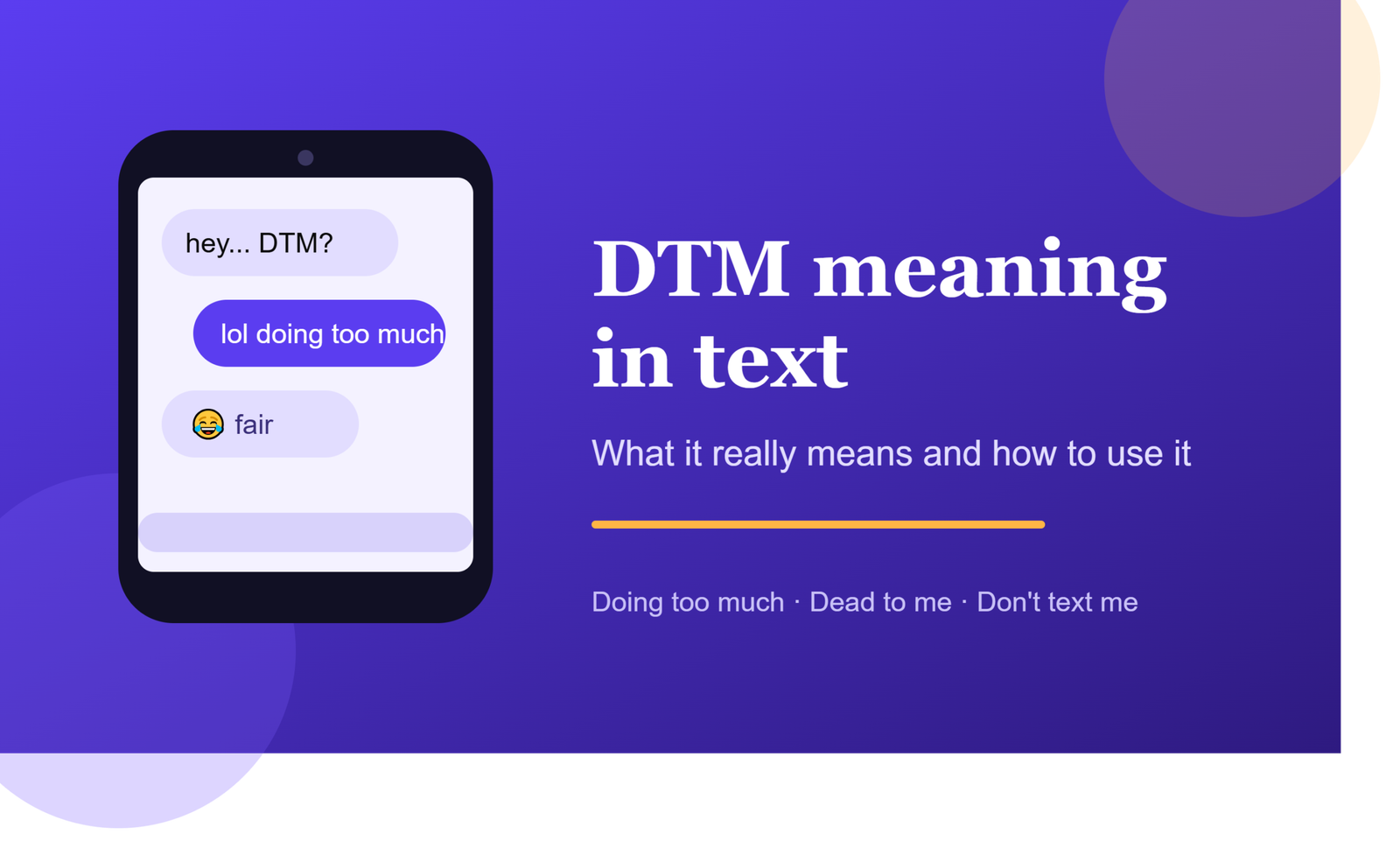
DTM meaning in text refers to a three-letter acronym with three common definitions: “doing too much,” “dead to me,” and “don’t text me.” The correct DTM meaning in text shifts based on tone, platform, and the relationship between the people texting.
Picture opening your phone to a single text that just reads “DTM.” No emoji, no explanation, just three letters carrying an entire message on their own. That tiny bit of mystery is exactly why this acronym has taken over group chats, comment sections, and dating app conversations everywhere.
This guide breaks down the true DTM meaning in text, shows how it changes across Snapchat, TikTok, and Discord, and gives you the exact clues to read before you type back a single word.
Quick Answer
Here’s the short version before we get into the details:
DTM most commonly means “Doing Too Much.” It’s used when someone is overreacting, overdoing something, or being extra. Depending on the conversation, DTM can also mean “Dead to Me” (you’re cutting someone off completely) or “Don’t Text Me” (a blunt request for someone to stop messaging you).
| Meaning | What It Signals | Common Setting |
|---|---|---|
| Doing Too Much | Overreacting or overdoing an effort | Friends, memes, TikTok comments |
| Dead to Me | Ending a friendship or relationship | Serious falling-outs, breakups |
| Don’t Text Me | A direct texting boundary | Arguments, unwanted attention |
Outside of texting, DTM also stands for something completely unrelated: a real racing series called the Deutsche Tourenwagen Masters. We’ll cover that too, since it trips up a lot of people searching for the term.
Now let’s break each one down properly, because the right DTM definition really does depend on who’s texting you and why.
What Does DTM Mean in Text?
DTM meaning in text isn’t fixed. It behaves more like slang usually does: the letters stay the same, but the intent shifts with tone, timing, and relationship. Think of it like the word “fine.” Said one way, it means everything’s okay. Said another way, it means the opposite. DTM works the same. Here are the three meanings you’ll actually run into.
Doing Too Much
This is, by far, the most common use of DTM slang in everyday text messages. “Doing too much” describes someone who’s overdoing it — putting in way more effort, drama, or energy than a situation actually calls for.
Picture this: your friend writes a three-paragraph text explaining why they’re running ten minutes late. That’s DTM. Someone spends two hours color-coding a group project spreadsheet that didn’t need color-coding. Also DTM. A person gets furious over a lost fantasy football game like it’s a personal attack. DTM again.
In this sense, DTM is basically a shorter, funnier way of saying “relax” or “you’re being extra.” It’s rarely meant to be cruel. Most of the time, it’s a light jab between people who know each other well enough to poke fun.
“You wrote a whole essay apologizing for replying five minutes late. Bro, DTM.”
That’s the tone. Playful, a little teasing, and usually harmless.
Dead to Me
This meaning carries a lot more weight. When someone says “dead to me,” they mean the relationship, friendship, or connection is over — completely. It’s one of the more dramatic pieces of relationship slang you’ll come across in a text thread, and it’s not meant to be taken lightly.
Unlike “doing too much,” which usually stays light, DTM as “dead to me” shows up during real conflict: betrayals, big arguments, or the kind of falling-out where someone decides they’re done with someone for good.
“After what you did at the party, you’re DTM. Don’t bother explaining.”
If someone sends you this version of DTM, don’t reply with a joke. Read the room. This isn’t the “you’re being extra” kind of DTM — it’s the “we’re finished” kind.
Don’t Text Me
The third major meaning is the most direct: “don’t text me.” This one functions as a texting boundary, plain and simple. It shows up when someone wants no messages, no follow-ups, and no more contact — at least for now.
This version often pops up after an argument, a breakup, or when someone’s simply overwhelmed and needs space. It’s blunt on purpose. There’s no room to misread “DTM (don’t text me)” the way you might misread the other two versions, especially when it’s paired with a period or sent with no other context.
“I need space right now. DTM for a while, please.”
Setting boundaries through text has become normal, and DTM is one of the shortest ways people do it. It’s not always angry — sometimes it’s just someone being honest about needing a break.
A Fourth Meaning You Might See (With a Caveat)
You may occasionally spot claims online that DTM also means “Down to Meet,” especially on dating apps. This one shows up far less often and isn’t backed by major slang dictionaries the way the three meanings above are. If you see it used this way, treat it as a local or app-specific shorthand rather than an established texting abbreviation — and when in doubt, just ask what someone meant.
DTM Outside of Texting: The Motorsport Meaning
Not every search for “DTM” is about texting slang. If you’ve seen “DTM” attached to cars, engines, or racing news, you’re looking at something entirely different: the Deutsche Tourenwagen Masters, one of Europe’s most well-known touring car racing series.
Here’s what makes DTM racing worth knowing about, even briefly:
- It’s a German-based racing series featuring modified touring cars — production-style vehicles built for high-performance racing.
- The series has gone through multiple eras and manufacturer lineups since it began, with periods of pause and relaunch over the decades.
- It’s considered one of the top touring car championships in the world, alongside series like the World Touring Car Cup.
- Fans and journalists refer to both the championship and individual race weekends as “DTM,” which is why you’ll see the acronym in sports headlines with zero connection to slang.
If you searched “DTM meaning” hoping to find out about cars and landed here instead, now you know: same three letters, completely different world. The motorsport meaning and the slang meaning share nothing but an acronym.
This kind of overlap is more common than people expect. Plenty of three- and four-letter acronyms carry entirely separate meanings depending on the industry or community using them. “DM” can mean a direct message on Instagram, but it also stands for dozens of unrelated terms in science, sports, and linguistics. DTM is no different — the letters are shared property, and only the surrounding context tells you which world you’re actually in. If a headline mentions lap times, engine specs, or a manufacturer lineup, you’re reading about the racing series, not the slang.
Where DTM Slang Comes From
Like most internet slang, DTM didn’t appear overnight with a clear inventor or launch date. It grew out of casual online speech, particularly language patterns common in African American Vernacular English (AAVE), which has shaped a huge portion of modern social media slang — from “lit” to “extra” to “slay.”
“Doing too much” existed as a spoken phrase long before it became an acronym meaning for texting. People used the full phrase to call out over-the-top behavior in everyday conversation. As texting culture sped up and character limits mattered (especially in the Twitter and early Vine era), phrases naturally got shortened into acronyms people could type in two seconds.
From there, DTM spread through platforms that reward quick, punchy reactions — comment sections, group chats, and caption culture. Once TikTok comments and Gen Z texting habits picked it up, the acronym cemented itself as casual slang you didn’t need to explain to your friends.
A few things worth noting about how DTM’s history shaped its current use:
- It started as a text abbreviation for a spoken phrase, not the other way around.
- Its most common meaning (“doing too much”) has stayed fairly stable over time, even as other meanings attached themselves to the same letters.
- The Dead to Me and Don’t Text Me meanings came later, growing out of the natural tendency for short acronyms to get reused for other phrases that share the same first letters.
This is common in chat language — acronyms rarely stay tied to one meaning forever. NGL used to mean almost exclusively “not gonna lie,” but you’ll now see it stretched into other casual uses too. DTM followed a similar path.
It also helps to understand why slang like this spreads the way it does. Short internet abbreviation patterns tend to catch on when they solve a real problem: they let people say something with attitude, humor, or finality in the fewest possible characters. “Doing too much” takes nine keystrokes to type out in full. “DTM” takes three. When you’re texting quickly, reacting to a video, or dropping a comment before scrolling to the next post, that difference matters more than people realize.
There’s also a social layer to why acronyms like this stick around. Using shared texhttps://en.wikipedia.org/wiki/Acronymting slang signals that you’re plugged into the same cultural moment as the person you’re talking to. It works almost like a handshake — if someone drops “DTM” and you respond with the right energy, it confirms you’re both fluent in the same casual shorthand. Miss the reference entirely, and it can (briefly) make a conversation feel slightly out of sync, which is part of why guides like this one exist in the first place.
Slang trackers and language writers have also pointed out that phrases tied to calling out exaggerated behavior — “extra,” “dramatic,” “doing the most,” and “doing too much” — tend to resurface in cycles. Each generation of internet culture picks a slightly different phrase to describe the same basic idea: someone putting more energy into something than the situation actually requires. DTM is simply the current, shortened version of a much older pattern in casual speech.
How to Tell Which Meaning Someone Means
Since DTM texting carries three very different meanings, context does most of the heavy lifting. Here’s how to figure out which one you’re dealing with.
Read the Tone Before the Letters
Ask yourself: does the message feel playful, tense, or final?
- If it’s dropped in a group chat as a joke, it’s almost always “doing too much.”
- If it comes after a serious disagreement, it’s more likely “dead to me” or “don’t text me.”
- If it’s a one-word reply with no punctuation and no follow-up, lean toward the more serious meanings — casual jokes usually come with more texting energy, like emojis or extra words.
Tone rarely lies in texting, even without vocal cues. Pay attention to punctuation, capitalization, and whether the person adds anything else. “dtm lol” reads completely differently from “DTM.” with a period and nothing else.
Check Who’s Sending It
Relationship context changes everything. A close friend sending DTM after you overreact about a TV show finale is clearly teasing you (doing too much). A situationship going cold after an argument, sending “DTM,” is very likely setting a texting boundary or cutting contact.
Here’s a simple way to think about it:
| Relationship Type | Likely DTM Meaning |
|---|---|
| Close friend, joking tone | Doing Too Much |
| Ex or situationship, after conflict | Dead to Me / Don’t Text Me |
| Stranger or new match | Could go either way — ask |
| Family member, casual context | Doing Too Much |
When you genuinely can’t tell, it’s completely fine to ask. A simple “wait what do you mean by DTM lol” clears things up faster than guessing wrong and replying with the wrong energy.
Look at the Conversation Right Before It
Context clues rarely live in isolation. The messages sent right before “DTM” almost always tell you which meaning applies. If the previous few texts were lighthearted — memes, inside jokes, casual updates about someone’s day — DTM is overwhelmingly likely to mean “doing too much.” If the messages before it involve an apology, an accusation, or a long pause in the conversation, the odds shift heavily toward “dead to me” or “don’t text me.”
This matters because a lot of misunderstandings happen when someone reads a single text in isolation instead of as part of an ongoing thread. DTM texting rarely happens out of nowhere. It’s almost always a reaction to something specific that came right before it, so scrolling up before replying is one of the simplest ways to avoid a wrong guess.
Watch for Follow-Up Messages
Another reliable signal is what happens immediately after someone sends “DTM.” If a laughing emoji, a GIF, or another casual message follows within seconds, that’s a strong indicator of the lighter meaning. If the message sits alone with no follow-up, especially after several minutes of silence, that silence itself often reinforces the more serious interpretation. People rarely leave a joke hanging without some kind of playful follow-up.
DTM Meaning by Platform
Where you see DTM matters almost as much as who sends it. Different platforms have slightly different norms for how the acronym gets used, so here’s a platform-by-platform breakdown.
In Texting and iMessage
In regular text messages, DTM leans most often toward “doing too much” between friends, or “don’t text me” during a conflict. Because iMessage and SMS conversations tend to happen between people who already know each other, context clues (inside jokes, ongoing conversation history) usually make the meaning obvious fast.
On Snapchat
On Snapchat, DTM tends to show up in captions or chat replies with a more playful spin — often “doing too much” paired with a laughing emoji or a Bitmoji reaction. Because Snapchat conversations are often shorter and more visual, the acronym gets used almost like a stamp of reaction rather than a full sentence.
On TikTok and Instagram Comments
This is where “doing too much” dominates almost completely. In Instagram comments and TikTok replies, DTM usually pokes fun at a video, a caption, or someone’s reaction in the comments section. You’ll see it a lot under dramatic reaction videos, over-the-top dance routines, or captions that read as overly intense for the situation.
On Dating Apps
Dating app slang moves fast, and DTM shows up here in a couple of ways. Sometimes it’s the “doing too much” meaning, calling out someone who’s coming on too strong too early. Less commonly, and without strong backing from major slang trackers, some users stretch it toward “down to meet.” If you see it on a dating app and it’s unclear, a quick clarifying question avoids any awkward mismatch.
On Discord and Group Chats
In Discord slang, especially inside gaming servers, DTM sometimes gets used loosely and casually among group members, often carrying the “doing too much” meaning when someone overreacts to an in-game moment. Because Discord communities build their own inside jokes and shorthand over time, it’s worth paying attention to how a specific server or friend group uses it, since messaging slang inside tight-knit communities can drift from the wider internet norm.
Here’s a quick reference table for DTM meaning by platform:
| Platform | Most Common Meaning | Typical Tone |
|---|---|---|
| Texting/iMessage | Doing Too Much / Don’t Text Me | Depends on relationship |
| Snapchat | Doing Too Much | Playful |
| TikTok/Instagram | Doing Too Much | Comedic, reactive |
| Dating Apps | Doing Too Much (sometimes ambiguous) | Mixed |
| Discord | Doing Too Much | Casual, group-specific |
The pattern across nearly every platform is clear: “doing too much” is the default unless real conflict is involved. When conflict is present, the other two meanings take over almost entirely, regardless of platform.
Why Platform Habits Shape the Meaning
Every platform has its own texting rhythm, and that rhythm shapes how an acronym like DTM gets used. Comment sections on TikTok and Instagram are built for quick, public reactions, which naturally pushes people toward the lighter, funnier meaning — nobody wants to publicly declare a friendship over in a comment thread that strangers can see. Private messaging apps like iMessage and Snapchat, on the other hand, are where real conflict actually plays out, so the more serious meanings show up far more often there than in public comment sections.
Group chats add another layer. In a group setting, DTM often gets used almost performatively — someone calls out a friend’s dramatic behavior in front of the whole group, and everyone reacts with laughing emojis. That social, audience-driven context makes the “doing too much” meaning even more likely, since serious boundary-setting messages like “dead to me” or “don’t text me” are almost always sent privately, one-on-one, rather than broadcast to a whole group.
Understanding these platform habits helps explain something important: the same acronym can feel completely different depending on whether it lands in a semi-public comment section or a private, one-on-one thread after a hard conversation.
DTM in Real Conversations
Reading definitions only gets you so far. Seeing DTM in real conversations makes the meanings click faster. Here are several text examples covering each version.
Example 1 — Doing Too Much (Friends)
Friend: “I made a 12-slide presentation justifying why I should get the bigger slice of cake.” You: “DTM 😂”
This is the classic playful use — no hard feelings, just gentle teasing.
Example 2 — Doing Too Much (Overthinking)
Friend: “I analyzed every emoji in his text for an hour trying to figure out what he meant.” You: “girl you’re so DTM right now”
Overthinking and overanalyzing situations are two of the most common triggers for this version of DTM.
Example 3 — Dead to Me
Person: “After you told everyone what I told you in private, you’re DTM. Don’t reach out again.”
There’s no joke here. This is a clean, final statement about ending a friendship.
Example 4 — Don’t Text Me
Person: “We need space. DTM until I say otherwise.”
Notice how this reads more like an instruction than a joke — a clear texting boundary with no ambiguity.
Example 5 — Mixed Signals (Where Context Really Matters)
Person: “DTM.” (No other message, no emoji, sent after a heated argument.)
This is exactly the kind of message where clarification matters. Without more context, this single-word DTM could mean either “dead to me” or “don’t text me” — both serious, both worth taking at face value rather than assuming the lighter meaning.
A Short Case Study: Same Word, Two Totally Different Outcomes
Two people each got a text that just said “DTM.” Person A had just posted a dramatic 20-photo carousel about a minor inconvenience, and their friend replied “DTM” with a laughing emoji seconds later. Person A laughed it off immediately, because the tone and timing made it obviously the “doing too much” joke.
Person B, on the other hand, received “DTM.” after a serious falling-out with a friend, with no punctuation softening it and no emoji attached. Person B correctly read it as “dead to me” and didn’t try to smooth things over with a joke, because doing so would have made things worse.
Same three letters. Two completely different situations. That’s the entire point of paying attention to tone, timing, and relationship before reacting.
Example 6 — Group Chat Callout
Group chat: “Someone in here just sent a 400-word apology for missing one text. That’s insane.” Reply: “lmaooo DTM behavior fr”
This shows how DTM gets used almost like a running joke within a friend group, applied to a general pattern of behavior rather than one specific person’s single action.
Example 7 — Dating App Ambiguity
Match: “You’ve texted me nonstop for three days straight lol, kinda DTM ngl”
Here, “doing too much” is being used to gently call out someone moving too fast, which is one of the more common ways this meaning shows up specifically in dating app slang.
Example 8 — Escalating Conflict
Person A: “I can’t believe you told her that.” Person B: “It wasn’t a big deal.” Person A: “It was to me. DTM.”
This kind of exchange shows how DTM often lands as the final word in an argument rather than the opening one — a short, sharp way of ending a back-and-forth instead of continuing to argue over text.
These chat examples all point to the same underlying rule: DTM rarely exists in a vacuum. It reflects whatever came before it in the conversation, which is why context always outranks the acronym itself when you’re trying to figure out what someone actually means.
When to Use DTM (and When Not To)
Knowing when to use DTM matters just as much as knowing what it means. Appropriate usage depends heavily on who you’re talking to and how well they already know your texting style.
Good times to use DTM:
- Teasing a close friend who’s clearly overreacting or acting extra
- Reacting to a funny, over-the-top TikTok or Instagram post in the comments
- Light casual texting between people who already understand internet shorthand
Times to avoid it:
- Professional messages, work Slack, or emails — DTM reads as unclear and unprofessional outside casual chat
- First conversations with someone new, where they might not know your texting habits yet
- Serious conversations where a real explanation matters more than a shorthand reaction
DTM works best as informal communication between people who already share a texting rhythm. Drop it into a conversation with someone who doesn’t know texting acronyms well, and you risk confusing them instead of landing the joke — or worse, sounding harsher than you meant to.
A Simple Rule of Thumb
Before sending DTM, ask yourself two quick questions: does this person already understand my texting style, and could this message be read more harshly than I intend? If the answer to the first is yes and the second is no, DTM is probably a safe, natural fit. If you’re unsure about either, it’s usually worth spelling out what you mean instead of relying on the acronym to carry the tone for you.
This matters most in situations where stakes are higher than a casual joke — coordinating with a coworker, texting a new acquaintance, or messaging someone during an already tense moment. In those cases, clarity beats cleverness every time. Appropriate usage of any casual slang, DTM included, comes down to reading your audience correctly before you hit send.
How to Respond to DTM
Getting a reply to DTM right depends entirely on which version was sent. Here’s how to handle each one.
If it’s “Doing Too Much”:
- Laugh it off. A simple “lol I know” or a laughing emoji usually closes the loop.
- If you disagree, you can push back playfully: “I’m not DTM, you just don’t get my vision.”
If it’s “Dead to Me”:
- Don’t joke. This calls for a real texting response, not a shorthand one.
- If you want to repair things, apologize directly and ask for a real conversation instead of trying to fix it over text.
- If you accept the situation, it’s okay to simply respect the boundary and step back.
If it’s “Don’t Text Me”:
- Respect it immediately. Sending more messages after this response option has been stated usually makes things worse.
- If you need to say something important, wait until the person reaches out again, or send one short, respectful message acknowledging their request for space.
Here’s a quick cheat sheet for response options:
| DTM Meaning | Best Response |
|---|---|
| Doing Too Much | Playful acknowledgment or joke back |
| Dead to Me | Sincere apology or respectful silence |
| Don’t Text Me | Immediate compliance, no more messages |
When you’re not sure which meaning applies, asking directly — “wait, DTM as in what?” — beats guessing wrong every time.
DTM vs. Similar Acronyms
DTM vs. similar acronyms is worth breaking down, since several other short texting terms get mixed up with it or used in overlapping situations.
| Acronym | Meaning | How It Differs From DTM |
|---|---|---|
| IDGAF | “I don’t give a f***” | Expresses total indifference, not overreaction or boundary-setting |
| IDC | “I don’t care” | Softer version of IDGAF, doesn’t carry DTM’s multiple meanings |
| DTF | “Down to f***” | Sexual/dating context only, completely separate from DTM |
| GTG | “Got to go” | Simply signals leaving a conversation, no emotional weight |
| K | “Okay” (short) | Neutral or passive-aggressive acknowledgment, not a full reaction |
The biggest difference between DTM and most slang comparisons on this list is flexibility. Acronyms like IDGAF, IDC, and DTF each carry one fixed meaning. DTM is unusual because it holds three separate, commonly used meanings depending entirely on context — which is exactly why it causes more confusion than most other texting acronyms.
Common Mix-Ups and Misreadings
Because DTM carries multiple meanings, misreadings happen constantly. Here are the most common ones.
- Mistaking a joke for an insult. Someone jokingly texts “DTM” about a friend being dramatic, and the friend reads it as “dead to me,” assuming the friendship is over when it was really a lighthearted jab.
- Mistaking a serious message for a joke. The reverse also happens — someone sends “dead to me” after real hurt, and the other person laughs it off assuming it’s the “doing too much” joke, which can escalate the situation.
- Confusing DTM with DTF. These look similar at a glance but mean completely different things — one is about behavior, the other is explicitly about intent for a physical relationship.
- Assuming “down to meet” universally. As covered earlier, this fourth meaning isn’t as established as the other three, so assuming it without context can lead to a very awkward reply on a dating app.
- Reading punctuation as more meaningful than it is. Some people add a period out of habit, not to signal finality. While punctuation is a useful clue, it shouldn’t be treated as absolute proof of tone on its own — pair it with the rest of the conversation before drawing a firm conclusion.
The fix for nearly every mix-up on this list is the same: don’t assume, especially in a serious-sounding message. A ten-second clarifying question saves a lot of unnecessary conflict.
- Misreading tone in text form. Texting strips out facial expressions, vocal tone, and body language, all of which normally help people interpret a phrase like “you’re doing too much” in person. Over text, that same phrase, shortened to three letters, loses even more of that context, making misreadings more common than they’d be in a spoken conversation.
- Assuming everyone uses DTM the same way. Not every friend group or platform uses DTM identically. Some circles lean almost entirely on the “doing too much” meaning and rarely use it for anything serious, while others use it more often as a hard boundary. If you’re new to a group chat or friend circle, it’s worth watching how they use it a few times before assuming you know their default meaning.
- Overcorrecting after a misunderstanding. Sometimes people swing too far the other way after one mix-up, treating every future “DTM” as automatically serious. This can create unnecessary tension in situations where the person genuinely meant it as a joke. Staying calibrated to context each time, rather than assuming based on one past experience, keeps texting response habits accurate going forward.
Who Actually Uses DTM
DTM slang skews heavily toward younger internet users, particularly teens and young adults active on TikTok, Snapchat, Instagram, and group texting. It fits squarely into what’s broadly labeled Gen Z slang, alongside terms like “rizz,” “no cap,” and “it’s giving.”
That said, usage isn’t strictly limited by age. Millennials who spend time in comment sections and group chats have picked it up too, especially the “doing too much” meaning, since it maps closely onto phrases like “extra” and “over it” that were already common in millennial internet speech.
A few patterns worth knowing:
- It’s more common in casual slang environments — friend groups, comment sections, gaming communities — than in formal or professional settings.
- English-speaking internet communities use it most heavily, though slang spreads quickly across language communities through shared platforms like TikTok.
- It tends to cluster in social circles that already use a lot of shorthand, meaning if your friend group uses NGL, ICYMI, or FR often, DTM likely fits right into that same vocabulary.
Content creators and meme accounts have also played a role in keeping DTM in circulation. When a caption or comment using DTM gets shared widely, it reintroduces the term to new audiences who might not have encountered it before, refreshing its usage cycle every so often rather than letting it fade out the way some older acronyms eventually do. This is part of why DTM slang has stuck around longer than many short-lived internet phrases that disappear within a single trend cycle.
It’s also worth noting that usage isn’t limited to any one country or region. Because platforms like TikTok and Instagram operate globally, English-language slang terms like DTM spread quickly to English-speaking communities well outside the US, even if the original cultural roots trace back to specific online communities. This is a common pattern across modern social media slang — the internet moves faster than any single region can contain a phrase.
Variations You Might See
DTM shows up in a few slightly different forms depending on typing habits and emphasis:
- dtm (lowercase) — the most casual version, used in quick texts and comments
- DTM (all caps) — often used for emphasis, especially in the “dead to me” or “don’t text me” sense
- DTM. (with a period) — the period adds finality, usually signaling the more serious meanings
- “you’re so dtm” — turns the acronym into a descriptive phrase about someone’s behavior, almost always meaning “doing too much”
- “that’s dtm energy” — a newer, looser phrasing that treats DTM as a vibe or category of behavior rather than a direct label
None of these variations change the core meanings covered earlier — they just shift tone slightly. Capitalization and punctuation, as covered earlier in this guide, are some of your best clues for figuring out which meaning is intended.
FAQs
Is DTM still commonly used in 2026?
Yes. DTM meaning in text remains active across TikTok comments, Snapchat, and group chats, with “doing too much” still the most-used version.
What does DTM mean on Instagram right now?
On Instagram comments, DTM almost always means “doing too much” — a playful jab at dramatic or over-the-top posts.
Is “Down to Meet” a real meaning for DTM?
It shows up occasionally on dating apps, but it’s not backed by major slang dictionaries, so treat it as unofficial and confirm before assuming.
Does DTM mean anything besides slang today?
Yes, it still refers to the Deutsche Tourenwagen Masters, an active European touring car racing series, unrelated to the texting slang.
Is DTM appropriate to use at work or in professional messages?
No. It’s strictly casual slang, and using it in professional texts or emails usually comes across as unclear or unprofessional.
conclusion
DTM meaning in text isn’t hard once you know the signs. Most of the time, it means “doing too much,” used as a light joke between friends. But it can also mean “dead to me” or “don’t text me,” especially after a real argument. Tone, timing, and platform all give you clues.
When in doubt, just ask. Understanding DTM meaning in text takes seconds, but guessing wrong can start a fight or cause hurt feelings. Read the conversation first, then reply with the right energy. That’s really all it takes to never get caught confused by DTM again.