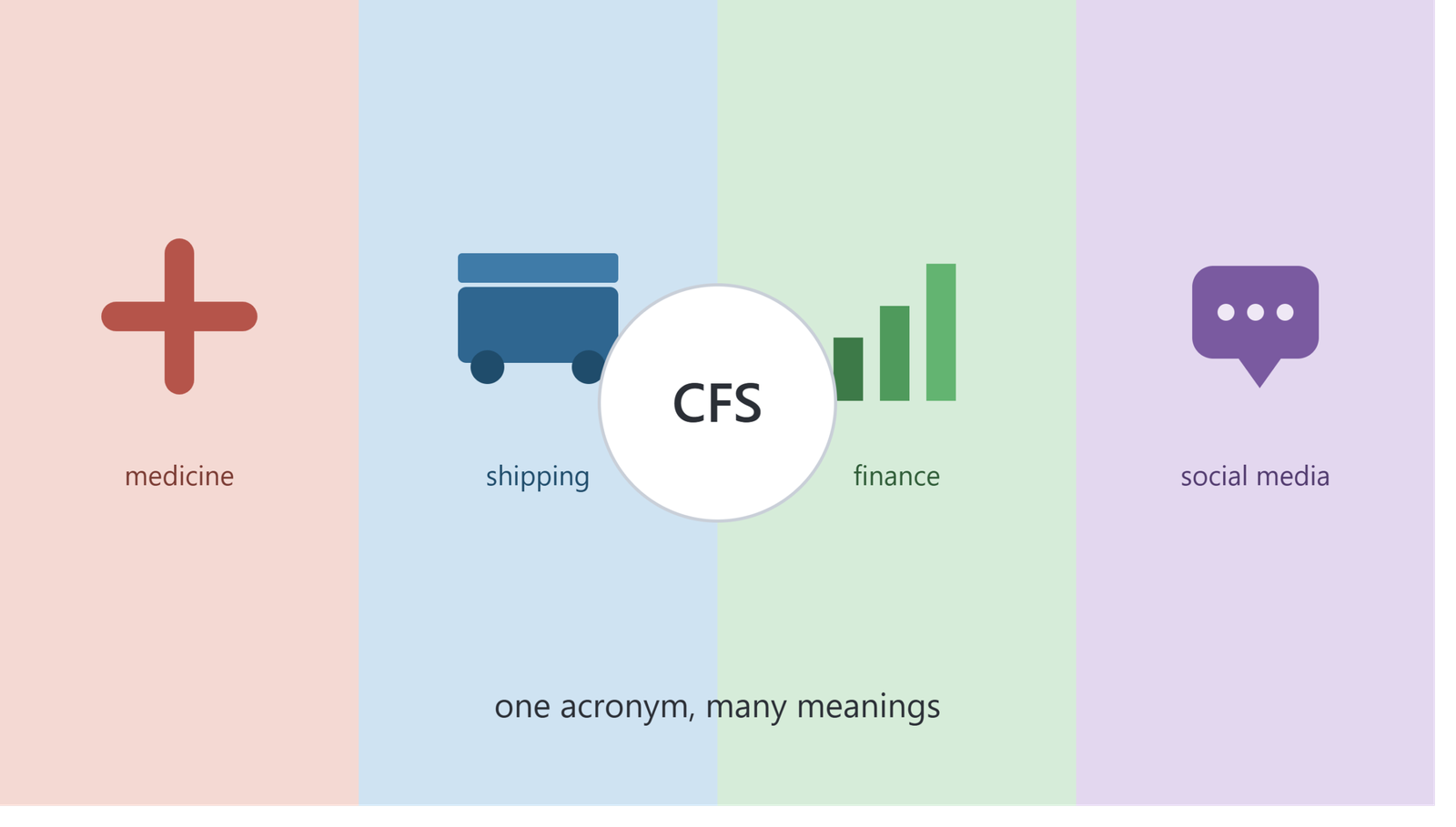
CFS meaning changes completely depending on where you encounter it. In medicine, CFS stands for chronic fatigue syndrome (ME/CFS), a serious illness marked by profound, unrelenting exhaustion. In shipping, it means container freight station. In finance, it’s consolidated financial statements. Same three letters, entirely different worlds.
Here’s the twist: one abbreviation, seven industries, zero overlap. A doctor, a freight forwarder, and a teenager texting “check my CFS” are all using the exact same acronym for completely unrelated things, and getting it wrong can genuinely confuse a diagnosis, a shipment, or a financial report.
Understanding true CFS meaning takes more than a quick guess. This guide breaks down every real, documented cfs meaning, from myalgic encephalomyelitis and post-exertional malaise to container freight stations and consolidated statements, so you always land on the right definition, fast.
CFS Isn’t One Term — It’s Six (or Seven) Different Ones Wearing the Same Three Letters
Type “CFS” into Google and you’ll get a strange mix of results: a medical journal article next to a shipping glossary next to an Instagram slang dictionary. That’s not a search engine glitch. It’s just what happens when three letters get claimed by seven unrelated industries over the course of nearly a century.
Here’s the short version, before we go deep on each one:
| Meaning | Field | What It Refers To |
|---|---|---|
| ME/CFS (Chronic Fatigue Syndrome) | Medicine | A serious, long-term illness marked by profound fatigue and post-exertional malaise |
| Close Friends Story | Social media / texting | An Instagram Story visible only to your “close friends” list |
| Container Freight Station | Shipping & logistics | A warehouse where LCL cargo gets consolidated or deconsolidated |
| Consolidated Financial Statements | Finance & accounting | Combined financial reports for a parent company and its subsidiaries |
| Central Flying School | Aviation | The Royal Air Force’s flight instructor training school |
| Cubic Feet per Second | Engineering & hydrology | A unit measuring water flow rate through rivers, streams, or pipes |
| Community Food Security / Cystic Fibrosis Society | Nonprofit organizations | Two separate advocacy and public-health groups |
That’s a lot of ground for one acronym to cover. And here’s the thing most competitor articles skip: this isn’t a coincidence or SEO noise. Each field adopted “CFS” independently, decades apart, because the letters happened to fit their own terminology. Once you know the field you’re reading about, picking the right CFS definition takes seconds.
Why One Search Query Pulls Up Six Unrelated Industries
Search engines rank pages based on what other people clicked on for the same query, not on what any one person actually needs. Since “CFS meaning” gets searched by patients, shippers, accountants, and teenagers alike, Google serves a blend of all of it. That’s genuinely useful if you’re not sure which CFS abbreviation you’re chasing, but it’s a headache if you already know your context and just want the answer.
The Fast Way to Spot Which CFS You’re Looking At
You don’t need to read a whole article to figure out which CFS meaning applies. Check these context clues first:
- Where did you see it? A medical chart, a doctor’s note, or a health forum almost certainly means chronic fatigue syndrome. A bill of lading or customs form means container freight station.
- What words surround it? “CFS charges,” “CY,” and “LCL” point to shipping. “Symptoms,” “diagnosis,” and “fatigue” point to medicine. “Parent company” and “subsidiaries” point to accounting.
- Who sent the message? If a friend sent it after “check my Insta,” it’s almost certainly close friends story.
- What industry are you working in? Pilots, hydrologists, and auditors each have their own professional terminology, and CFS means something different in each.
Now let’s go through each CFS meaning in real depth, starting with the one carrying the most weight.
CFS in Medicine — Myalgic Encephalomyelitis/Chronic Fatigue Syndrome (ME/CFS)
In healthcare, CFS medical meaning refers to chronic fatigue syndrome, more accurately called myalgic encephalomyelitis/chronic fatigue syndrome, or ME/CFS. It’s a serious, often disabling illness, not a synonym for “feeling tired a lot.” Confusing the two is one of the most common (and most harmful) mistakes people make with this term.
What ME/CFS Actually Is
According to the CDC, ME/CFS is a serious and often long-lasting illness that keeps people from doing their usual activities. It makes physical and mental exertion difficult, and symptoms include trouble thinking, severe tiredness, and a cluster of other problems that affect the whole body, not just energy levels. There’s no known cause and no cure yet. Care generally focuses on managing whichever symptoms hit a given patient hardest.
People with ME/CFS often don’t “look sick,” which is part of why the chronic illness gets dismissed so often, both by acquaintances and, historically, by clinicians themselves. About 1 in 4 people with ME/CFS become bed-bound at some point in their illness. This isn’t a mild inconvenience. It’s a condition that can strip away someone’s ability to work, study, or care for themselves.
Why “ME/CFS” Replaced “CFS” in Clinical Use
You’ll notice most medical sources now write myalgic encephalomyelitis/chronic fatigue syndrome rather than just “chronic fatigue syndrome.” That’s deliberate. The original name, coined decades ago, made the illness sound like ordinary tiredness and led both the public and some clinicians to underestimate how severe it can be.
In 2015, the Institute of Medicine (IOM), now called the National Academy of Medicine, published a major report reviewing the evidence and proposing updated chronic fatigue syndrome diagnosis criteria. The committee even suggested renaming the illness “systemic exertion intolerance disease” (SEID) to better capture how exertion of any kind, physical, cognitive, or emotional, can trigger a crash. That name never caught on. Instead, the field settled on the hybrid ME/CFS medical abbreviation, which the CDC and most major health bodies use today.
Post-Exertional Malaise — The Symptom That Defines the Diagnosis
If there’s one thing to understand about ME/CFS symptoms, it’s this: post-exertional malaise, often shortened to PEM, is the defining feature.
PEM is a disproportionate worsening of symptoms after physical, cognitive, or even emotional exertion, and the crash can be delayed by hours or days rather than showing up immediately. Someone might feel fine after a short walk, then find themselves unable to get out of bed the next day. This delayed, exaggerated payback is what separates ME/CFS from ordinary tiredness, and it’s why “just push through it” advice can actively harm patients rather than help them.
The 2015 IOM criteria require three core symptoms for diagnosis, plus at least one of two additional symptoms:
Required for diagnosis:
- A substantial reduction in the ability to engage in pre-illness levels of activity, lasting more than six months, accompanied by profound fatigue not caused by ongoing overexertion and not meaningfully relieved by rest
- Post-exertional malaise (PEM)
- Unrefreshing sleep, meaning the person wakes up exhausted no matter how much they slept
Plus at least one of:
- Cognitive impairment (“brain fog,” trouble concentrating or processing information)
- Orthostatic intolerance (dizziness, lightheadedness, or fainting when standing up)
How Common Is It? What the Research Actually Shows
This is a spot where a lot of CFS meaning content online gets it wrong, so let’s be precise. The CDC’s current estimate is that up to 3.3 million people in the United States live with ME/CFS. More strikingly, more than 9 in 10 people with ME/CFS have never been formally diagnosed, largely because there’s no single lab test for the illness and many doctors still aren’t trained to recognize it.
You’ll also see a widely repeated figure claiming 17 to 24 million people have ME/CFS worldwide. That number traces back to a citation error in a research paper’s background section, one that pointed to a study about multiple sclerosis, not ME/CFS, and got copied uncritically across advocacy sites and news articles ever since. The CDC’s own figures, along with claims-data research putting U.S. prevalence somewhere between 0.5% and 1.4% of the population, are the more defensible numbers to cite.
A few more data points worth knowing:
- ME/CFS is roughly three to four times more common in women than men, though 35–40% of diagnosed patients are men, so it’s not accurate to call it a “women’s disease.”
- Prevalence is higher among people in poverty and in rural communities.
- The illness costs the U.S. economy an estimated $18 to $51 billion annually in medical costs and lost income.
- The condition affects people of every age, race, and background, though diagnosis rates skew toward ages 40–50.
CFS vs. Everyday Fatigue — Why Doctors Don’t Use These Interchangeably
This is the mix-up that causes the most real-world harm, and it’s worth spelling out clearly.
| Everyday Fatigue | ME/CFS | |
|---|---|---|
| Cause | Poor sleep, stress, overwork, illness recovery | Unknown; likely involves immune, neurological, and energy-metabolism dysfunction |
| Response to rest | Improves with a good night’s sleep or a few days off | Not substantially relieved by rest |
| Response to exercise | Usually improves with light activity | Worsens, often with a delayed crash (PEM) |
| Duration | Days to a few weeks | Persists for six months or longer, often years |
| Impact on daily life | Noticeable but manageable | Can prevent working, studying, or basic self-care |
Ordinary fatigue vs. chronic fatigue syndrome isn’t a matter of degree. It’s a difference in what’s actually happening in the body, which is exactly why clinicians insist on keeping the terms distinct.
Why CFS Is Still Misunderstood in Clinical Settings
Diagnosis remains genuinely hard. There’s no lab test that confirms ME/CFS on its own. Instead, doctors have to take a detailed history, rule out other conditions that cause similar symptoms (thyroid disease, anemia, sleep disorders, depression), and check whether the patient meets the IOM criteria. That process takes time most primary care visits don’t allow for, and many providers still received little to no training on ME/CFS in medical school.
The result: a condition the CDC now describes as “far less rare than many clinicians realize,” but one that remains chronically underdiagnosed. Patient advocates have spent years pushing to get ME/CFS taken as seriously as other chronic, disabling conditions, and that work is very much still ongoing in 2026.
CFS as Internet/Social Media Slang — What’s Actually Documented
Away from clinical settings, CFS slang meaning shows up constantly in texting, chat apps, and social media. But this is also the corner of the internet most polluted by made-up “definitions” that exist purely to fill out low-effort SEO content. Here’s what’s actually real.
“Close Friends Story” — The One Slang Meaning With Real Usage Data
The one CFS internet slang meaning with genuine, verifiable usage is close friends story. On Instagram, users can post a Story visible only to a hand-picked “close friends” list, marked with a green ring instead of the standard rainbow one. When someone says “check my CFS” or “posted that on my CFS,” they mean their Close Friends Story specifically, not their main, public Story.
You’ll see this phrase most in:
- Instagram captions and DMs (“that’s on my cfs 🤍”)
- Snapchat-adjacent slang conversations, even though the feature itself is Instagram’s
- Teen and young-adult social circles, where “close friends only” content is a deliberate way to share something more personal than a public post
That’s the extent of what’s actually documented. CFS meaning Instagram and close friends story meaning both point to this single, well-established usage.
Why You’ll See a Dozen Contradictory “Definitions” Online
Search “CFS meaning in texting” and you’ll find pages claiming CFS also means “can’t find sleep,” “come find someone,” or half a dozen other made-up phrases. Almost none of these have any real usage history. They exist because acronym-dictionary sites generate entries algorithmically or via crowdsourced guessing, and once one site publishes a fabricated definition, others copy it to appear comprehensive.
This matters because it muddies genuine research. If you’re trying to figure out what does CFS mean in messages, you deserve an answer grounded in how people actually use the term, not a guess dressed up as a definition.
How to Tell Real Slang From Fabricated “Slang”
A few quick checks separate real usage from filler content:
- Check vote counts and example sentences on sites like Urban Dictionary. A definition with zero context or votes is a red flag.
- Search the phrase in context (“posted on my cfs”) rather than just the acronym. Real slang shows up in natural sentences across many unrelated posts.
- See if multiple independent sources agree. If only acronym-dictionary sites list a meaning and no actual social posts use it that way, treat it as unverified.
- Consider the platform. “Close friends story” only makes sense on Instagram, which is exactly where you’ll find it used.
CFS in Shipping & Logistics — Container Freight Station
In international trade and the shipping industry, CFS shipping meaning refers to a container freight station: a warehouse facility, typically near a port, where cargo gets consolidated into containers or unloaded (deconsolidated) out of them.
What a Container Freight Station Actually Does
A container freight station exists because not every shipment fills an entire container on its own. When a shipper doesn’t have enough goods for a Full Container Load (FCL), their cargo travels as LCL, “Less than Container Load”, and gets grouped with other shippers’ goods inside one shared container at a CFS.
Typical CFS functions include:
- Cargo consolidation: combining multiple smaller shipments from different exporters into a single container bound for the same destination
- Cargo deconsolidation: unpacking a shared container at the destination and sorting goods back out to individual importers
- Short-term storage while cargo awaits customs clearance
- Documentation handling, inspection, and cargo staging before loading onto a vessel
Freight forwarders and customs brokers rely on CFS facilities constantly, since most small and mid-sized shippers don’t generate enough volume to justify booking a full container on every shipment.
CFS vs. CY (Container Yard) — Key Differences Explained
CFS vs. CY confusion is extremely common among people new to freight, so here’s the distinction laid out clearly:
| Container Freight Station (CFS) | Container Yard (CY) | |
|---|---|---|
| Handles | Loose cargo (LCL) | Full containers (FCL) |
| Main activity | Consolidation and deconsolidation | Container storage, loading, and staging |
| Cargo state | Unpacked or partially packed goods | Sealed, ready-to-ship containers |
| Who uses it | Shippers without a full container’s worth of goods | Shippers with enough volume for a whole container |
| Location | Often near the port, sometimes inland | Directly within port terminal grounds |
In short: CY shipping meaning covers whole, sealed containers moving in and out of a terminal, while a CFS is where the loose stuff gets sorted and packed before it ever reaches that stage.
The LCL Shipping Process, Step by Step
Here’s how a shipment typically moves through LCL consolidation:
- Booking: The shipper books space with a freight forwarder rather than an entire container.
- Delivery to CFS: Cargo arrives at the origin container freight station.
- Consolidation: The CFS combines it with other shippers’ cargo heading to the same destination, packing it into a shared container.
- Documentation and customs: Export paperwork and customs clearance happen at or through the CFS.
- Loading and transit: The consolidated container moves to the container yard, gets loaded onto a vessel, and ships out.
- Arrival and deconsolidation: At the destination port, the container goes to a CFS, where it’s unpacked and cargo is sorted by consignee.
- Final delivery: Each importer’s goods clear customs and move on to their final destination.
CFS charges typically apply at both ends of this process, covering handling, storage, and documentation, and they’re a standard line item on most LCL freight invoices.
Why Freight and Logistics Professionals Are the Heaviest Searchers of This Term
Unlike some of the other CFS meanings on this list, this one gets searched almost exclusively by people already working in the field: freight forwarders, importers, exporters, and customs brokers looking up CFS location details, charges, or process questions for a specific shipment. If you found this section while working an actual freight document, you’re very likely in the right place.
CFS in Finance & Accounting — Consolidated Financial Statements
In financial reporting, CFS finance meaning stands for consolidated financial statements: the combined financial reports of a parent company and all the subsidiaries it controls, presented as though they were a single economic entity.
What Consolidated Financial Statements Actually Cover
When one company owns a controlling stake in another, accounting standards generally require the parent to report their combined financial position rather than listing each entity separately. Consolidated financial statements typically include:
- A consolidated balance sheet
- A consolidated income statement
- A consolidated statement of changes in equity
- Notes disclosing intercompany transactions and the basis of consolidation
The goal is to give investors, regulators, and analysts one clear picture of the whole corporate group’s financial health, rather than a fragmented view across each subsidiary.
When Analysts and Auditors Actually Use the Term “CFS” This Way
You’ll see CFS accounting meaning come up in a few recurring contexts:
- Audits, where auditors verify that intercompany transactions have been properly eliminated and the consolidated accounts fairly represent the group
- Mergers and acquisitions, where buyers examine a target’s consolidated position, not just the standalone parent entity
- Investor reporting, since public companies with subsidiaries are generally required to file consolidated statements rather than parent-only ones
- Credit analysis, where lenders assess a group’s combined debt and cash position before extending financing
Don’t Confuse It With “Cash Flow Statement” — Same Initials, Different Document
This is the single most common mix-up in business terminology, and it’s an easy one to make since both terms share the same three letters.
| Consolidated Financial Statements | Cash Flow Statement | |
|---|---|---|
| What it shows | Combined financial position of a parent company and subsidiaries | Movement of cash in and out of a single entity |
| Scope | Balance sheet, income statement, equity, and notes together | One specific statement, focused only on cash |
| Used for | Group-wide financial reporting and analysis | Assessing liquidity and cash management |
| Who typically prepares it | Corporate groups with multiple subsidiaries | Any business, regardless of structure |
If someone asks for “the CFS” in a finance meeting, always clarify which one they mean. Getting this wrong in a report or presentation is a fast way to look like you don’t know your financial accounting terminology.
Other Real Professional Uses of CFS
Beyond medicine, shipping, finance, and slang, a handful of other fields use CFS in ways that are genuinely documented, not filler.
Central Flying School — Aviation’s CFS
In aviation, CFS stands for Central Flying School, the Royal Air Force’s institution responsible for training flight instructors. Founded in 1912, it’s one of the oldest flying schools in the world and has trained generations of RAF instructor pilots. RAF Central Flying School graduates go on to train other pilots across the RAF and, historically, allied air forces as well. If you’re reading a military aviation history text or an RAF service record and see “CFS,” this is almost certainly it.
Cubic Feet per Second — Engineering’s CFS
In hydrology and civil engineering, cubic feet per second (sometimes written cfs or ft³/s) is a standard unit for measuring flow rate, how much water passes a given point over one second.
You’ll encounter this CFS unit constantly in:
- River flow rate and streamflow measurement reports from agencies like the U.S. Geological Survey
- Dam and reservoir management, where discharge rate determines downstream water levels
- Flood forecasting, where sudden spikes in cubic feet per second signal rising flood risk
- Municipal water system design and stormwater engineering
A single cubic foot per second equals roughly 7.48 gallons of water flowing past a point every second, a small-sounding unit that adds up fast across a major river system.
Community Food Security and Cystic Fibrosis Society
Two more legitimate, if smaller, organizational uses of the CFS acronym:
- Community Food Security refers to efforts ensuring all community members have reliable access to adequate, nutritious food, a term used across public health and food-policy organizations.
- The Cystic Fibrosis Society name is used by various national and regional advocacy and research organizations supporting people with cystic fibrosis, distinct from cystic fibrosis itself and unrelated to chronic fatigue syndrome despite the similar-sounding names.
A Fast Way to Tell Which Professional CFS You’re Reading
- Military history or pilot training content → Central Flying School
- Rivers, dams, water flow numbers → cubic feet per second
- Public health or food-policy nonprofits → Community Food Security
- Genetic lung disease advocacy → Cystic Fibrosis Society
Common Mix-Ups People Actually Make
A few mistakes come up again and again across every field that uses this acronym.
Assuming the Medical Meaning in a Casual or Business Context (and Vice Versa)
Someone unfamiliar with shipping who sees “CFS charges apply” on an invoice might genuinely wonder what that has to do with fatigue. Likewise, someone reading about “CFS diagnosis” in a health forum after just learning the shipping term might assume it’s an unrelated typo. Context always resolves this, but it trips up plenty of readers moving between unrelated documents in the same day.
Treating “Chronic Fatigue” as the Same Thing as ME/CFS
“I’m so chronically fatigued” and “I have ME/CFS” are not interchangeable statements, even though they sound similar. Chronic fatigue is a symptom that shows up in dozens of conditions, from anemia to depression to poor sleep. ME/CFS is a specific, diagnosable illness with defined criteria, including post-exertional malaise, that most causes of ordinary tiredness simply don’t produce. Using the terms interchangeably, especially casually around someone with a real diagnosis, tends to minimize a serious, disabling condition.
Confusing Consolidated Financial Statements With a Cash Flow Statement
Covered in detail above, but worth repeating here: these are two entirely different financial documents that happen to share an initialism. Always confirm which one a colleague, client, or report is referring to before you build analysis on top of it.
How to Use “CFS” Correctly, by Context
Here’s a practical rundown of how to use the term correctly depending on where you’re writing or speaking.
Texting and Social Media
Use CFS to mean Close Friends Story only in casual conversation with people who already use Instagram slang. Outside that specific context, most people won’t know what you mean, so it’s worth spelling it out the first time in any wider group chat.
Shipping and Trade Documents
Always pair CFS with enough surrounding detail (charges, location, LCL vs. FCL) so readers immediately know you mean container freight station, especially in documents that also reference other three-letter shipping codes.
Business and Financial Writing
Spell out “consolidated financial statements” on first use in any report, then abbreviate to CFS afterward. Never assume a reader will default to the consolidated-statements meaning over cash flow statement; the ambiguity is real enough that clarity up front saves confusion later.
Medical and Clinical Writing
Use ME/CFS rather than a bare “CFS” wherever possible. It’s the standard the CDC and most current medical literature use, and it signals that you’re referring to the diagnosable illness, not a vague description of tiredness.
Quick-Reference Table — Context → Likely Meaning
| If you see “CFS” here… | It almost certainly means… |
|---|---|
| Doctor’s note, health forum, symptom list | ME/CFS (chronic fatigue syndrome) |
| Instagram caption or DM | Close Friends Story |
| Bill of lading, customs form, freight invoice | Container Freight Station |
| Audit report, M&A due diligence, investor filing | Consolidated Financial Statements |
| RAF or military aviation history | Central Flying School |
| River gauge data, dam report, flood forecast | Cubic Feet per Second |
| Public health or food-policy nonprofit content | Community Food Security |
| Genetic disease advocacy organization | Cystic Fibrosis Society |
FAQs
What’s the difference between a cash flow statement and consolidated financial statements?
A cash flow statement tracks cash movement for one entity, while consolidated financial statements combine a parent company’s full financials with its subsidiaries.
What is post-exertional malaise in ME/CFS?
It’s a delayed, disproportionate worsening of symptoms after physical, mental, or emotional exertion — the defining symptom used in current ME/CFS diagnostic criteria.
Is there a lab test to diagnose ME/CFS?
No — as of 2026, there’s still no single confirmatory test; diagnosis relies on clinical history, symptom criteria, and ruling out other conditions.
What is cubic feet per second used to measure?
It’s a standard unit for water flow rate, commonly used in hydrology to track river, dam, and stream discharge levels.
What does Central Flying School mean in aviation?
It refers to the Royal Air Force’s institution for training flight instructors, established in 1912 and still operating today.
conclusion
CFS meaning really comes down to context. In medicine, it points to a serious illness. In shipping, it’s a warehouse for cargo. In finance, it’s a combined report. Same three letters, different worlds entirely. Once you know the field, the right meaning becomes obvious fast.
So next time you see “CFS,” don’t guess. Check the context first. That simple habit clears up CFS meaning every time, whether you’re reading a medical chart, a shipping invoice, or a friend’s Instagram caption. Now you know exactly what to look for.