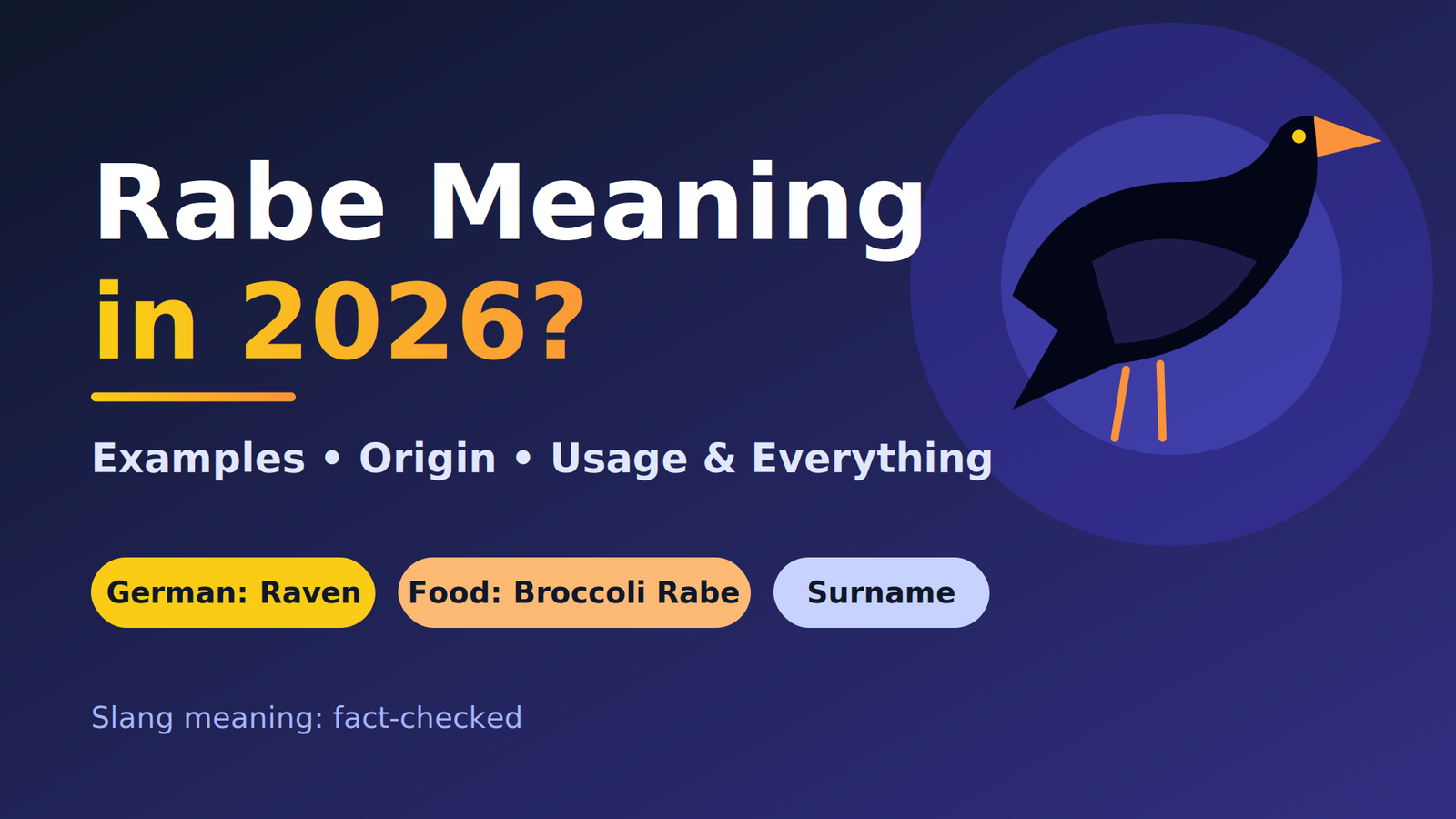
The rabe meaning slang searchers want has a simple definition. “Rabe” is a German word for raven, a short form of broccoli rabe, and a surname. As texting slang, it has no dictionary entry.
One four-letter word has the internet totally split. Some call it a sweet nickname. Others swear it’s only a typo. The truth sits somewhere stranger.
Here’s what you’ll find ahead. The real rabe meaning slang question comes down to evidence, since no major dictionary lists it. You’ll see where the word comes from, how people text it, and how to read it in context. Once you finish, the rabe meaning slang mystery will make sense.
Quick Answer: What Does Rabe Mean?
The meaning of rabe depends on where you meet it. In German, it means raven. In a kitchen, it’s a bitter green. As a last name, it’s German. In texting slang, it has no confirmed entry in major references.
Here’s the full picture at a glance:
| Context | Rabe meaning | Language | Verified? |
|---|---|---|---|
| German noun | Raven or crow | German | Yes |
| German figurative | A cunning or sly person | German | Yes |
| Food | Short for broccoli rabe (rapini) | English/Italian | Yes |
| Surname | Family name tied to the raven | German | Yes |
| French informal | Leftovers, extra portion (“du rabe”) | French | Yes |
| Astronomy (German) | The constellation Corvus | German | Yes |
| Texting | Possible babe stand-in or filler | English | No dictionary entry |
Notice the pattern. Every verified sense is old and well documented. The slang sense isn’t.
Rabe Meaning Slang: What the Evidence Shows
Let’s tackle the question most people type into search. Is there an established rabe meaning slang entry?
As of October 2026, major reference sites don’t list “rabe” as a slang term. Dictionary.com covers babe in detail. Merriam-Webster covers broccoli rabe. Neither gives “rabe” a standalone slang sense.
That doesn’t mean nobody types it. People invent playful spellings all the time. It means the usage hasn’t reached the point where lexicographers record it.
Is Rabe a Recognized Slang Term?
No. It isn’t a recognized slang term in the sense that a slang dictionary would use. A recognized term needs documented, widespread use over time.
Compare that with established slang like “babe.” Etymonline traces “babe” to the late 1300s, with the “attractive young woman” sense appearing by 1915 and the endearment use attested by 1901. That’s more than a century of paper trail.
“Rabe” has no such trail. Any site that gives you a confident rabe slang meaning is guessing, or copying another site that guessed.
How a Word Becomes a Recognized Slang Term
Lexicographers follow a fairly consistent checklist. Here’s how it works in practice:
| Stage | What happens | Does “rabe” qualify? |
|---|---|---|
| Spark | A word appears in a small group | Possibly |
| Spread | Strangers start using it with the same meaning | Not documented |
| Staying power | Use continues for months or years | Not documented |
| Citations | Dictionaries find it in print or recordings | No |
| Entry | A slang dictionary adds it | No |
Think of it like a restaurant review. One diner saying “great pasta” doesn’t make a Michelin star. You need many independent voices over time.
Rabe Slang Meaning on TikTok, Instagram, and Social Media
You’d expect TikTok slang to move fast, and it does. New phrases can reach millions of people within weeks. Instagram expressions and comment-section shorthand spread the same way.
Still, speed doesn’t equal proof. When a word is truly viral vocabulary, it leaves marks. News outlets write about it. Dictionaries flag it. Linguists tweet about it. None of that exists for “rabe” as social media slang right now.
So if you see it in a caption or DM, treat it as a personal choice. It might be a nickname, a typo, or a joke between friends.
Rabe Origin: Where the Word Comes From
The rabe origin story splits into three solid branches. Each has real documentation.
The German Root: From Middle High German “raban”
The German noun Rabe has deep roots. It descends from the Middle High German word “raban.” That makes it a medieval word at minimum, with linguistic roots reaching back even further into Germanic languages.
English “raven” is a cousin. Both words trace to the same Germanic family. If you speak English, you’ve been using a relative of Rabe your whole life.
The Italian-to-English Root: Turnip Greens
The food sense has a completely separate word origin. Merriam-Webster says “broccoli rabe” comes from southern Italian dialect forms such as Neapolitan “vruoccole de rapa,” meaning “flower stalks of the turnip.”
The same entry notes that the spellings “rabe” and “raab” reflect how English speakers heard the soft consonant and reduced vowel in those dialects. In other words, English speakers wrote down what they heard.
The first known English use dates to 1928. So this sense of “rabe” is about a century old in print.
The Surname Root: A German Family Name
The third branch is name origin. Wikipedia’s Raabe page says the surname “Rabe” originates in Germany and also means raven. The same page notes that the double-a spelling “Raabe” has its own history, including Prussian ties.
Many surnames began as nicknames or symbols. A family might have carried a raven on a crest. Or a villager with dark hair might have earned the label. Either way, the German surname stuck.
Slang Etymology: What We Can and Can’t Say
Now the honest part. Slang etymology needs evidence. For “rabe” as texting slang, there’s no documented first use, no early citation, and no traced path.
So any “origin story” for slang “rabe” is speculation. The sections below discuss plausible mechanisms. They’re labeled as possibilities, not facts.
Rabe in German: Raven, Crow, and Cunning Person
German is where “rabe” lives most naturally. If you’re reading German text, this is almost certainly your rabe word definition.
Core Meaning and Grammar
“Rabe” is a masculine noun meaning raven, crow, or a cunning person. Here are the grammar basics:
| Form | German | Pronunciation (approx.) |
|---|---|---|
| Singular (nominative) | der Rabe | RAH-buh |
| Plural | die Raben | RAH-ben |
| Genitive | des Raben | des RAH-ben |
| Dative | dem Raben | dem RAH-ben |
French Wiktionary lists the pronunciation as roughly [ˈraːbə]. Notice the long “a” and the soft “e” at the end. That’s very different from the English “babe” sound.
Figurative Meanings and Idioms
Germans use the raven as a character type. The word can describe a cunning or unscrupulous person, similar to “sly fox” or “rogue.”
A few related German terms help show how the word behaves:
- Rabenschwarz means raven-black. People use it for very dark hair or night skies.
- Rabenvogel means corvid, the bird family that includes crows and jays.
- Kolkrabe is the common raven specifically.
- Rabenmutter literally means “raven mother.” It’s an old insult for a mother seen as neglectful.
That last one reveals how culture shapes language. The raven carries a mixed reputation in German-speaking regions. It’s clever, but it can also be sinister.
German Rabe Examples
Here are usage examples you can adapt. The first comes from a dictionary entry. The others show everyday patterns:
| German | English |
|---|---|
| “Der Rabe krächzt laut.” | The raven croaks loudly. |
| Ein Rabe sitzt auf dem Dach. | A raven sits on the roof. |
| Zwei Raben fliegen über den Wald. | Two ravens fly over the forest. |
| Er ist schlau wie ein Rabe. | He’s as clever as a raven. |
Short, simple, and clear. If you’re learning German, these are great practice sentences.
The Raven in the Sky and in Myth
Rabe also names a constellation in German. French Wiktionary lists “Rabe” as the German name for the constellation Corvus. Corvus is Latin for crow.
Mythology adds more color. German-language dictionaries note that ravens often symbolize intelligence and wisdom in poetry and legend. Norse myth is a famous case. Odin kept two ravens, Huginn and Muninn, whose names mean “thought” and “memory.”
Why does this matter for you? Because it explains why the word feels loaded in German. A raven isn’t just a bird. It’s a symbol.
Broccoli Rabe: The Food Meaning of Rabe
If you saw “rabe” on a menu, relax. You’ve found the rabe meaning that most English speakers know.
What Is Broccoli Rabe?
Merriam-Webster describes broccoli rabe as a garden brassica related to the turnip, with leafy, branching stalks and small clusters of yellow florets. It’s also called rapini, and despite the name it isn’t a true broccoli.
Think of it as a cousin of turnip greens that happens to look like skinny broccoli. The flavor is bold and bitter, and that bite is the whole point.
Names and Spellings You’ll Meet
The same vegetable wears many labels. Home cooks and food writers use broccoli rabe, raab, rappi, rapini, and Italian names like cime di rapa for the same plant. A language database also links it to the Neapolitan term “friarielli.”
| Name | Where you’ll see it |
|---|---|
| Broccoli rabe | US menus and grocery stores |
| Broccoli raab | Alternate US spelling |
| Rapini | Canada, UK, and many US stores |
| Cime di rapa | Italian recipes |
| Friarielli | Naples and Neapolitan cooking |
| Rabe | Short form in recipes and restaurant menus |
Broccoli Rabe vs. Broccolini vs. Broccoli
People mix these up constantly. Here’s the clear breakdown:
| Feature | Broccoli rabe | Broccolini | Regular broccoli |
|---|---|---|---|
| Taste | Pungent and bitter | Mild and slightly sweet | Mild |
| Look | Leafy with tiny buds | Long stems, small florets | Thick head |
| Best cooked | Sautéed or blanched first | Roasted or steamed | Almost any method |
| Relation | Turnip family | Broccoli hybrid | Broccoli |
Broccoli rabe is usually sautéed and served in pasta dishes or sandwiches, and it’s known for a bitter flavor.
How to Pronounce Broccoli Rabe
The standard pronunciation is “brok-uh-lee rahb.” Merriam-Webster also lists a variant that rhymes with “grab.” Both are acceptable.
Don’t say “rayb.” That’s how people pronounce “babe,” and it can cause confusion at a restaurant.
Case Study: How “Rabe” Became a Menu Staple
Here’s a real example of a word traveling. Southern Italian farmers grew turnip greens for centuries. Italian immigrants brought the crop and the name to American cities. English writers then spelled the dialect sounds as best they could.
That process produced “broccoli rabe,” first recorded in English in 1928. Today it shows up in restaurant dishes nationwide. Recent menu examples include orecchiette with sausage and broccoli rabe, and pork and broccoli rabe sandwiches.
Notice how food terms spread. A dish moves first. A name follows. A dictionary entry comes last. That’s the opposite of how a slang term usually works.
Rabe as a Standalone Food Word
Cooks now say “rabe” alone, as in “sautéed rabe with garlic.” English Wiktionary treats this as a back-formation from “broccoli rabe,” and it even lists “kale rabe” as a related term.
So there’s one more legitimate use. If a friend texts “dinner is pasta and rabe,” they mean the vegetable.
Rabe as a German Surname
Now we reach name origin in practice. “Rabe” is a real family name with real people behind it.
Origin and Spelling
The surname Rabe originates in Germany and means raven, while “Raabe” is a related spelling with additional Prussian history. Spelling variants like Rabe and Raabe often split families by region or by a clerk’s handwriting.
Notable People Named Rabe
A few well-known bearers show how the name appears in public life:
| Name | Known for |
|---|---|
| John Rabe (1882–1950) | German businessman who helped shelter Chinese civilians in Nanjing during 1937–38 |
| David Rabe | American playwright, author of Sticks and Bones and Hurlyburly |
| Lily Rabe | American actress, known for stage and television work |
| Jean Rabe | American fantasy author and editor |
Check each name before you cite it elsewhere. Dates and credits can change in the telling.
Case Study: John Rabe and the Nanjing Safety Zone
John Rabe is the best-known historical case. He worked for Siemens in China. When Japanese forces attacked Nanjing in December 1937, he helped lead the International Committee for the Nanking Safety Zone. The zone sheltered many civilians.
His diaries later became an important historical record. For anyone searching the meaning of rabe, this is a reminder. A surname can carry weight far beyond a dictionary line.
Other Languages and Spelling Traps
Some “rabe” results come from other languages or similar-looking words.
French: “Du Rabe”
In informal French, “du rabe” means extra or leftover food. English Wiktionary gives the example “Y’a du rabe, qui en veut ?” meaning “There’s more left over, who wants some?”
If a French speaker texts you “y’a du rabe,” they’re offering seconds. Nothing flirty about it.
Hindi and Urdu: “Raabe” Is a Different Word
Dictionary sites sometimes show a Hindi or Urdu entry spelled “raabe.” Rekhta’s dictionary defines “raabe'” as an adjective meaning “fourth,” plus an astrological sense about a star near the sun’s rays.
That’s a transliteration of a different word. It shares letters with “rabe” but not meaning.
Unreliable Dictionary Entries
Be careful with low-quality sites. One online dictionary defines “rabe” as a salad green used as garnish. HinKhoj gives that definition and a sample sentence about a “rabe villa” rose garden. The entry is inconsistent and mixes up its own example.
When definitions conflict, trust sources with editorial standards. Merriam-Webster, Wiktionary with citations, and established language references are safer.
Rabe as a Babe Stand-In: Possible Texting Usage
Here’s where casual messaging gets interesting. Some people suggest “rabe” works as a babe stand-in. Let’s look at what’s plausible and what’s proven.
Why “Babe” Is Such a Strong Pet Name
“Babe” is one of the most common terms of endearment in English. Britannica’s learner dictionary says it’s used as an informal way of addressing a lover or friend, though it can offend when used with strangers.
“used as an informal way of addressing a lover, friend, etc.”
— Britannica Dictionary
It’s also a classic romantic nickname. The word began as a shortened form of “baban,” an imitative baby-talk term from the early 1200s. Over time it grew from “infant” to “darling.”
Case Study: How “Babe” Changed Meaning
This is a real example of how a word becomes an affectionate nickname:
| Era | Meaning of “babe” |
|---|---|
| 1200s | Infant or baby |
| 1795 | “Babe in the woods” (an innocent person) |
| 1839–1901 | Sweetheart and endearment |
| 1915 | Attractive young woman (college slang) |
| Today | Pet name, flirty address, casual greeting |
Each step took decades. Each left written evidence. That’s what slang recognition looks like.
How “Rabe” Could Appear in a Text
Several mechanisms could turn “babe” into “rabe.” These are possibilities, not documented facts:
- Autocorrect or predictive text. A phone may swap a rare word for a familiar one.
- Voice-to-text errors. A quick “babe” can be heard differently.
- Deliberate playfulness. Couples invent cute alternatives all the time.
- Fast thumb typing. Mistakes happen, though R and B aren’t neighbors on a standard QWERTY keyboard. That makes a simple slip less likely than people claim.
The last point matters. Many articles blame “neighboring keys.” On a QWERTY layout, R sits in the top row and B sits in the bottom row. They’re not adjacent. So a pure slip is a weaker theory than it sounds.
Using Rabe as an Affectionate Nickname
Couples and friends build private language. A pet name only needs two people to understand it. If your partner calls you “rabe,” it’s a cute nickname because you both agreed it is.
That makes it an endearing term within one relationship. It doesn’t make it a popular slang word. The difference is scale and documentation.
Sample Conversations: Texting Examples
The following are illustrative chat examples, not quotes from real users. They show how context shapes the rabe interpretation.
Scenario one: affectionate
Her: Running late, sorry rabe 🥲
Him: No stress. See you soon.
The emoji and warm tone point to an affectionate nickname.
Scenario two: likely typo
Friend: Hey rabe, can you send me the file?
You: Did you mean babe? 😂
Friend: Ha, autocorrect.
A quick check solves it.
Scenario three: food
Roommate: Making orecchiette with sausage and rabe tonight.
You: Save me a plate.
Rabe as a Filler Word: Conversational Filler and Tone Marker
Another claim you’ll read is that “rabe” works as a filler word. Again, no dictionary documents it. But we can explain how real conversational fillers work, and then judge whether “rabe” fits.
What a Filler Word Actually Is
A filler word or conversational filler is a short sound or word that fills a pause. Classic English examples include “um,” “uh,” “like,” and “you know.” Linguists often call many of these discourse markers because they guide the flow of talk.
Fillers do real work. They signal that you’re still speaking. They soften a statement. They show hesitation or friendliness.
Tone Markers in Text Language
In text language, people use a tone marker to show attitude. Examples include “lol,” “haha,” “lmao,” and trailing emojis. These mimic the voice cues we lose in writing.
An informal phrase becomes a tone marker when many people read it the same way. That shared reading is the key.
Does Rabe Qualify?
Not yet. A true discourse marker has a consistent function across speakers. “Rabe” has no documented, consistent function. If someone uses it as a casual expression at the start of a message, it’s personal style.
| Question | Real filler or marker | “Rabe” today |
|---|---|---|
| Do many strangers use it the same way? | Yes | Not documented |
| Does it serve a clear function? | Yes | Unclear |
| Do dictionaries describe it? | Often | No |
| Can you find it in recordings or print? | Yes | Not in major sources |
Rabe as a Username or Nickname
Plenty of people simply like the way “rabe” looks. It’s short and memorable. It sounds a bit like “rave” and “babe,” and it carries the raven meaning in German.
That’s why you’ll find it in gamer tags and handles. It’s also why online communication about “rabe” gets confusing. A username isn’t slang. It’s a label.
Why It Works as a Handle
- It has only four letters.
- It’s easy to pronounce.
- It has a dark, stylish feel thanks to the raven link.
- It’s often still available as a username.
If you meet a user named Rabe, assume a name before you assume a meaning.
Rabe Examples and Usage: Real-Life Contexts
Let’s pull all the rabe usage patterns into one place. This section gives you real-life contexts and sample conversations you can recognize quickly.
Usage Examples Table
| Context | Rabe usage | Example |
|---|---|---|
| German | Raven or crow | Der Rabe fliegt über das Feld. |
| German figurative | A sly person | Er ist ein echter Rabe. |
| Cooking | Short for broccoli rabe | Sauté the rabe with garlic. |
| Menu | Dish ingredient | Sausage and broccoli rabe sandwich |
| Surname | Family name | The Rabe family emigrated in 1890. |
| French informal | Extra portion | Y’a du rabe? |
| Texting (unverified) | Pet name or typo | Love you, rabe! |
| Username | Online handle | @rabe_official |
Everyday Language Check
Everyday language shifts quickly, so use this simple method. Ask three questions when you see “rabe”:
- Who’s saying it? A German speaker, a chef, or a close friend?
- Where is it? A recipe, a chat, or a profile name?
- What’s the tone? Warm, neutral, or joking?
Those answers usually reveal the contextual meaning within seconds.
How to Tell If “Rabe” Is Slang, a Nickname, or a Typo
You can decode most cases with a few clues. Here’s a practical guide for casual texting:
| Clue | Points to | Why |
|---|---|---|
| Sent once, then never again | Typo | Mistakes rarely repeat |
| Appears often from the same person | Nickname | Repeated use signals intent |
| Sits next to hearts or kisses | Term of endearment | Tone matches affection |
| Appears in a food conversation | Vegetable | Context decides |
| Sender is German or writes in German | Raven or crow | Native-language meaning |
| Sender corrects it right away | Typo | Self-correction proves it |
| Sender uses it with strangers or a crowd | Possibly a username or joke | Group use changes the read |
When in doubt, ask. A friendly “wait, rabe?” costs nothing. It beats guessing wrong and awkwardly replying “love you too.”
How to Reply If Someone Texts You “Rabe”
Your best reply depends on your relationship. Here are simple options:
- Close partner: Match the warmth. Send a heart or use their name.
- Friend: Joke about it. “Did you just call me rabe?”
- New contact: Ask politely. “Quick question, did you mean babe?”
- Colleague: Stay neutral and professional. Ignore it unless it repeats.
Avoid assuming romance. A single odd word isn’t a confession.
Common Mistakes People Make With Rabe
Because the word has so many senses, errors pile up. Watch for these:
- Treating one site’s slang claim as fact. Look for dictionary support.
- Mixing up rabe and raab. Both spellings exist for the vegetable.
- Confusing rabe with broccolini. They taste and look different.
- Assuming “rabe” means “babe” in German. It doesn’t. It means raven.
- Using it in a professional message. Pet names can offend coworkers.
- Ignoring the surname. “Rabe” is a real family name.
- Reading too much into a typo. Autocorrect causes plenty of strange words.
Could Rabe Catch On as Modern Slang?
Predicting emerging terminology is hard, but we can name the conditions. A word like this could become modern slang if a few things happen.
What Would Need to Happen
- A visible creator or community adopts it with a clear meaning.
- Strangers copy that meaning in comments and videos.
- Media or linguists notice the pattern.
- It survives long enough to leave a record.
Look at how trending words behave. Some burn bright for a month. Others fade in days. A few stay for decades. Only time and documentation separate them.
Tracking Online Trends Yourself
You can watch for online trends without guessing. Try these steps:
- Search the word in quotation marks on social platforms.
- Check search interest over time with a trends tool.
- Look for the term in newer slang dictionary updates.
- See whether journalists or linguists cover it.
If none of those show growth, you’re looking at a personal quirk, not digital language evolution.
Why Digital Language Moves So Fast
Understanding the bigger picture helps you judge claims about “rabe.” Digital communication rewards speed, brevity, and play. People shorten words and invent spellings to sound friendly or funny.
You’ll recognize these patterns in chat abbreviations and internet vocabulary. Think “bb,” “omg,” “ngl,” and “fr.” One explainer notes that “bb” in chat most commonly stands for “babe” or “baby,” especially in romantic or flirty messages. That’s a real, widely used texting terminology example. It shows why people might connect “rabe” to “babe” in the first place.
Texting Terminology Compared
| Term | Typical meaning | Status |
|---|---|---|
| bb | Babe or baby | Widely used chat abbreviation |
| babe | Endearment or attractive person | Established slang |
| bae | Short for “babe” or “before anyone else” | Widely recognized |
| rabe | Unclear | No verified entry |
Seeing “rabe” beside these terms makes the gap clear. The others have clear paper trails. “Rabe” doesn’t.
FAQs
What does rabe mean?
“Rabe” is the German word for raven or crow. It also works as a short form of broccoli rabe and as a German surname. The German noun can also describe a cunning person.
Is rabe a recognized slang term in 2026?
No major dictionary lists it as slang. Merriam-Webster covers only broccoli rabe, the turnip-family vegetable also called rapini. Some blogs do claim a slang sense, but that’s different from dictionary recognition.
Does rabe mean “babe” in texts?
Maybe, but nobody has confirmed it. One 2026 blog calls it a playful spelling or quick typo for “babe.” That’s a guess without a documented source, so check the context or ask the sender.
Do the 2026 articles claiming rabe means “bold” or “cool” hold up?
Treat them with caution. One says rabe means boldly authentic, creative, and effortlessly cool. Another calls it a stylized version of “babe” or a reaction word. Their definitions disagree, and none cites a dictionary or a traceable first use. Compare that with “6-7,” a 2025 slang term with news coverage and a documented origin on TikTok and Instagram Reels.
How do you pronounce broccoli rabe?
Say “brok-uh-lee rahb.” That’s the standard pronunciation. Merriam-Webster also lists a variant that rhymes with “grab.”
conclusion
The rabe meaning slang question has a clear answer. “Rabe” is a German word for raven. It’s also a vegetable and a surname. No major dictionary lists it as slang. Many blogs disagree with each other. That tells you to be careful.
Use context when you see rabe meaning slang in a text. A heart emoji may point to a pet name. A recipe points to food. Still unsure? Just ask. Language changes fast. Check back later. If a dictionary adds the word, the story will change. Until then, trust the facts.