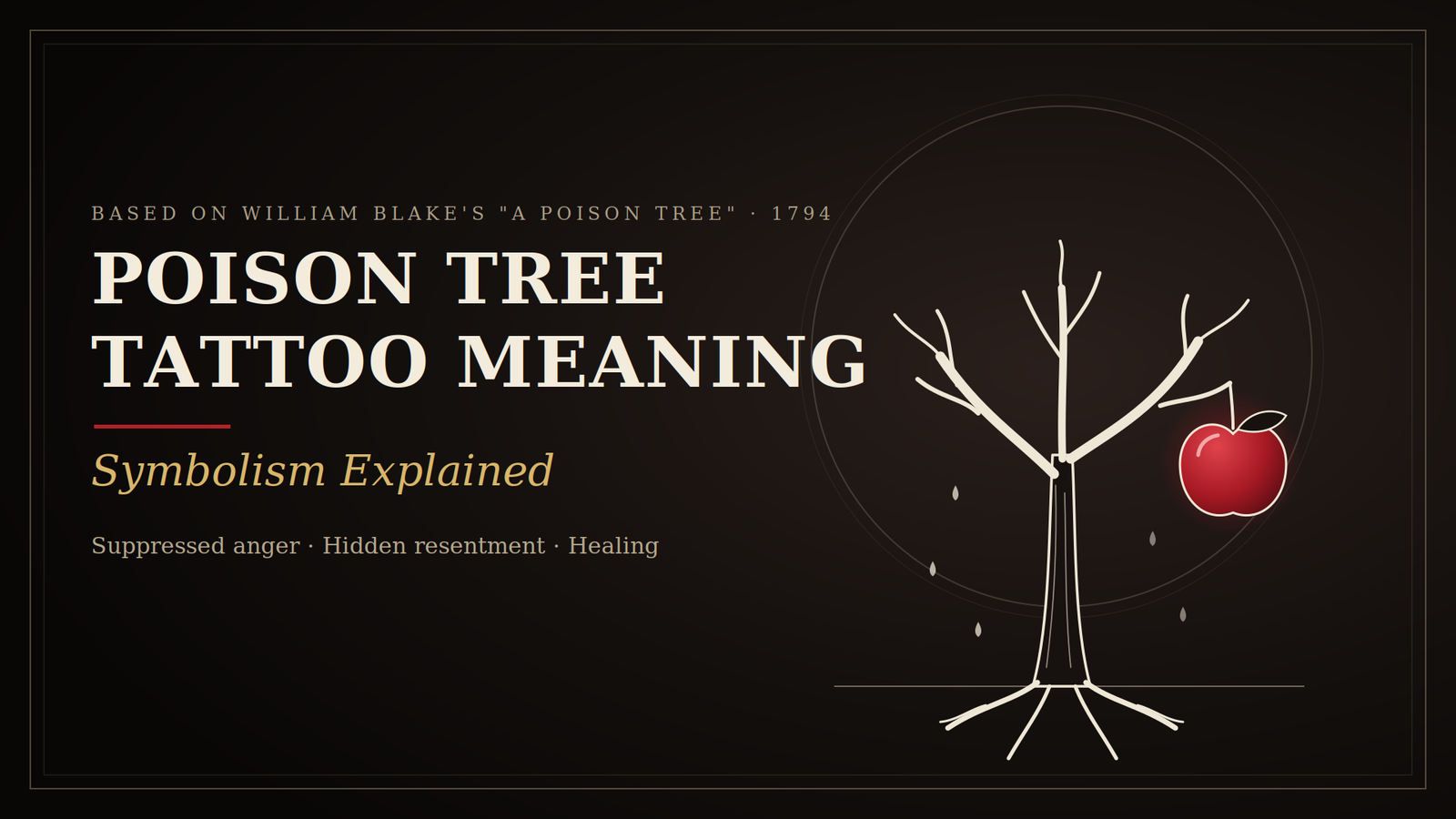
The poison tree tattoo meaning refers to the symbolism of a tree that grows from suppressed anger and bears harmful fruit. Drawn from William Blake’s 1794 poem “A Poison Tree,” the design represents hidden resentment and the damage silence can cause.
One bare tree. One glossy apple. A warning that has haunted readers for more than two centuries, now etched permanently into skin.
The poison tree tattoo meaning shifts with each wearer. Some mark a toxic relationship or a lost friendship. Others use it as a reminder to speak up early, a vow of revenge, or a sign of healing.
What Does a Poison Tree Tattoo Mean? (Quick Answer)
The poison tree tattoo meaning comes down to one idea. Hidden resentment grows when you refuse to speak about it. Left alone, it turns into something that can hurt you and the people around you.
Most wearers pick this design for one of four reasons:
- To remember a lesson about bottled-up anger
- To mark the end of a toxic relationship
- To honor a favorite William Blake poem
- To carry a cautionary symbol on their skin
Here’s a snapshot of the tattoo significance most people attach to the image.
| Element | Common symbolic meaning |
|---|---|
| The tree | Toxic growth fed by anger |
| The apple | The harm that buried anger finally produces |
| Smiling face or mask | Concealed hostility behind politeness |
| Bare branches | Emotional damage and emotional distance |
| Roots | The original wound or unresolved conflict |
| Water drops | The tears and fears that feed resentment |
The design carries real emotional symbolism. It also carries room for personal reading. Two people can wear nearly identical artwork and mean opposite things. One sees a warning. The other sees a vow of payback. Later sections cover both readings.
The Source of Poison Tree Symbolism: A William Blake Poem
Nearly every serious poison tree tattoo meaning starts with Blake. The English poet and engraver lived from 1757 to 1827. He published “A Poison Tree” in 1794 as part of Songs of Experience. That book was the darker companion to his 1789 Songs of Innocence.
Together the two collections show what Blake called the two contrary states of the human soul. Innocence looks at the world with trust. Experience looks at what happens after people learn to hide, deceive, and harm one another.
Why Blake’s Poem Sits at the Heart of Romantic Poetry
Blake belongs to the Romantic poetry movement. Romantic writers cared about raw feeling and individual experience. They often challenged rigid social rules. “A Poison Tree” fits that mold perfectly.
The poem has only 16 lines. It uses four short rhyming stanzas. The tone sounds almost like a nursery rhyme. That simple sound makes the content more unsettling. One analysis describes it as a poem that sounds like a nursery rhyme but works like a trap.
What Happens in A Poison Tree
The poem runs on a clear contrast. Read the opening stanza:
“I was angry with my friend; / I told my wrath, my wrath did end.”
Speaking the anger kills it. The next lines flip the situation:
“I was angry with my foe: / I told it not, my wrath did grow.”
Silence makes the anger bigger. From there the speaker tells a short, grim story:
- Stanza two: The speaker waters the anger with “fears” and “tears.” Then he sunns it with “smiles” and “deceitful wiles.”
- Stanza three: The anger grows into a bright apple. The foe sees it and knows it belongs to the speaker.
- Stanza four: The foe sneaks into the garden at night and eats the apple. Morning comes. The speaker finds him “outstretch’d beneath the tree.”
That final image is dark. The speaker feels glad. Blake leaves readers to decide what that gladness says about him.
Case Study: How Blake Changed the Title
Blake didn’t start with “A Poison Tree.” In his notebook draft he used the title “Christian Forbearance.” Forbearance means patient restraint.
That original title matters for literary symbolism. Blake suspected that polite, pious restraint could hide something ugly. Scholar D. Gillham reads the poem as Blake’s distrust of forbearance. He saw it as cowardice dressed up as virtue. The speaker never confronts his enemy. He attacks in secret while he smiles.
For anyone considering this symbolic tree tattoo, the lesson is useful. The tattoo doesn’t just warn against anger. It warns against the habit of hiding anger behind a pleasant face.
Blake’s Own Illustration
Blake didn’t write the poem and walk away. He engraved and hand-colored a plate for it. The image shows a stiff body stretched beneath a leafless tree. The arms extend in a posture that echoes a crucifixion.
Tattoo artists often borrow from this plate. You can browse high-quality scans of Blake’s work at the William Blake Archive. Bringing a printed reference to your artist saves a lot of guesswork.
Why the Poem Keeps Inspiring Artists
The poem has also drawn poetic inspiration from composers. Ralph Vaughan Williams set it to music in 1958 in Ten Blake Songs. Benjamin Britten followed in 1965 with Songs and Proverbs of William Blake.
That long afterlife explains why the poison tree symbolism still feels fresh. The idea doesn’t age. People still bottle things up.
Poison Tree Tattoo Symbolism Decoded: Every Element Explained
A poison tree tattoo can look very different depending on the artist. Still, the same building blocks appear again and again. Each one adds symbolic meaning to the final design.
The Tree: Toxic Growth You Feed Yourself
The tree is the core of any poisonous tree design. In the poem the speaker plants no seed on purpose. The anger simply takes root and keeps growing because he feeds it.
That detail matters. The tree doesn’t represent your enemy. It represents your own internal process. Wearers often say the tree reminds them that they control the watering can.
The Apple: Poison Apple Tattoo Imagery
The apple turns an abstract feeling into something you can see. A poison apple tattoo variation puts the fruit front and center. Sometimes the apple appears alone with a single leaf.
Apples carry heavy cultural baggage. They connect to fairy tales, temptation, and Eden. Blake used all of that on purpose. Later sections explain the biblical symbolism in more detail.
Water and Sunlight: How Anger Gets Fed
Most people miss this layer. The speaker doesn’t just ignore his anger. He waters it with tears and sunlight it with false smiles. Fake friendliness becomes fertilizer.
Some tattoo designs include small droplets falling toward the roots. Others add a faint sun or crescent moon. These touches signal emotional bitterness being nurtured over time.
The Figure Beneath the Tree
Some versions include the body from Blake’s plate. That choice leans toward the darker reading. It points at consequence and retaliation. Many wearers skip it. They prefer to show the tree alone and let the viewer imagine what happens next.
Quick Reference Table
| Design choice | Likely message | Mood |
|---|---|---|
| Lone tree, bare branches | Isolation from repressed emotions | Somber |
| Tree with one bright apple | Consequences of bottled-up anger | Warning |
| Tree with roots showing | Source of the unresolved frustration | Reflective |
| Tree plus text from the poem | Direct tie to the source | Literary |
| Tree with a mask | Hidden hostility behind a polite face | Sharp |
| Tree with fresh leaves | Recovery and personal growth | Hopeful |
Psychological Poison Tree Tattoo Meaning: Suppressed Anger and Emotional Suppression
Blake wrote in the 1790s. Yet his instinct about emotional suppression lines up well with modern research. Psychologists have studied what happens when people hide what they feel.
What Research Says About Hidden Feelings
A well-known 1993 study by James Gross and Robert Levenson looked at suppression directly. The paper found that people who hid their emotional reactions showed less outward expression. However, the study did not find that suppression reduced the inner feeling. Participants also showed increased physical arousal.
Later work in the same field links habitual suppression with strained social connection. In plain terms, hiding anger doesn’t make it vanish. It often just moves out of sight.
That finding mirrors the poem. The speaker hides his wrath. The wrath doesn’t fade. It grows.
How Suppressed Rage Tends to Behave
People who write about suppressed rage often describe a similar pattern. It rarely stays quiet forever. It shows up as:
- Sudden outbursts over minor things
- Sarcasm and passive-aggressive remarks
- Persistent emotional tension in the body
- Replaying old arguments for weeks or years
- Pulling away from people without explanation
None of this is a diagnosis. These are common patterns that therapists and writers describe. If anger feels unmanageable, a licensed professional can help far more than any tattoo can.
Why the Tattoo Works as a Warning to Yourself
The best hidden anger tattoo doesn’t announce your feelings to strangers. It speaks to you. Each time you glance at it, you get a quiet nudge.
Think of it like a smoke detector. It doesn’t put out fires. It tells you early that something’s burning. That early signal is the whole point of this poison tree tattoo meaning.
Poison Tree Tattoo Meaning in a Toxic Relationship
A toxic relationship and the poem share one core mechanic. Small hurts go unspoken. They pile up. Eventually something breaks.
How the Symbolism Fits an Unhealthy Relationship
In an unhealthy relationship, people often swallow complaints to keep the peace. The surface looks calm. Underneath, unspoken bitterness builds. Blake’s tree captures that slow burn.
Common situations that lead people to choose this tattoo include:
- Relationship betrayal that never got a real conversation
- Broken trust that one partner tried to forget instead of repair
- Romantic conflict that kept replaying without resolution
- A partner who used charm to cover emotional toxicity
The tattoo can serve as a marker. It says, “I saw the pattern, and I’m done feeding it.”
Case Study: A Composite Scenario
The following is an illustrative scenario built from common patterns. It isn’t a real person’s story.
Maya spends three years in a relationship where she never raises her concerns. Every time something bothers her she smiles and says it’s fine. Her partner takes the calm as agreement.
By year three she feels distant and tired. Small things set her off. When the relationship ends she realizes she never once said what she needed. Months later she gets a small poison tree tattoo on her forearm. For her the poison tree tattoo meaning is simple: “Say it early.”
Notice what the tattoo does here. It doesn’t blame her ex. It points at her own habit. That’s the most useful reading of the poem for relationships.
Can a Poison Tree Tattoo Represent a Toxic Relationship?
Yes. Many wearers use it exactly this way. Still, a thoughtful artist will ask what you want the piece to say. A tattoo about someone else’s behavior can lock a painful chapter on your body. A tattoo about your own lesson tends to age better.
Poison Tree Tattoo Meaning After Broken Friendships
Blake opens the poem with a friend, not a lover. That detail often gets overlooked. The first stanza shows the healthy path. The speaker tells his friend he’s angry and the anger ends.
Why Friendship Fits the Poem So Well
Friendships rarely end with a loud fight. More often they fade through silence. One person feels hurt and says nothing. The other never notices. Emotional distance grows. Eventually the two stop calling.
Those quiet endings produce a unique kind of grief. You can lose someone without ever having a clear breakup.
Common Triggers for a Friendship Breakup
| Trigger | How the poem applies |
|---|---|
| Friendship betrayal (shared secrets, broken promises) | Anger swallowed instead of spoken |
| Years of one-sided effort | Resentment watered by silence |
| A single unaddressed insult | Unresolved feelings growing over time |
| Drifting apart after big life changes | Nobody names the hurt |
Case Study: Another Composite Scenario
Again, this is an illustrative scenario and not a real individual.
Daniel and his closest friend of ten years stop talking after a missed wedding invitation. Neither calls the other. Daniel tells himself it doesn’t matter. Two years later he still thinks about it daily.
He eventually reaches out. The friend had assumed Daniel was angry and had stayed away out of guilt. They never rebuild the full friendship. Still, the conversation ends the grudge. Daniel gets a tiny poison tree on his wrist. For him, the tattoo marks the first stanza of the poem, the one where the anger ends because someone spoke.
That’s a fresh angle on poison tree tattoo meaning. It can celebrate the moment you broke the cycle.
Anger and Revenge: The Darker Poison Tree Tattoo Meaning
Not everyone reads the poem as a warning. Some wearers see anger and revenge as the real subject. The speaker plans, waits, and wins. In the poem’s last lines he’s glad.
The Revenge Reading
For this audience the tattoo expresses a desire for revenge or a promise of vengeance. The apple becomes bait. The garden becomes a trap. The tree stands for patience used as a weapon.
Plenty of art follows this reading. Dark, high-contrast blackwork suits it well. So does engraving-style linework.
Does the Poem Actually Support That Reading?
Partly. The speaker does get what he seems to want. However, Gillham’s view is that the speaker is corrupted by his own scheme. He poisons his foe, and the act diminishes him as well.
Blake also wrote in The Marriage of Heaven and Hell that “He who desires but acts not, breeds pestilence.” That line fits the poem neatly. It suggests the real harm comes from bitterness that goes nowhere.
Four Ways People Read the Tattoo
| Reading | Core message |
|---|---|
| Warning | Bottled anger harms you first |
| Revenge | Patient retaliation wins in the end |
| Critique | Fake politeness hides real hostility |
| Forgiveness | Speaking up ends the cycle |
The poem stays ambiguous on purpose. That ambiguity is a feature. It lets you attach your own tattoo interpretation.
Revenge or Forgiveness? How to Decide
Ask yourself one question. Which stanza do you want to live in? The first stanza ends the anger. The last stanza ends in a body under a tree. Your answer shapes the design and the story you tell about it.
The Biblical Meaning of a Poison Tree Tattoo
Many people ask about the biblical meaning of this design. Blake never names Eden directly. Still, the poem leans hard on Garden of Eden imagery: a garden, a tree, a bright apple, and a sin that leads to death.
The Garden of Eden Connection
In Genesis the first humans live in a garden. God warns them not to eat from the tree of the knowledge of good and evil (Genesis 2:17). They eat anyway. The result is exile.
Here’s a detail most articles skip. Genesis never names the fruit as an apple. The apple tradition developed later in Western art and language. Blake inherited that tradition and used it.
In the poem, the speaker plays a twisted version of the serpent. He sets out the forbidden fruit on purpose. His foe takes it. The pattern of temptation and consequence matches Eden closely.
Biblical Symbolism in the Design
Wearers who want a faith-oriented poison tree tattoo meaning often add:
- A coiled serpent around the trunk
- A single apple with a bite mark
- A small cross or broken branch
- Short scripture or poem text
Spiritual Lessons Behind the Image
The spiritual lessons here are practical. Different traditions teach similar points about anger. Many encourage speaking honestly and seeking reconciliation early. Others warn that resentment poisons the person who carries it.
Common lessons include:
- Address conflict while it’s small.
- Don’t disguise hostility as kindness.
- Recognize that temptation often comes with a price.
- Treat your own heart as a garden that needs tending.
Blake himself challenged organized religion. So this tattoo may suit someone who loves biblical symbolism and questions religious authority at the same time.
Other Poison Trees: Upas, Manchineel, and Why They Matter
Some searchers who type “poison tree tattoo” aren’t thinking of Blake at all. Two real and legendary trees often show up.
The Upas Tree
The upas has a real basis. Antiaris toxicaria grows in Southeast Asia. Its sap has been used in arrow and dart poison. A famous legend in 18th-century Europe exaggerated the tree into a killer that poisoned everything for miles. The Russian poet Alexander Pushkin wrote about it in “Anchar” in 1828.
A tattoo based on the upas usually signals danger and isolation.
The Manchineel
The manchineel (Hippomane mancinella) grows along coasts in Florida, the Caribbean, and Central America. Its sap can blister skin. Its fruit looks like a small apple. Spanish speakers have called it the “little apple of death.”
That nickname makes the manchineel a perfect partner for a poison apple tattoo. The botanical fact adds weight to the design.
Comparison Table
| Tree | Origin | Typical meaning |
|---|---|---|
| Blake’s poison tree | Literary (1794) | Suppressed anger and its consequences |
| Upas | Legend plus real botany | Isolation and hidden danger |
| Manchineel | Real tropical tree | Beautiful things that hurt |
| Tree of knowledge | Genesis | Temptation and loss of innocence |
Minimalist Poison Tree Tattoo Ideas: Small, Simple, and Fine-Line
You don’t need a huge piece to carry this meaning. A minimalist tattoo can carry the full poison tree tattoo meaning in a few lines. Plenty of wearers actually prefer it. A discreet design keeps the message personal.
Why Small Works Well Here
The poem itself is short and plain. A simple tattoo design matches its tone. A small tree tattoo also fits easily on the wrist, ankle, ribs, or behind the ear.
Minimalist body art has trade-offs, though. Very fine lines can blur over many years as skin changes. A skilled artist knows how to space details so the image stays readable.
Tree Tattoo Ideas for Small Spaces
- A single bare tree with one apple
- A tiny poison tree drawn in one continuous line
- A branch with a single dark fruit
- A fine-line tattoo of roots and trunk only
- An apple with a tiny crack down one side
- A tree silhouette inside a small circle
Placement Guide
| Placement | Best for | Note |
|---|---|---|
| Inner wrist | Tiny, private designs | Visible and easy to cover |
| Forearm | Medium vertical trees | Good for longer branches |
| Ribs | Personal pieces | Often more painful |
| Behind the ear | Very small marks | Little room for detail |
| Ankle | Simple outlines | Check how it ages with shoes |
| Upper back | Large, dramatic work | Fits the Blake plate |
Practical Facts on Cost and Care
Prices vary by city and artist. Many US shops set minimum charges, often in the range of roughly $80 to $200. A detailed small piece from an experienced artist can cost more. Always confirm the price with your chosen studio.
For healing, expect the surface to settle in about two to four weeks. Protect the tattoo from direct sun. Sunscreen helps fine lines last longer.
Does Size Change the Meaning?
Not really. A small piece and a large piece can express the same idea. However, size changes how you use it. A small tattoo works like a private reminder. A large one works like a statement.
Literary Tattoo Text: Choosing Words From the Poem
Many people pair the image with words. A literary tattoo that includes text adds clarity. It also adds risk. Errors in a quote last forever.
Short Lines That Work Well
The poem contains lines short enough for a tattoo:
- “I told my wrath, my wrath did end.”
- “I told it not, my wrath did grow.”
- “A Poison Tree”
Blake is in the public domain. You can use his words freely.
Getting the Text Right
Blake’s spelling and punctuation differ between editions. For instance, “outstretch’d” appears with an apostrophe in many printings. Pick one trusted source. Bring a printed copy to your artist. Check the final stencil carefully before the needle starts.
Many artists advise against very small lettering. Letters that are too tiny tend to blur together as the tattoo ages. If you want text, plan for a size that can hold up.
Personal Transformation: Poison Tree Tattoo as Healing and Growth
The poem is grim. Yet the tattoo doesn’t have to be. A growing number of wearers treat it as a symbol of personal transformation.
From Warning to Reminder of Healing
Think about the poem’s structure. The first stanza describes a way out. You tell the truth and the anger ends. A tattoo built around that stanza becomes an emblem of emotional healing.
Some wearers add new growth to the design. A fresh green shoot at the base shows change. A bird perched on a branch signals peace.
Self-Reflection Through the Design
Choosing the design pushes you into self-reflection. You have to decide what the tree means to you. That process often surfaces unresolved feelings you didn’t know you carried.
Questions worth asking:
- What am I still watering?
- Who needs a direct conversation?
- Which grudge would I like to retire?
Learning From Pain on Your Own Terms
Many people describe the healing journey as slow and uneven. A tattoo won’t fix anything. It can mark a decision, though. It can say, “I’m learning from pain, not repeating it.”
That’s the version of personal growth that sticks. It starts with honesty.
When to Seek More Than a Tattoo
If anger feels constant or frightening, talk to a licensed mental health professional. Therapy offers tools that no symbol can provide. The tattoo can sit beside that work as a reminder.
Before You Book: Questions Worth Asking
A permanent design deserves a clear head. Run through these checks first.
Self-Check List
- Does this poison tree tattoo meaning still fit me in ten years?
- Am I marking my own lesson or another person’s behavior?
- Would I be comfortable explaining the story to a stranger?
- Do I want the piece visible at work?
Artist Checklist
- Ask to see healed examples of fine-line or engraving work.
- Bring references from Blake’s original plate.
- Confirm the exact quote text in writing.
- Request a stencil and review it before inking.
- Ask how the design will age.
Cover-Up Reality
Dark, bold tattoos cover old ones more easily. Small, light designs offer fewer options later. Consider this before choosing a very tiny version.
FAQs
What does a poison tree tattoo mean?
It represents suppressed anger that grows when you hide it. The idea comes from William Blake’s 1794 poem “A Poison Tree.”
Is a poison tree tattoo about revenge?
Not always. The poem includes revenge, but many readers see it as a warning about bottled-up anger. Wearers choose the meaning that fits their story.
Who wrote “A Poison Tree”?
William Blake published it in 1794 in Songs of Experience. He first titled it “Christian Forbearance.”
Is a poison tree tattoo biblical?
Not directly. The poem echoes the Garden of Eden, though Genesis never names the forbidden fruit as an apple.
Does a small poison tree tattoo still carry the meaning?
Yes. A fine-line tree with a single apple expresses the full symbolism. Pick an artist experienced in fine-line work so the details age well.
Conclusion
The poison tree tattoo meaning is simple. Anger grows when you hide it. William Blake showed this in his 1794 poem. A tree with one dark apple says it all. It warns you to speak early. It also reminds you that silence has a cost.
Your own poison tree tattoo meaning is up to you. Some wearers think of revenge. Others think of a lost friendship or a toxic past. Many see healing and growth. Pick the story that feels true. Then choose a skilled artist. Done right, this tattoo will guide you for years.