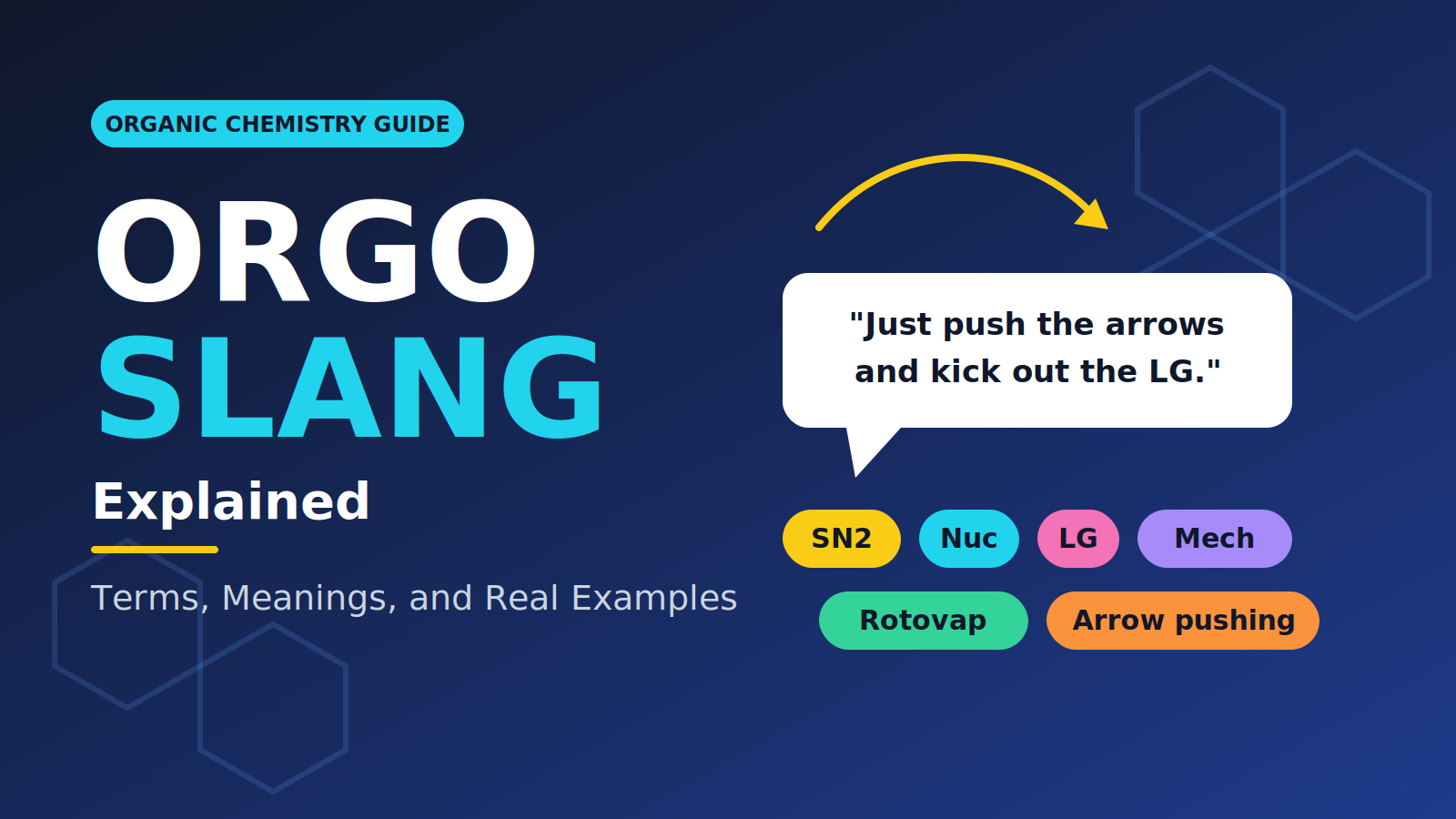
Orgo slang is the informal shorthand that students and instructors use to talk about organic chemistry. It covers nicknames for the course, quick labels for reactions, and casual names for lab gear. Words like “nuc,” “LG,” and “rotovap” save time and keep ideas moving.
Picture a stranger whispering, “Just push the arrows and kick out the LG.” Everyone nods except you. That moment feels like cracking a secret code.
Learning orgo slang helps you follow lectures, join study groups, and decode lab talk. This guide covers the most common terms, their origins, and real examples. Once you know them, orgo slang stops sounding like a foreign language.
What Is Orgo Slang?
Orgo slang is the informal vocabulary that students and instructors use when they talk about organic chemistry. It includes nicknames for the course itself. It also covers quick labels for organic chemistry reactions and casual names for lab gear.
You’ll also hear it called organic chemistry slang, orgo lingo, orgo jargon, or chemistry student slang. The names differ, but the idea stays the same. People shorten long phrases so they can think and talk faster.
The slang falls into three layers:
- Nicknames: “orgo,” “o-chem,” and “org chem” all mean the same course.
- Shorthand labels: “Nuc,” “LG,” and “E+” stand in for nucleophile, leaving group, and electrophile.
- Lab talk: “Rotovap,” “crude,” and “column” describe laboratory procedures that happen at the bench.
Some of these terms are true slang. Others are standard abbreviations that students say out loud so often they feel like slang. Later, you’ll see a table that separates the two.
Orgo Slang Definition at a Glance
This table gives you the basics in one place.
| Feature | Details |
|---|---|
| Main meaning | Informal words and abbreviations used in organic chemistry |
| Who uses it | Chemistry majors, pre-med students, university chemistry students, teaching assistants, and many professors |
| Where you hear it | Lectures, labs, office hours, and study groups |
| Where you see it | Class notes, group chats, flashcards, and whiteboards |
| Formality level | Informal to semi-formal |
| Closest relatives | Other chemistry slang words, such as “gen chem,” “p-chem,” and “biochem” |
| Example | “Is that an SN2 or an E2?” |
Orgo vs O-Chem: Which Do Chemistry Students Say?
Here’s the first thing every newcomer asks. Is it “orgo” or “o-chem”? Both work. Orgo vs O-Chem is a matter of habit rather than correctness.
| Nickname | Spelling variants | Notes |
|---|---|---|
| Orgo | orgo | Rhymes with “cargo.” Common in speech and texts. |
| O-Chem | o-chem, ochem, O Chem | Common in writing and on course forums. |
| Org Chem | org chem, orgchem | Clipped from “organic chemistry.” Often heard in labs. |
| Organic | organic | Often used alone, as in “I have organic at 9 a.m.” |
Is there a regional split? Many people claim there is. However, no published dataset settles it. If you want proof for your own area, use Google Trends. Compare “orgo” and “ochem” and filter by U.S. state. The results show which nickname people search for more where you live.
Either way, nobody will misunderstand you. Both terms point to the same organic chemistry course.
Where the Word “Orgo” Comes From
Let’s stick to what we can verify. Slang is mostly spoken. That makes exact origin stories tough to prove. Still, the word-building pattern behind “orgo” is clear.
How English Clips Academic Words
Linguists call this process clipping. You cut a long word down to its first syllable or two. Students have done this with school subjects for generations.
Here are some familiar examples:
- Chemistry becomes “chem.”
- Biology becomes “bio.”
- Calculus becomes “calc.”
- Economics becomes “econ.”
- Psychology becomes “psych.”
- Statistics becomes “stats.”
“Orgo” takes one extra step. It clips “organic” to “org” and then adds an -o ending. English does this often. Think of “demo,” “promo,” “combo,” and “typo.” The ending makes the word easier to say and gives it a casual, friendly sound.
That friendliness is a bit ironic. Few courses have a scarier reputation.
What the Written Record Shows
Standard references list the word. You can look it up in a dictionary like Merriam-Webster, and you can track how often it appeared in print with the Google Books Ngram Viewer. Those tools show “orgo” climbing as college textbooks and student writing moved online.
What you won’t find is a single agreed-upon date for the first use. Spoken slang spreads in hallways long before a dictionary notices it. So any article that names a specific campus, year, or inventor of the word is guessing. The safe takeaway is simple. “Orgo” is a standard example of English clipping, and it’s now firmly established in American student speech.
Why Students Use Orgo Slang
Every piece of orgo slang exists for a reason. Students didn’t invent these words for fun. They invented them because the course demands speed, shared understanding, and a little stress relief.
Speed in Notes and Exams
An organic chemistry course moves fast. A single lecture might cover a mechanism with four or five steps. Writing “nucleophile” in full each time wastes precious seconds.
Look at the savings:
| Full phrase | Shorthand | Letters saved |
|---|---|---|
| Nucleophile | Nuc | 7 |
| Electrophile | E+ | 10 |
| Leaving group | LG | 11 |
| Electron-withdrawing group | EWG | 23 |
| Round-bottom flask | RBF | 15 |
| Reagents | Reags | 3 |
This is classic chemistry shorthand. During chemistry exam preparation, it helps you fit more onto a flashcard. During a timed test, it helps you finish.
Shared Mental Models
Some terms do more than save time. They pack a whole idea into a few syllables.
Take arrow pushing. It means drawing curved arrows to show how electrons move from one atom to another. Those arrows are the core of reaction mechanisms. When a professor says “push the arrows,” students know to track the electron flow, step by step.
The same goes for a proton shufflee. That phrase describes a bit of housekeeping in a mechanism, where an H⁺ ion moves from one atom to another. Say it once and everyone in the room knows what to draw.
Good student shorthand works like a zip file. It compresses an idea so you can send it fast. Anyone with the right software, meaning the right background, can unzip it instantly.
Humor and Stress Relief
Organic chemistry has a reputation as a “weed-out” course. Many pre-med students take it because most U.S. medical schools expect it. The MCAT also tests organic chemistry concepts in its chemical and physical foundations section, according to the AAMC. That adds pressure.
Jokes help. Students nickname tough topics and swap memes about stubborn mechanisms. They call a bad exam “a bloodbath” and a good one “a gift.” This is campus slang at its most human.
It’s also a form of collaborative learning. When people laugh together about a hard subject, they feel less alone with it.
Common Orgo Slang Terms and Their Meanings
Ready for the main vocabulary list? These orgo slang terms show up again and again. Each table gives a plain definition. Most also give an example you can borrow.
Course and Exam Terms
| Term | Meaning | Example |
|---|---|---|
| Orgo / O-Chem | The organic chemistry course | “I’m taking orgo this fall.” |
| Orgo 1 / Orgo 2 | First and second semesters of the O-Chem course | “Orgo 2 starts with carbonyl chemistry.” |
| Org chem | Short for organic chemistry | “She’s tutoring org chem.” |
| Mech | A reaction mechanism | “Draw the mech for this reaction.” |
| Synth | A synthesis problem, where you build a target molecule from a starting material | “Exam three is mostly synth.” |
| Gen chem | General chemistry, the usual prerequisite | “Gen chem didn’t prepare me for this.” |
| P-chem | Physical chemistry | “P-chem is next semester.” |
These chemistry nicknames are part of everyday college chemistry talk. You’ll hear them in advising offices as much as in classrooms.
Reaction and Mechanism Shorthand
This is the heart of orgo terminology. These abbreviations describe chemical transformations and how they happen.
| Term | Stands for | Plain meaning |
|---|---|---|
| Nuc | Nucleophile | An electron-rich species that attacks a positive or partially positive atom |
| E+ | Electrophile | An electron-poor species that accepts electrons |
| LG | Leaving group | The atom or group that departs with a pair of electrons |
| EWG | Electron-withdrawing group | A group that pulls electron density toward itself |
| EDG | Electron-donating group | A group that pushes electron density away |
| Reags | Reagents | The chemicals added to make a reaction happen |
| Arrow pushing | Drawing curved arrows | Tracking electron movement in a mechanism |
| Curly arrows | Curved arrows | Another name for the same arrows, common in British usage |
| Proton shuffle | Moving H⁺ between atoms | A proton transfer step in a mechanism |
A quick note on regions. American students usually say “arrow pushing.” British texts often say “curly arrows.” That’s a small slice of regional chemistry terminology you can actually observe in textbooks.
SN1 and SN2: Substitution Reactions Made Simple
Substitution reactions swap one group for another. The two big ones are SN1 reactions and SN2 reactions. Together they make up nucleophilic substitution.
Here’s what the letters mean. “S” stands for substitution. “N” stands for nucleophilic. The number tells you the molecularity of the slow step. It does not tell you how many steps the reaction has. That trips up a lot of students.
SN2 in brief:
- It happens in one step.
- The nucleophile attacks from the back side while the leaving group departs.
- The reaction rate depends on both the substrate and the nucleophile.
- It flips the stereochemistry, a result called inversion of configuration (also known as Walden inversion).
- It works best on methyl and primary carbons.
- Polar aprotic solvents such as DMSO and acetone speed it up.
SN1 in brief:
- It happens in two steps.
- The leaving group departs first and creates a carbocation.
- The nucleophile then attacks the carbocation.
- The rate depends only on the substrate.
- It often scrambles stereochemistry, which produces a mix of products.
- It works best on tertiary, allylic, and benzylic substrates.
- Polar protic solvents such as water and alcohols help it along.
E1 and E2: Elimination Reactions Made Simple
Elimination reactions remove atoms to form a double bond. The two main types are E1 mechanisms and E2 mechanisms.
E2 in brief:
- It happens in one step.
- A strong base pulls off a hydrogen while the leaving group departs.
- The rate depends on both the substrate and the base.
- The hydrogen and leaving group usually line up anti to each other.
- It typically follows Zaitsev’s rule, which favors the more substituted alkene.
- A bulky base such as potassium tert-butoxide often gives the less substituted alkene instead.
E1 in brief:
- It happens in two steps.
- The leaving group departs first and forms a carbocation.
- A weak base then removes a nearby hydrogen.
- It often competes with SN1, since both start the same way.
- Heat tends to favor elimination over substitution.
Here’s a side-by-side view of SN1 and SN2 next to E1 and E2:
| Feature | SN1 | SN2 | E1 | E2 |
|---|---|---|---|---|
| Steps | 2 | 1 | 2 | 1 |
| Intermediate | Carbocation | None | Carbocation | None |
| Rate depends on | Substrate | Substrate and nucleophile | Substrate | Substrate and base |
| Best substrate | Tertiary | Methyl or primary | Tertiary | Tertiary or secondary |
| Typical reagent | Weak nucleophile | Strong nucleophile | Weak base | Strong base |
| Stereochemistry | Mix of products | Inversion | Not applicable | Depends on geometry |
This table is a favorite for chemistry exam preparation. If you want deeper walkthroughs of each mechanism, Master Organic Chemistry has detailed guides on every one of these organic reaction pathways.
Orgo Lab Slang
Chemistry lab work has its own dialect. The organic chemistry experiments you run each week create a steady stream of new words. Most of this is informal chemistry terminology that you pick up by doing.
| Term | Meaning | Where you’ll hear it |
|---|---|---|
| Rotovap | A rotary evaporator that removes solvent under reduced pressure | “Put it on the rotovap.” |
| Sep funnel | A separatory funnel used for liquid-liquid extraction | “Shake the sep funnel and vent it.” |
| RBF | Round-bottom flask | “Add the mixture to the 50 mL RBF.” |
| TLC | Thin-layer chromatography | “Run a TLC to check the reaction.” |
| Column | Column chromatography, a method for separating a mixture | “I’m running a column tomorrow.” |
| Crude | The impure product before purification | “My crude looks messy.” |
| Workup | The steps after a reaction that isolate the product | “The workup took two hours.” |
| Crashing out | A solid forming suddenly in solution | “It crashed out when I added water.” |
| Brine | A saturated sodium chloride solution used in washes | “Wash it with brine.” |
A few quick facts make these terms stick.
The rotovap has a real history. American chemist Lyman Craig developed the rotary evaporator in 1950. The Swiss company Büchi then launched a commercial version, the Rotavapor, in the late 1950s. Today, almost every organic lab owns one.
Flash chromatography has an origin story too. W. Clark Still and his coworkers described the method in the Journal of Organic Chemistry in 1978. It made reaction purification faster and cheaper. When a student says “I’m running a column,” they usually mean this technique.
Workup terminology covers a lot of ground. A typical workup might include these steps:
- Quench the reaction to stop it.
- Extract the product into an organic solvent.
- Wash the organic layer with water or brine.
- Dry it over a drying agent such as magnesium sulfate or sodium sulfate.
- Filter and concentrate it on the rotovap.
This sequence shows how chemical extraction and lab techniques fit into a normal lab day.
Spectroscopy Shorthand
After you make a compound, you need to prove what you made. That’s where spectroscopy comes in. Students use chemical abbreviations here constantly.
| Term | Meaning | Quick fact |
|---|---|---|
| NMR | Nuclear magnetic resonance | Shows the hydrogen and carbon environment in a molecule |
| IR | Infrared spectroscopy | A C=O stretch appears near 1700 cm⁻¹, and an O–H stretch is broad near 3300 cm⁻¹ |
| MS | Mass spectrometry | Gives the molecular weight |
| Peaks | Signals on a spectrum | “I see two peaks near 7 ppm.” |
| Splitting | How an NMR signal divides into smaller lines | Follows the n+1 rule for neighboring hydrogens |
| Integration | The area under an NMR signal | Tells you the relative number of hydrogens |
| Singlet, doublet, triplet | Peak patterns | One, two, and three lines |
If you see a triplet in a proton NMR spectrum, the neighboring carbon has two hydrogens. That’s the n+1 rule at work. The shorthand lets you describe a pattern in one word.
Slang vs. Standard Notation
Not every abbreviation counts as slang. Some are official. This table separates the two.
| True slang | Standard notation or terminology |
|---|---|
| Orgo, o-chem | Organic chemistry |
| Mech | Reaction mechanism |
| Nuc | Nucleophile (the abbreviation “Nu” is standard in many textbooks) |
| Rotovap | Rotary evaporator |
| Crashing out | Precipitation |
| Reags | Reagents |
| Arrow pushing | Electron-pushing formalism |
| SN2, E1, TLC | Standard abbreviations with defined meanings |
For official definitions, check the IUPAC Gold Book. It’s the reference for technical chemistry terms. Think of it this way. Slang is what you say at the bench. The Gold Book is what you write in a paper.
Orgo Slang Examples in Real Conversations
Seeing orgo slang in context makes it click. These four short scenes show how organic chemistry slang examples sound in real life. Each one ends with a plain-English translation.
Study Group Conversation
Picture a library table at 10 p.m. Four orgo study groups members are working through problem set five.
Maya: “Okay, tertiary alkyl bromide with a weak nuc. That’s SN1 or E1, right?”
Jordan: “Yeah. Carbocation forms first. Then it’s heat that decides it.”
Sam: “Heat means E1. Draw the mech and don’t forget the proton shuffle.”
Maya: “Got it. Arrow from the C–H bond to form the pi bond.”
Translation: The group is figuring out which reaction pathway a tertiary substrate follows. They decide that heat favors elimination.
This is peer learning in action. Explaining a mechanism out loud is one of the best ways to find the holes in your own understanding. Research on peer-led team learning in chemistry, which grew from National Science Foundation–supported work in the 1990s, has reported better student performance when learners work through problems together in structured groups.
Lab Bench Chatter
Now we’re in the teaching lab. Two university chemistry students are finishing an extraction.
Dev: “My crude is a yellow oil. Should I rotovap it now?”
Priya: “Dry it over MgSO₄ first. Then filter into the RBF.”
Dev: “And after that? Column?”
Priya: “Run a TLC first. If there’s one clean spot, you might skip the column.”
Translation: Dev has an impure product. Priya tells him to dry the organic layer and then check its purity on a TLC plate before deciding whether to purify it further.
Notice how much laboratory procedure fits into four lines. Without the shorthand, this chat would take twice as long.
Text Message Before an Exam
Here’s a group chat at 11 p.m. the night before a test.
Alex: “Anyone have the reags cheat sheet for orgo 2?”
Chris: “Sent it. Focus on Grignard and aldol. Those are always on the final.”
Alex: “Thx. Also what’s the deal with EWGs on benzene?”
Chris: “They deactivate the ring and direct meta. EDGs do the opposite.”
Translation: Alex asks for a list of reagents. Chris points out two high-yield topics. Then Chris explains that electron-withdrawing groups make a benzene ring less reactive and send new groups to the meta position.
Professor Aside During Lecture
Last, a classic moment in a lecture hall.
Professor: “I know it’s tempting to memorize every reaction. Don’t. Learn the mechanism. If you can push the arrows, you can solve problems you’ve never seen.”
Translation: The professor wants students to understand electron flow instead of memorizing lists.
This advice appears in countless organic chemistry studies guides, and for good reason. A few core principles explain hundreds of organic chemistry reactions.
Case Study: How SN2 Became Everyday Student Shorthand
Some of today’s student shorthand began as serious scientific notation. SN2 is the best example.
In the 1930s, British chemists Christopher Ingold and Edward Hughes worked at University College London. They studied how nucleophiles replace leaving groups on carbon. Their experiments measured reaction rates and revealed two distinct patterns. In one pattern, the rate depended on both reactants. In the other, it depended on only one. They named the patterns SN2 and SN1, using the number to show the molecularity of the rate-determining step.
That notation spread through journals and then through textbooks. Over the decades, it moved into lectures and onto flashcards. Today, students say “SN2” the way they say “gen chem.” Nobody stops to think about the 1930s.
Here’s the path the term took:
| Stage | Where the term lived |
|---|---|
| 1930s | Research papers by Hughes and Ingold |
| Mid-1900s | Advanced textbooks |
| Late 1900s | Standard chemistry curriculum at colleges |
| Today | Casual speech among science students |
The lesson is simple. A lot of chemistry student terminology starts out formal and then gets shortened and softened by daily use. SN2 is both official notation and everyday talk. It sits right where the two worlds overlap.
When to Use Orgo Slang (and When to Skip It)
Good orgo slang helps you communicate faster. Bad timing makes you look careless. Here’s how to tell the difference.
Where It Works
Use casual shorthand in these settings:
- Study groups and group study sessions
- Office hours with your professor or TA
- The lab bench, when you’re talking to study partners
- Your own notes, flashcards, and practice problems
- Text chats and messaging apps with classmates
In these places, speed matters more than polish. Everyone shares the same orgo vocabulary, so nobody gets confused.
Where It Doesn’t
Skip the slang in these situations:
- Formal lab reports. Write “round-bottom flask” and “rotary evaporator” in full.
- Graded written answers. Use complete terms unless your instructor says abbreviations are fine.
- Emails to professors. Keep a respectful, clear tone.
- Research papers and theses. Follow journal style.
For formal writing, check the style rules from the American Chemical Society. The ACS sets standards for how to write about chemistry in journals. Its guidance favors precise, standard terms over casual nicknames.
A good rule of thumb: if a stranger could read it, spell it out.
How Orgo Slang Compares to Slang in Other Science Courses
Orgo isn’t the only class with a private language. Most science education terminology includes some academic slang. Still, organic chemistry stands out because the vocabulary is both large and tied to visual reasoning.
| Course | Sample shorthand | What it means |
|---|---|---|
| General chemistry | ICE table, stoich | A table of initial, change, and equilibrium amounts, and short for stoichiometry |
| Physics | FBD, KE | Free-body diagram and kinetic energy |
| Biology | PCR, mito | Polymerase chain reaction and mitochondria |
| Calculus | IVT, FTC | Intermediate value theorem and fundamental theorem of calculus |
| Organic chemistry | SN2, LG, arrow pushing | Mechanism types, leaving group, and electron tracking |
Here’s the difference. In physics, shorthand mostly labels objects and quantities. In orgo, shorthand also labels processes. Phrases like “arrow pushing” and “proton shuffle” describe what you do on paper. That makes the language feel more like a toolkit than a list of names.
That’s why chemistry learners often say they’ve learned a new language by the end of the year. In a way, they have.
FAQs
What Is Orgo Slang?
Orgo slang is the informal shorthand students and instructors use for organic chemistry. It includes course nicknames like “orgo,” reaction labels like “nuc” and “LG,” and lab terms like “rotovap.”
Is It “Orgo” or “O-Chem”?
Both work, since each one names the same organic chemistry course. “Orgo” is common in speech, while “o-chem” shows up more in writing and online forums.
What Are Common Orgo Slang Terms?
Popular orgo slang terms include “nuc” (nucleophile), “LG” (leaving group), “mech” (mechanism), and “arrow pushing.” Lab regulars add “crude,” “column,” and “workup.”
Can You Use Orgo Slang in Lab Reports?
No. Keep orgo slang out of graded reports and write full terms like “rotary evaporator.” Standard abbreviations such as NMR, IR, and TLC are fine once you define them.
Why Do Organic Chemistry Students Use Orgo Lingo?
Organic chemistry students use orgo lingo to save time in notes and exams. It also helps study groups explain mechanisms quickly and cuts some of the stress.
conclusion
Orgo slang is a shortcut. It helps organic chemistry students save time, share ideas, and stay calm under pressure. Terms like “nuc,” “LG,” and “arrow pushing” turn long ideas into quick words.
Use orgo slang with classmates, in your notes, and at the lab bench. Switch to full terms in graded work. Pick five orgo lingo terms today and say them out loud. Soon, the language will feel natural.