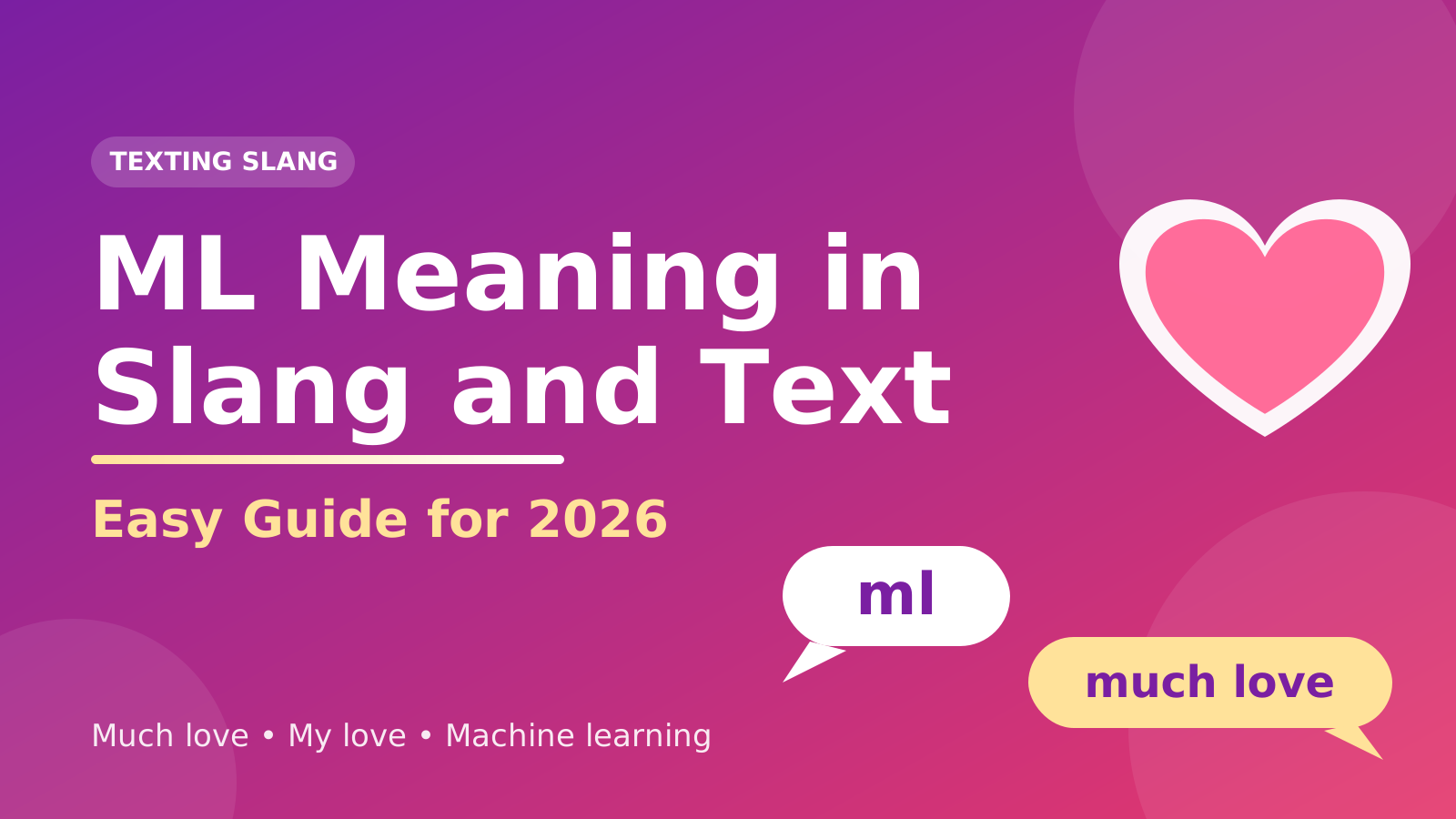
The ML meaning in text is simple. It stands for “much love” or “my love.” People send it to show warmth, care, or friendship in quick messages.
A single message lands on your screen. Just two letters: “ml.” No emoji. No explanation. Yet the ML meaning in text can melt a heart or leave you puzzled.
Affection isn’t the only story. ML can also mean machine learning, milliliter, or Mobile Legends. Each one appears in different chats and on different social media platforms. This guide explains the ML meaning in text and shows you how to reply with confidence.
What Does ML Mean in Text?
The most common ML meaning in text is Much Love. It’s a friendly expression that communicates affection, appreciation, or goodwill. Instead of typing the complete phrase, people use two simple letters to make their messages shorter and more relaxed.
For example, imagine helping a friend prepare for an important interview. After thanking you, they might send:
“Thanks for helping me today. ML!”
Here, ML means Much Love. Your friend isn’t necessarily expressing romantic feelings. They’re simply showing appreciation and ending the message warmly.
People often use this abbreviation as a small emotional gesture. It can make an ordinary message sound more personal without adding unnecessary words.
What Does Much Love Mean in Texting?
Much Love meaning refers to sending someone affection, kindness, or positive feelings. It works as a warm expression between people who share a friendly or caring connection.
You might see it in several situations:
- Showing appreciation: Someone thanks you for helping them.
- Supporting a friend: You want to encourage someone during a difficult time.
- Ending a conversation: You want to finish a message with warmth.
- Celebrating someone: You send congratulations with a little affection.
- Showing gratitude: You appreciate someone’s thoughtful words or actions.
For example:
| Message | Intended meaning |
|---|---|
| “Take care, ML!” | Sending affection and good wishes. |
| “Thanks for everything. ML.” | Expressing appreciation. |
| “You deserve happiness. ML!” | Showing support and kindness. |
| “Good luck tomorrow, ML.” | Sending encouragement. |
The expression doesn’t automatically indicate romantic interest. Friends, relatives, and even familiar online acquaintances can use it.
Is ML Friendly or Romantic?
This is where context becomes especially important.
When a close friend sends ML, they probably mean Much Love. However, a romantic partner might use the same letters to express affection or mean My Love.
Consider these two messages:
- Friend: “Great talking to you today. ML!”
- Partner: “Goodnight, ML. Miss you already.”
The first sounds like friendly appreciation. The second carries a more intimate tone because of the relationship and surrounding words.
The abbreviation alone doesn’t establish someone’s feelings. Look at your relationship and the conversation before interpreting it.
What Does ML Stand For? Full Form and Different Meanings
The ML abbreviation has several possible expansions. Although Much Love is common in casual texting, other meanings appear in technology, gaming, relationships, and measurements.
Understanding these alternatives helps you avoid confusing one conversation with another.
| ML full form | Meaning | Common context |
|---|---|---|
| Much Love | Affection and appreciation | Texting and social media |
| My Love | An affectionate way to address someone | Romantic conversations |
| Machine Learning | A branch of artificial intelligence | Technology and education |
| Mobile Legends | A multiplayer mobile game | Gaming communities |
| Milliliter (mL) | A unit of liquid volume | Cooking, science, and medicine |
Let’s examine each meaning more closely.
Much Love: The Common Texting Meaning
Much Love is a popular interpretation of ML in informal messages. People use it to communicate warmth without making a conversation feel overly serious.
For example:
“Congratulations on your new job! ML ❤️”
The sender is expressing happiness and affection. They might be a close friend, family member, or someone who appreciates you.
This usage works particularly well in friendly messages, supportive comments, and casual conversations.
My Love: An Affectionate Expression
Some people use ML to mean My Love. It can work as a shortened affectionate address between romantic partners or people with a close emotional connection.
For example:
“Good morning, ML. Hope you have a beautiful day.”
In this situation, the sender addresses the recipient affectionately.
However, My Love isn’t the only possible interpretation. Many people use ML for Much Love instead. Don’t assume someone has romantic intentions based on two letters alone.
Machine Learning: The Technology Meaning
In technology, ML stands for Machine Learning, an important field within Artificial Intelligence (AI).
Machine Learning allows computers to identify patterns in information and improve their performance through data and experience. Rather than relying only on fixed instructions, a machine learning system uses examples to make predictions or decisions.
You encounter this technology in many everyday products.
For example:
- Streaming services recommend movies based on your viewing habits.
- Email services identify suspicious messages and spam.
- Navigation applications estimate travel times.
- Shopping websites suggest products based on previous activity.
- Voice assistants process spoken requests.
In these situations, ML has nothing to do with affection or texting slang.
The surrounding discussion makes the meaning clear. If someone writes, “I’m studying ML algorithms,” they’re discussing technology rather than sending love.
Mobile Legends: The Gaming Meaning
In gaming conversations, ML often refers to Mobile Legends, particularly the popular multiplayer game Mobile Legends: Bang Bang.
Players commonly shorten the game’s name to ML when discussing matches, heroes, teams, and gameplay.
For example:
“Are you playing ML tonight?”
Here, the sender wants to know whether you’ll play Mobile Legends.
The abbreviation is especially understandable when the conversation already involves mobile gaming.
Milliliter: The Measurement Meaning
Another meaning appears in measurements. The symbol mL represents milliliter, a metric unit used to measure liquid volume.
One milliliter equals one-thousandth of a liter.
For example:
- 5 mL of cough syrup.
- 250 mL of milk.
- 500 mL of drinking water.
- 1,000 mL equals 1 liter.
Notice the capitalization: mL is the standard symbol for milliliter. In casual typing, people may use different capitalization, but the measurement context usually makes the intended meaning obvious.
Where Did ML Come From? Origin and History of the Slang
The popularity of short expressions like ML connects to the development of digital communication.
Before smartphones became widespread, people frequently sent messages through traditional SMS services. These messages often had character limits, so users developed shortcuts to communicate quickly.
Common examples included:
- LOL — Laughing Out Loud.
- BRB — Be Right Back.
- BTW — By the Way.
- TTYL — Talk To You Later.
- ILY — I Love You.
These Texting abbreviations made everyday communication faster. They also helped people express emotions without typing complete sentences.
ML fits naturally into this broader habit of internet shorthand.
How Text Messaging Encouraged Short Forms
Early text messaging encouraged users to shorten familiar phrases. Instead of typing every word, people relied on recognizable initials and abbreviations.
As mobile phones evolved, this habit continued. Smartphones made messaging easier, but users still preferred quick expressions.
The same behavior now appears across instant messaging services, social networks, and online communities.
ML offers two convenient letters instead of writing Much Love every time.
How Social Media Helped ML Spread
Social platforms created more opportunities for short expressions.
People began communicating through comments, captions, reactions, and private messages. Short phrases became useful because conversations moved quickly.
For example, someone might comment:
“Beautiful picture. ML!”
The abbreviation communicates appreciation without requiring a lengthy response.
However, there isn’t one verified invention date or universally documented creator for ML as texting slang. It’s more accurate to understand it as part of the wider development of online abbreviations rather than attribute it to a specific person or event.
Why People Still Use Internet Shorthand
Even with modern keyboards and voice typing, short expressions remain useful.
They can:
- Save typing time.
- Make messages feel casual.
- Communicate emotions quickly.
- Create a familiar tone between friends.
- Fit naturally into comments and short replies.
That convenience explains why Common texting slang continues to appear in modern digital communication.
How People Use ML in Everyday Conversations
The meaning of ML becomes clearer when you see it in realistic situations.
Most casual uses communicate affection or appreciation. However, the relationship between the sender and recipient can change the emotional tone.
ML Meaning in Text Messages
Traditional text messages remain one of the simplest places to encounter ML.
People often add it at the end of a message as an affectionate sign-off. It works like a friendly farewell or a small expression of gratitude.
Here are some examples:
Example 1: Showing appreciation
Friend A: “I really appreciate your help today.”
Friend B: “Anytime! ML ❤️”
Meaning: The sender is expressing warmth and appreciation.
Example 2: Ending a conversation
Friend A: “I’ll talk to you tomorrow.”
Friend B: “Sure! Take care. ML.”
Meaning: The sender is ending the conversation with affection.
Example 3: Offering encouragement
Friend A: “I’m nervous about my exam.”
Friend B: “You’ve got this! Stay confident. ML!”
Meaning: The sender is offering support and positive feelings.
Example 4: Celebrating success
Friend A: “I finally passed my driving test!”
Friend B: “That’s amazing! So happy for you. ML!”
Meaning: The sender is celebrating your achievement.
In each example, ML adds a personal touch. The exact emotional meaning depends on the conversation.
ML Meaning on Social Media
Social media usage has made short expressions part of everyday online communication.
People use ML in comments, captions, direct messages, and replies. It can communicate appreciation without taking attention away from the main conversation.
For instance, someone posts a picture of their graduation. A friend might comment:
“Congratulations! Wishing you the best. ML ❤️”
Here, ML works as a caring message.
You may also encounter it in:
- Instagram comments.
- TikTok replies.
- Facebook posts.
- Snapchat chats.
- WhatsApp messages.
- Online creator communities.
Although the platform changes, the general Much Love meaning often stays the same.
ML Meaning on Instagram
Instagram users communicate through posts, Stories, Reels, and direct messages. Short expressions fit naturally into these formats.
You might see ML in a comment beneath a friend’s photograph.
For example:
“Looking gorgeous! ML.”
The commenter is expressing affection or appreciation.
Another example:
“Thanks for supporting my small business. ML to everyone!”
Here, the expression communicates gratitude toward followers or customers.
On Instagram, emojis can help clarify the tone. A heart emoji may make the message feel more affectionate, while a simple smile can keep it friendly.
ML Meaning on TikTok
The ML meaning on TikTok usually depends on the video and comment section.
TikTok conversations move quickly. Users often leave short comments instead of writing complete sentences.
For example:
Creator: “Thank you for supporting my first video!”
Viewer: “Always supporting you. ML!”
The viewer uses ML to express appreciation and encouragement.
You might also encounter it in TikTok replies such as:
- “Love this video. ML!”
- “Sending ML to everyone here.”
- “Thanks for making my day. ML.”
- “You deserve all the support. ML ❤️”
Remember that TikTok doesn’t give ML one official platform-wide definition. Users bring different slang habits into their comments, so context matters.
ML Meaning on Snapchat
Snapchat conversations often involve quick messages, photos, videos, and private replies.
Someone might send:
“Had fun today. ML!”
This usually communicates affection or appreciation after spending time together.
Because Snapchat conversations are often personal, ML may carry a warmer tone between close friends or partners.
However, the abbreviation still doesn’t automatically mean My Love.
ML Meaning on WhatsApp
WhatsApp supports private chats, group conversations, voice messages, and status updates.
People may use ML to finish a message or respond to someone who has helped them.
For example:
“Thanks for checking on me. ML.”
It works as a short expression of gratitude.
In family groups, friends’ chats, and personal conversations, ML can make a simple message feel more caring.
ML Meaning on Facebook
Facebook users sometimes include ML in comments, posts, and Messenger conversations.
For example:
“Happy birthday! Wishing you endless happiness. ML.”
The abbreviation adds warmth to an ordinary birthday greeting.
People may also use it when thanking friends for their support or responding to thoughtful comments.
ML Meaning on Discord
Discord has communities focused on gaming, entertainment, education, and shared interests.
The meaning of ML depends heavily on the server.
In a friendly conversation, it may mean Much Love. In a gaming server, it might refer to Mobile Legends.
For example:
User A: “Anyone playing ML tonight?”
User B: “Yes, send me an invite.”
Here, the gaming context makes Mobile Legends the likely meaning.
In another channel, someone might write:
“Thanks for helping with the project. ML!”
That message uses ML as an expression of appreciation.
ML Between Friends and Family
Friendships and family relationships create natural opportunities for affectionate expressions.
People don’t always want to write long emotional messages. Sometimes, two letters are enough to show that someone matters.
For example, imagine your cousin helps you prepare for a family celebration.
You might send:
“Thanks for staying with me and helping everything go smoothly. ML!”
The message feels warm without sounding overly formal.
Here are other everyday examples:
| Situation | Example message | Meaning |
|---|---|---|
| Helping someone | “You saved my day. ML!” | Appreciation |
| Family conversation | “Miss everyone. ML.” | Affection |
| Birthday greeting | “Have a wonderful birthday. ML!” | Warm wishes |
| Difficult day | “Stay strong. ML ❤️” | Support |
| Friendly farewell | “Talk soon. ML!” | Caring goodbye |
The important point is that ML can express positive feelings without suggesting romance.
ML in Romantic Texting
Romantic conversations sometimes give ML a more personal meaning.
A partner might use it to express affection, especially when both people already understand each other’s texting habits.
For example:
Partner A: “I can’t wait to see you tomorrow.”
Partner B: “Same here. Goodnight, ML ❤️”
In this situation, ML may mean My Love or Much Love.
The romantic setting makes both interpretations possible.
How to Recognize Romantic Intent
Look for other clues in the message.
These may include:
- Pet names such as sweetheart or darling.
- Heart emojis and affectionate symbols.
- References to missing someone.
- Messages about dates or shared memories.
- Expressions of care and emotional closeness.
For example:
“Miss you so much. Goodnight, ML ❤️”
This message sounds more intimate than a simple comment beneath a friend’s photograph.
Still, don’t interpret one abbreviation as proof of someone’s romantic feelings. Their behavior and relationship with you provide better clues.
ML vs. I Love You in Relationships
ML and ILY don’t communicate exactly the same thing.
ML commonly expresses Much Love, which can be friendly, supportive, or affectionate.
ILY directly stands for I Love You. It usually communicates stronger or more explicit affection.
For example:
- “Thanks for everything. ML!” sounds warm and appreciative.
- “I miss you. ILY!” expresses love more directly.
Both can appear in romantic conversations, but they aren’t interchangeable in every situation.
ML Meaning in Gaming: Mobile Legends
Gaming communities often develop their own language. Mobile Legends is one example of how an abbreviation can have a completely different meaning outside ordinary texting.
Mobile Legends: Bang Bang is a multiplayer online battle arena game developed by Moonton.
Players commonly shorten its name to ML. They use the abbreviation when discussing matches, heroes, teams, and competitive gameplay.
How Gamers Use ML in Conversations
Consider these examples:
- “Do you play ML?” — Asking whether someone plays Mobile Legends.
- “Let’s play ML tonight.” — Suggesting a gaming session.
- “My ML rank improved.” — Discussing progress in the game.
- “Our ML team needs another player.” — Looking for a teammate.
- “I lost three ML matches.” — Talking about recent gameplay.
In these situations, interpreting ML as Much Love wouldn’t make sense.
Common Mobile Legends Terms
| Gaming term | Meaning |
|---|---|
| ML | Mobile Legends |
| MVP | Most Valuable Player |
| Rank | Competitive player level |
| Hero | Playable game character |
| Teamfight | A battle involving multiple players |
| Matchmaking | Finding players for a game |
| Solo queue | Playing without a prearranged team |
| Lane | A route across the game map |
These terms help explain why gaming conversations have their own shorthand.
Example: A Realistic Gaming Conversation
Player A: “Are you free tonight?”
Player B: “Yes, what’s up?”
Player A: “Let’s play ML after dinner.”
Player B: “Sure! Send me an invite.”
Here, both players understand ML as Mobile Legends because the conversation involves playing a game.
The surrounding words remove any confusion.
Other Meanings of ML You Should Know
Although Much Love appears frequently in casual texting, ML has several meanings across different subjects.
Understanding these meanings helps you interpret the abbreviation correctly.
ML in Technology: Machine Learning
Machine Learning is a major area of artificial intelligence.
It focuses on building systems that learn patterns from data and use those patterns to perform tasks.
For example, a recommendation system may analyze your previous activity. It then suggests content that matches your interests.
Machine Learning has several important applications:
- Image recognition.
- Fraud detection.
- Language processing.
- Product recommendations.
- Medical image analysis.
- Predictive maintenance.
- Speech recognition.
How Machine Learning Works
A typical machine learning process involves several stages:
- Data collection: A system gathers relevant information.
- Data preparation: Developers clean and organize the information.
- Model training: An algorithm identifies patterns in the data.
- Testing: Developers evaluate how accurately the model performs.
- Deployment: The trained model handles real-world tasks.
- Monitoring: Developers check performance and update the system when needed.
Machine learning models don’t all work in the same way. Some learn from labeled examples, while others identify patterns without predefined labels.
This technical meaning is common in discussions about AI technology, programming, and data science.
ML in Business and Professional Communication
In professional settings, ML usually means Machine Learning when the discussion involves technology or business analytics.
For example:
“Our company plans to use ML for customer behavior analysis.”
This sentence refers to machine learning rather than an affectionate expression.
Businesses use machine learning to support:
- Sales forecasting.
- Customer segmentation.
- Fraud prevention.
- Inventory planning.
- Automated recommendations.
- Risk analysis.
However, professional abbreviations can vary between industries. If the context isn’t clear, ask the sender what they mean.
ML in Cooking and Measurements
In recipes and scientific measurements, mL means milliliter.
For example:
“Add 100 mL of water.”
This instruction refers to liquid volume.
You might encounter the unit on:
- Milk cartons.
- Water bottles.
- Cooking instructions.
- Medicine labels.
- Laboratory equipment.
- Cosmetic product packaging.
The standard symbol is mL rather than ML. That distinction matters when precision is important.
How to Understand the Correct Meaning of ML
Seeing ML in a message doesn’t always reveal its intended meaning immediately.
Fortunately, you can usually understand it by examining a few details.
Check the Surrounding Words
The words around ML provide the strongest clue.
For example:
“Sending ML to everyone.”
This likely means Much Love.
However:
“I’m learning ML programming.”
This clearly refers to Machine Learning.
And:
“Let’s play ML.”
This probably refers to Mobile Legends if the conversation involves gaming.
Consider Your Relationship With the Sender
The sender’s relationship with you can help explain the emotional tone.
A close friend might use ML as a friendly sign-off. A romantic partner might use it affectionately.
A coworker might use it casually after thanking you. However, the same abbreviation in a technology meeting could refer to Machine Learning.
Don’t rely on relationships alone. Combine them with the message itself.
Pay Attention to the Platform
Different online communities have different communication habits.
For example:
- Instagram comments often contain appreciation and friendly expressions.
- Gaming servers frequently use game-related abbreviations.
- Technology forums discuss Machine Learning.
- WhatsApp messages often reflect personal relationships.
The platform provides useful context, but it doesn’t determine the meaning by itself.
Look at Capitalization
Capitalization can offer another clue.
ML often appears as an informal abbreviation in texting and gaming.
mL is the standard symbol for milliliter.
However, people don’t always follow capitalization rules in casual messages. Treat this as a helpful clue rather than a definite rule.
Ask When You’re Unsure
There’s nothing wrong with asking someone what they mean.
You can simply reply:
“Just checking, do you mean Much Love?”
A quick question prevents misunderstandings and keeps the conversation natural.
ML vs. Similar Texting Abbreviations
ML belongs to a wider group of expressions used to communicate affection, appreciation, and friendship.
Some abbreviations look similar but carry different meanings.
ML vs. ILY
| ML | ILY |
|---|---|
| Usually means Much Love | Means I Love You |
| Can express friendly affection | Expresses love directly |
| Works as a warm sign-off | Often feels more personal |
| Can suit friends and family | Common between close people |
Example:
“Thanks for being there. ML!”
Compared with:
“I miss you. ILY!”
The second message expresses love more directly.
ML vs. LY
LY usually means Love You.
It’s a shorter expression that people use in personal messages.
For example:
“Goodnight! LY.”
ML can mean Much Love, while LY directly communicates Love You.
Both can sound affectionate, but their exact meaning depends on the relationship.
ML vs. XOXO
XOXO represents hugs and kisses.
People often use it at the end of friendly or affectionate messages.
For example:
“See you tomorrow! XOXO.”
Unlike ML, XOXO uses symbols to suggest physical affection.
ML vs. LOML
LOML stands for Love of My Life.
It’s generally more intense and personal than ML.
For example:
“You’re my LOML.”
This expression usually refers to someone who holds a very special place in the sender’s life.
ML vs. BML
BML can have different meanings depending on the community and conversation. One recognized informal expansion is Be My Lover.
It isn’t as straightforward as ML because its interpretation depends more heavily on context.
Don’t assume BML and ML communicate the same message.
ML vs. TLC
TLC stands for Tender Loving Care.
It refers to kindness, attention, comfort, and thoughtful treatment.
For example:
“You deserve some TLC after such a stressful week.”
ML is generally a short expression of affection, while TLC describes caring treatment or support.
Real-Life Examples of ML in Text Conversations
Examples make slang easier to understand because they show how people use it naturally.
Below are realistic situations involving different relationships and communication styles.
Example: Two Friends Sharing Appreciation
Emma: “Thanks for listening to me yesterday. I really needed someone to talk to.”
Sarah: “Anytime! I’m always here for you. ML ❤️”
Meaning: Sarah uses ML to express friendship, affection, and emotional support.
Example: A Family Conversation
Brother: “Mom said everyone is coming over Sunday.”
Sister: “Great! Can’t wait to see everyone. ML!”
Meaning: The abbreviation communicates affection toward family members.
Example: A Romantic Conversation
Alex: “I had such a wonderful time with you today.”
Jamie: “Me too. Already missing you. Goodnight, ML ❤️”
Meaning: ML carries an affectionate and potentially romantic tone.
Example: An Instagram Comment
Creator: “Thank you for all the lovely birthday wishes!”
Follower: “You deserve all the happiness. ML!”
Meaning: The follower expresses appreciation and positive feelings.
Example: A TikTok Reply
User A: “Your video really made my day.”
Creator: “That means so much. Sending ML!”
Meaning: The creator responds with warmth and gratitude.
Example: A Gaming Conversation
Player A: “Are we playing ML after dinner?”
Player B: “Definitely. I’ll join in ten minutes.”
Meaning: ML means Mobile Legends because the conversation involves gaming.
Example: A Technology Discussion
Student A: “Which subject are you studying this semester?”
Student B: “Machine Learning and data science.”
Student A: “Is ML difficult?”
Meaning: ML refers to Machine Learning rather than texting slang.
Case Studies: How Context Changes the Meaning of ML
The following situations show why you shouldn’t interpret ML without reading the entire message.
Case Study: A Friendly Message
Someone receives help from a friend and replies:
“Thanks again. ML!”
The message follows an act of kindness. Much Love is the most natural interpretation.
Key clue: The sender expresses gratitude.
Case Study: A Romantic Message
A person receives this message from their partner:
“Sleep well, ML. Can’t wait to see you.”
Here, ML sounds affectionate because of the relationship and the surrounding words.
Key clue: The conversation already contains romantic affection.
Case Study: A Gaming Group
A member writes:
“Anyone online for ML?”
The message appears in a gaming group where members regularly discuss mobile games.
Key clue: The topic involves gaming activity.
Case Study: A Technology Class
A student posts:
“ML models can help identify patterns in large datasets.”
The technical vocabulary makes the meaning obvious.
Key clue: The message discusses data, algorithms, and technology.
These examples demonstrate one simple rule: context is more important than the abbreviation itself.
How to Reply When Someone Sends You ML
Your response should match the sender’s tone and your relationship.
You don’t need a complicated reply. A short, natural message usually works best.
Sweet and Friendly Replies
Use these responses when a friend or relative sends ML.
- “Much love to you too!”
- “Sending lots of love!”
- “You’re the best. ❤️”
- “Always here for you!”
- “Love and happiness to you!”
These replies communicate warmth without making the conversation romantic.
Casual and Simple Replies
If you prefer short responses, try:
- “Thanks!”
- “You too!”
- “Same here!”
- “Appreciate it!”
- “Take care!”
These options work well in everyday conversations.
Funny and Playful Replies
A little humor can make a casual chat more enjoyable.
- “Sending it right back!”
- “Double the love!”
- “Love received!”
- “Right back at you!”
- “You’re too sweet!”
Choose a playful response when the other person enjoys joking around.
Romantic Replies
If your partner sends ML, you can respond with something more affectionate.
- “Much more love for you. ❤️”
- “Love you too!”
- “You’re always in my heart.”
- “Missing you already.”
- “Sending endless kisses!”
Use these responses when romantic affection already exists between you.
Polite Replies for Acquaintances
Sometimes someone you don’t know very well uses ML.
You can respond warmly without sounding overly personal.
For example:
- “Thank you! That’s very kind.”
- “Appreciate your support!”
- “Wishing you the same!”
- “Thanks for the lovely message.”
A polite response keeps the conversation friendly and comfortable.
Is ML Appropriate to Use in Every Conversation?
Although ML is useful in casual communication, it doesn’t suit every situation.
The abbreviation feels natural when people already understand informal expressions. However, it may confuse someone unfamiliar with texting slang.
When ML Is Appropriate
You can comfortably use ML in:
- Conversations with friends.
- Family group chats.
- Personal WhatsApp messages.
- Friendly social media comments.
- Supportive messages.
- Informal online communities.
It works especially well when you want to express affection quickly.
When You Should Avoid ML
Some situations call for clearer language.
For example, avoid relying on ML in:
- Formal business emails.
- Academic assignments.
- Professional reports.
- Official customer communications.
- Important instructions.
- Messages involving people unfamiliar with internet slang.
Instead of writing:
“Thanks for your help. ML!”
You could write:
“Thank you for your help. I really appreciate your support.”
The second version sounds more suitable for a professional setting.
Why Context Matters in Professional Communication
Professional conversations often require precise wording.
For example, ML could refer to Machine Learning in a technology company. Using it without explanation might confuse someone outside that field.
When clarity matters, spell out the full term the first time.
This simple habit makes communication easier for everyone.
Is ML Still Used in Modern Texting and Social Media?
Short abbreviations remain part of digital communication because people value quick and familiar expressions.
ML continues to make sense as an informal way to communicate Much Love. However, its popularity can vary between age groups, platforms, and online communities.
There isn’t a reliable universal figure showing how frequently people use ML across every messaging platform. Therefore, it’s better to discuss its practical usage rather than claim a specific popularity ranking.
Why People Continue Using ML
Several reasons explain the continued appeal of short expressions.
Convenience: Two letters take less time to type than a complete phrase.
Emotional tone: ML adds warmth to otherwise ordinary messages.
Familiarity: People who understand the abbreviation can interpret it quickly.
Flexibility: It works in friendly messages, comments, and supportive conversations.
Digital habits: Online communication encourages short replies and familiar shorthand.
How Modern Messaging Has Changed Slang
Today’s messaging apps offer emojis, stickers, voice notes, GIFs, and reactions.
Despite these features, abbreviations remain useful.
Someone can send a heart emoji and write ML in the same message. The combination makes the expression feel more personal.
For example:
“Thanks for always supporting me. ML ❤️”
The words provide the message while the emoji adds emotional tone.
Does Every Generation Understand ML?
Not necessarily.
Younger users may recognize many common texting abbreviations through frequent online interactions. Other people might prefer complete words and sentences.
Even regular social media users don’t necessarily know every abbreviation.
That’s why clear communication matters more than using the latest slang.
Quick Facts About ML Meaning in Text
Here’s a quick summary to help you remember the main points.
| Fact | Answer |
|---|---|
| Most common texting meaning | Much Love |
| Other affectionate meaning | My Love |
| Technology meaning | Machine Learning |
| Gaming meaning | Mobile Legends |
| Measurement symbol | mL |
| Common usage | Informal communication |
| Typical tone | Friendly, caring, or affectionate |
| Romantic meaning | Possible, depending on context |
| Common platforms | Instagram, TikTok, WhatsApp, Snapchat |
| Similar abbreviations | ILY, LY, XOXO, TLC |
| Formal or informal? | Mostly informal |
| Best way to understand it | Read the surrounding conversation |
Important Things to Remember
- ML most commonly means Much Love in casual texting.
- It can express appreciation without suggesting romance.
- Some people use it to mean My Love.
- In technology, ML stands for Machine Learning.
- In gaming conversations, ML can refer to Mobile Legends.
- The standard measurement symbol for milliliter is mL.
- The sender’s words and relationship provide important clues.
- You can always ask for clarification when a message seems unclear.
FAQs
What does ML mean in text?
ML most often means much love or my love. It’s a warm sign-off, similar to xoxo.
What does ML mean on social media?
On social media, it works as an affectionate sign-off in comments, captions, and DMs. Among gamers, ML can also point to Mobile Legends.
Does ML always mean “much love”?
No. It can also mean machine learning in tech talk or milliliter next to a number. Context tells you which one fits.
Is ML romantic?
Not always. “Much love” is friendly, and “my love” is more romantic. The sender’s relationship to you decides the tone.
How do you reply to ML?
Send a warm match, such as “ML back!” or “Much love to you too.” Keep it simple, since the sign-off is casual.
conclusion
The ML meaning in text is easy once you know the clues. It usually stands for much love or my love. People use it to show warmth in chats and on social media. Some people also use ML for machine learning, milliliter, or Mobile Legends.
Now you know the ML meaning in text. Check the topic first. Then look at who sent it. Context gives you the answer. Not sure? Just ask. Reply with a warm “much love” and keep it simple.